Knowledge Centre · Species guidance
Swordtail vs platy: differences, identification and care
Swordtails and platies are separate, closely related species in the same genus, Xiphophorus, and they interbreed readily, producing fertile offspring — a meaningful share of what's actually sold under either name today is the product of generations of crossbreeding between the two, which is why confidently telling them apart from appearance alone isn't always possible, even for the fish themselves. One difference reliably holds up regardless: adult size. A confirmed platy tops out at roughly 5–7.5cm, while a confirmed swordtail reaches roughly 14–16cm — meaningfully larger either way, though see "Swordtail vs platy: what actually differs" below for why we've stopped short of a precise multiplier. Their care needs are otherwise essentially identical, and both share the same important welfare point as prolific livebearers: males pursue females persistently to mate, and a tank with too few females relative to males means that attention never lets up. This guide covers what actually distinguishes them, what they need, why an ongoing population of fry is the normal outcome of keeping both sexes together, and the stocking ratio that actually protects your females.
Before adding swordtails or platies
May be suitable when…
Your tank has plenty of open swimming space, you're planning a female-heavy ratio (at least two to three females per male) rather than 1:1 or male-heavy, and you're prepared for an ongoing, self-sustaining population once both sexes are present.
Reconsider when…
You're planning to keep a single male with only one or two females, you don't want an ongoing breeding population and have no plan for fry, or your water is very soft and acidic with little flexibility.
Worth knowing: the sword-shaped tail extension often used to tell these apart is a male swordtail characteristic, but generations of crossbreeding between swordtails and platies mean it isn't always a reliable identifier on its own.
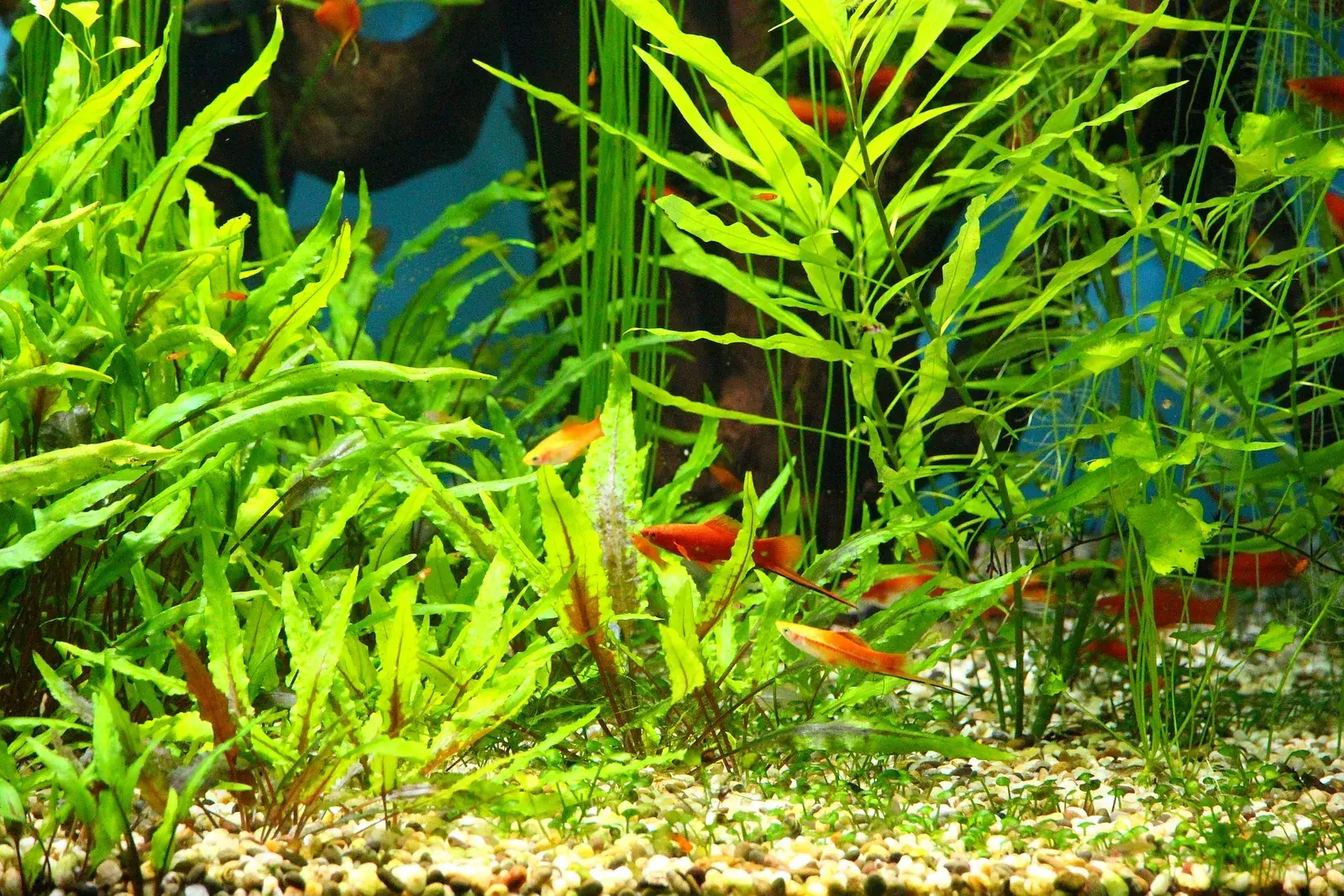
Identification: one genus, and why "which one is this" isn't always answerable
The common swordtail, Xiphophorus hellerii Heckel, 1848, and the southern platy, Xiphophorus maculatus (Günther, 1866), are both members of genus Xiphophorus[1]. They're closely related enough that interspecies hybrids are fertile, not sterile — a fact well-established enough that Xiphophorus hybrids are used as a genetic research model in their own right[4]. In the aquarium trade, decades of breeding for colour and fin shape have mixed swordtail and platy lineages extensively, so a meaningful share of what's sold under either name today carries some ancestry from both.
The classic identifying feature — the sword-shaped lower extension of the male's tail fin — is a genuine swordtail characteristic, but it isn't a fully reliable identifier on its own given how much crossbreeding has occurred: some hybrid-derived females show a partial sword, and a platy-leaning individual sold as a "swordtail" may not have one at all. In the photo above, that diagnostic detail isn't clearly resolved, so we're treating this guide as covering both species together rather than claiming a confirmed identification — which also happens to be accurate to how they're actually kept, since their husbandry needs don't meaningfully differ.
Swordtail vs platy: what actually differs
Given how much crossbreeding blurs the classic sword-tail identifier, it's worth knowing which difference actually holds up. Adult size is the sturdier answer: a specialist hobbyist reference puts platies at roughly 5–7.5cm and swordtails meaningfully larger at roughly 14–16cm[5][3], corroborated in the same general direction by FishBase's own size records[6] — a difference crossbreeding doesn't erase the way it erases the sword. We've deliberately stopped short of citing a precise multiplier or calling either figure a single "typical" size: the numbers we found look like they mix male and female maximums rather than describing one simple range, and we couldn't independently confirm they use the same measurement convention (for example, whether the swordtail figure includes the male's sword extension), so treat this as confirmation that swordtails run noticeably larger, not as a precise ratio.
| Factor | Platy (X. maculatus) | Swordtail (X. hellerii) |
|---|---|---|
| Adult length (see caveat above) | Roughly 5–7.5cm[5] | Roughly 14–16cm[3][6] — not confirmed whether this includes the male's sword |
| Tail shape | No sword extension | Males typically show a sword-shaped lower tail extension — but see "Identification" above for why this isn't fully reliable |
| Water needs, diet, breeding | Essentially identical between the two — see the sections below | |
Beyond size and the sword, we didn't find body-shape or temperament claims corroborated consistently enough across our sources to state as settled differences rather than commonly repeated impressions, so we've left them out rather than presenting a rule of thumb as a confirmed fact. If your tank footprint is genuinely tight, that size gap is worth planning around either way — see "Tank size and layout" below.
Water parameters that matter most
X. maculatus is native to Mexico and northern Belize[1], and X. hellerii to a range spanning southeastern Mexico, Guatemala, Belize and Honduras[2], both from warm, often slow-moving freshwater with dense vegetation. Treat the ranges below as a practical starting point rather than a single precise target.
| Factor | Commonly reported range | Notes |
|---|---|---|
| Temperature | Roughly 21–28°C (70–82°F) | A tropical species; consistency matters more than the exact figure. |
| pH | Roughly 7.0–8.0 | Slightly alkaline is generally preferred; broadly tolerant otherwise. |
| General hardness | Moderate to hard | Both species are generally adaptable, captive-bred-for-generations trade stock. |
| Ammonia / nitrite | Zero | Same standard as any freshwater fish — see our ammonia and nitrite guides. |
| Nitrate | Kept low | No species-specific numeric ceiling in the sources we reviewed was well-supported enough to repeat here — see our nitrate guide for general guidance. |
Tank size and layout
Both species are active, open-water swimmers that benefit from a tank with genuine horizontal swimming space rather than just floor footprint. Specialist sources commonly suggest a minimum of roughly 75–100 litres for a small group, more for a larger one[3], with dense planting around the edges giving fry and less dominant fish somewhere to retreat — genuinely useful given the breeding and stocking-ratio considerations covered below. If you've confirmed you actually have swordtails rather than platies, plan toward the larger end of that range and beyond as your group matures — see "Swordtail vs platy: what actually differs" above for the size gap between the two.
Feeding behaviour and diet
Both are easy, undemanding omnivores, accepting flake, pellets, and occasional live or frozen foods such as brine shrimp or daphnia, alongside a genuine appetite for algae and soft plant matter. A varied diet is commonly recommended over a single staple food. As with most fish, feeding a modest amount once or twice daily, rather than as much as they'll accept, is the more cautious general approach.
Breeding: why the fry keep coming
This is worth understanding clearly before buying either species, because it directly determines what your tank will look like in a few months. Both are livebearers: females give birth to free-swimming fry rather than laying eggs, need no special water chemistry or marine larval stage to reproduce — unlike some aquarium shrimp — and are widely described as prolific, continuous breeders once mature. A single pregnant female arriving from a shop, or a mixed-sex group settling in, will very likely result in an ongoing population without any deliberate breeding effort on your part.
Practically, this means deciding in advance what you'll do with fry — whether that's rehoming them, accepting natural predation from tankmates in a community setup, or keeping a single-sex group if you don't want reproduction at all — is worth doing before you buy, not after you're surprised by a tank full of young fish.
Stocking ratio and tank mates
This is the single most important welfare consideration for this species pair, and it's frequently left off basic care sheets. Males pursue females persistently to mate, and specialist sources are consistent that an insufficient number of females relative to males means that attention doesn't let up, causing real, avoidable stress. A female-heavy ratio — commonly cited as at least two to three females per male, sometimes more[3] — spreads that attention across more individuals and gives each female genuine rest between interactions. A single male with only one or two females is a well-documented source of the problem, not a safe minimum.
Beyond their own kind, both are generally peaceful and compatible with calm community fish of a similar size. See our guide to choosing tank mates for how adult size, temperament and water-parameter overlap apply generally. AquaPulse's Water Check can help you confirm your water chemistry is stable while you plan a stocking or ratio change.
Water stability considerations
Avoid adding swordtails or platies to a tank that's still cycling or has recently shown signs of a cycle disruption. Both are generally hardy once established, but sudden ammonia or nitrite exposure remains a genuine welfare risk regardless of a species' general reputation for toughness.
Normal behaviour
- Males persistently following and displaying at females — normal mating behaviour, though see "Stocking ratio" above for why the ratio of males to females determines whether this is genuinely tolerable for the females involved.
- Near-constant, active swimming through open water — normal for this genus, not a sign of stress on its own.
- A visibly rounded, darkening abdomen in a mature female — a normal sign of pregnancy in a livebearer, not illness.
- Grazing at algae and surfaces throughout the day — normal foraging behaviour.
Warning signs and what to check first
None of the signs below confirms a specific problem on its own. Each has more than one possible explanation, and reacting immediately — especially by adding a product or a large water change — before checking the more likely causes can make things worse.
A female hiding constantly or showing worn, stressed fins
What it might mean: Excessive mating pressure from an insufficient female-to-male ratio; see "Stocking ratio" above.
What else could explain it: General water-quality stress, or genuine illness unrelated to mating pressure.
Check this first: Your actual male-to-female ratio, and water parameters.
Don't: Assume it's "just how the species behaves" without checking whether your ratio is contributing.
A sudden, unexplained population of tiny fish
What it might mean: Normal livebearer reproduction; see "Breeding" above.
What else could explain it: Little else — this is the expected outcome of keeping both sexes together, not a sign of a problem.
Check this first: Whether you have a plan for the growing population, and whether your tank's bioload can support it.
Don't: Panic — this is normal, though it's worth having a plan rather than letting numbers grow unchecked indefinitely.
Clamped fins or a duller-than-usual colour
What it might mean: A recognised general stress indicator, often linked to water quality, temperature, or mating pressure.
What else could explain it: Recent transport, a new tank, or a recent water change.
Check this first: Ammonia, nitrite and current temperature. See our clamped fins guide for the general picture across species.
Don't: Wait several days before testing water if this appears suddenly.
Not eating, or ignoring food it previously accepted
What it might mean: Stress, water-quality problems, or, if brief, sometimes simply normal appetite variation.
What else could explain it: Recent overfeeding, or being outcompeted by faster tankmates at feeding time.
Check this first: How many feeds have actually been refused, and water parameters. See our fish not eating guide for more.
Don't: Immediately switch foods repeatedly — check the environment first.
Common husbandry mistakes
- Keeping a single male with only one or two females, underestimating how persistent mating pursuit can be for the females involved.
- Not planning for an ongoing fry population, then being surprised by rapid, unmanaged population growth.
- Assuming appearance alone confirms swordtail versus platy, when extensive crossbreeding in the trade makes that unreliable.
- Treating "easy beginner fish" as "no planning needed", rather than accounting for stocking ratio and breeding in advance.
What the aquarium cannot compensate for
- A larger tank alone doesn't fix an insufficient female-to-male ratio — that's a stocking decision, not a space one.
- Good water quality doesn't prevent the stress of persistent, disproportionate mating pressure on too few females.
- Dense planting gives fry and stressed fish somewhere to retreat but doesn't replace a genuinely appropriate sex ratio.
- No amount of husbandry skill stops these species reproducing once both sexes are present in ordinary conditions — plan for fry rather than expecting to prevent them.
When specialist help may be appropriate
Aquatic veterinary expertise specific to ornamental fish is less widely available than for common pets, but it exists, and a knowledgeable specialist retailer or aquatic-health specialist can sometimes help with a genuinely puzzling case.
Frequently asked questions
What's the difference between a swordtail and a platy?
Mainly adult size: a confirmed platy tops out at roughly 5–7.5cm, while a confirmed swordtail reaches roughly 14–16cm — meaningfully larger, though the available figures look like a mix of male and female maximums rather than one simple range, so we've avoided citing a precise multiplier. The sword-shaped tail extension is the more commonly cited difference, but extensive crossbreeding in the trade makes it an unreliable identifier on its own — size is the sturdier clue of the two.
Is this fish a swordtail or a platy?
We can't confirm that from a photo alone in every case, and it isn't always a clean-cut question even for the fish itself. Swordtails and platies are closely related species in the same genus, Xiphophorus, and interbreed readily, producing fertile hybrid offspring. A meaningful share of the colourful "swordtails" and "platies" sold in shops are already the product of generations of crossbreeding between the two, which is part of why the diagnostic sword-shaped tail extension isn't always a reliable identifier on its own. This guide covers care for both, since their needs are essentially identical.
Why shouldn't I keep more male swordtails or platies than females?
Because males persistently pursue females to mate, and if females are outnumbered or too few, that attention doesn't let up. Specialist sources consistently recommend a female-heavy ratio, commonly cited as at least two to three females per male and sometimes more, specifically to spread that attention out and give individual females a genuine break. A single male with only one or two females is a well-documented source of avoidable stress for the females involved.
Will my swordtails or platies keep breeding on their own?
Very likely, yes, without you doing anything deliberate to cause it. Both are livebearers that give birth to free-swimming fry rather than laying eggs, need no special water chemistry or larval stage to reproduce, and are widely described as prolific breeders. If you keep both sexes together in ordinary community conditions, expect an ongoing population rather than a one-off event, and plan for what you'll do with fry in advance.
Do only male swordtails have the sword-shaped tail?
In a true, unmixed swordtail, yes, the sword-shaped lower caudal fin extension is a male characteristic. In practice, this is complicated by how extensively swordtails and platies have been crossbred, since some hybrid-derived females can show a partial sword-like extension, and not every fish sold as a swordtail necessarily has one at all if it's platy-leaning in ancestry. Treat the sword as a helpful clue rather than a guaranteed identifier.
Are swordtails and platies easy fish for a beginner?
In terms of water-parameter tolerance and general hardiness, genuinely yes. Where a beginner is most likely to be caught out isn't difficulty so much as an unplanned outcome: an under-planned sex ratio causing stressed females, or simply not expecting how quickly a small starting group turns into an ongoing population once both sexes are present.
Sources and uncertainty
- Published
- 29 July 2026
- Last reviewed
- 29 July 2026
- Written and maintained by
- AquaPulse (Valeon Labs Ltd)
This guide covers two closely related, frequently interbred species together, since the source photo's exact identification can't be confirmed (see "Identification" above) and their husbandry needs don't meaningfully differ. It draws on a taxonomic reference database, a US federal ecological risk assessment, a specialist hobbyist reference already used elsewhere on this site, and a peer-reviewed review of Xiphophorus interspecies hybrid genetics. We'll update this page if we find something we've got wrong.
Good to know: This guide provides general informational guidance only. It is not a veterinary service and does not replace specialist or aquatic health advice for serious livestock health issues.
- [1] Integrated Taxonomic Information System (ITIS) — "Xiphophorus maculatus (Günther, 1866)" (TSN 165922) and "Xiphophorus hellerii Heckel, 1848" (TSN 647013) Used as the taxonomic authority for both species' names and author citations, and for Xiphophorus maculatus's native range (Mexico to northern Belize).
- [2] US Fish & Wildlife Service — "Ecological Risk Screening Summary: Green Swordtail (Xiphophorus hellerii)" Used for Xiphophorus hellerii's native range and wild habitat description.
- [3] Seriously Fish — "Xiphophorus hellerii – Green Swordtail" Specialist hobbyist reference source, already used elsewhere on this site. Used for water-parameter ranges, tank size, stocking-ratio guidance, and swordtail adult length. Not a peer-reviewed source; we could not independently confirm whether its length figure includes the male's sword.
- [4] Walter, R.B. & Kazianis, S. (2001), "Xiphophorus Interspecies Hybrids as Genetic Models of Induced Neoplasia," ILAR Journal, 42(4), 299–321 Peer-reviewed review article, used for the fact that Xiphophorus interspecies hybrids are fertile, not sterile, and are used as a genetic research model on that basis.
- [5] Seriously Fish — "Xiphophorus maculatus – Platy" Specialist hobbyist reference source. Used for platy adult size, cited alongside FishBase for the size-comparison table.
- [6] FishBase — "Xiphophorus hellerii" and "Xiphophorus maculatus" Scientific fish database. Cited alongside the hobbyist sources above for both species' adult-size figures. We were not able to independently confirm the exact figures or measurement convention (standard length vs. total length) it lists, or that they match the hobbyist sources precisely — see "Swordtail vs platy: what actually differs" above.
What we deliberately left out: a confirmed species-level identification of the fish pictured, since the diagnostic sword-tail detail isn't clearly resolved and extensive crossbreeding in the trade makes appearance alone an unreliable guide; a precise brood size or gestation-length figure, since sources we reviewed varied and we didn't want to imply false precision for what varies by individual female size and age; and a precise size-difference multiplier or a single confirmed measurement convention for the two species' adult length, since we couldn't establish whether our cited figures represent one typical range per species, separate male and female maximums, or a mix of the two — treat the size gap as real and worth planning around, but the exact numbers as an approximate, not a precise, comparison.