Knowledge Centre · Species guidance
Mbuna cichlid care: why a crowded tank is safer than a small group
"Mbuna" isn't one species. It's an informal name for a group of small, rock-dwelling, intensely territorial cichlids endemic to Lake Malawi, spanning several genera including Pseudotropheus, Maylandia, Cynotilapia and others. Almost everything about keeping them well runs against instincts that work fine for other cichlids. They need hard, alkaline water rather than the soft, acidic water many popular South American cichlids prefer, a strict plant-based diet rather than protein-rich foods, and, most counter-intuitively, a larger, deliberately crowded group rather than a small one: concentrating aggression on just two or three fish is more dangerous to them than spreading it across a dozen. That last point catches out more keepers than anything else covered here.
Before adding mbuna
May be suitable when…
You can provide a dedicated species-only tank of at least roughly 200 litres with hard, alkaline water, plenty of rockwork and caves, a proper crowded group rather than two or three, and a herbivore-appropriate diet.
Reconsider when…
You're planning a mixed community tank with peaceful or small fish, your water is soft and acidic, you're only planning to keep two or three individuals, or you're not prepared to feed a largely plant-based diet.
Worth knowing: a small, calm-looking group of mbuna in a shop tank is not a preview of how they'll behave in an under-stocked tank at home — too few individuals is a documented aggression risk in itself.
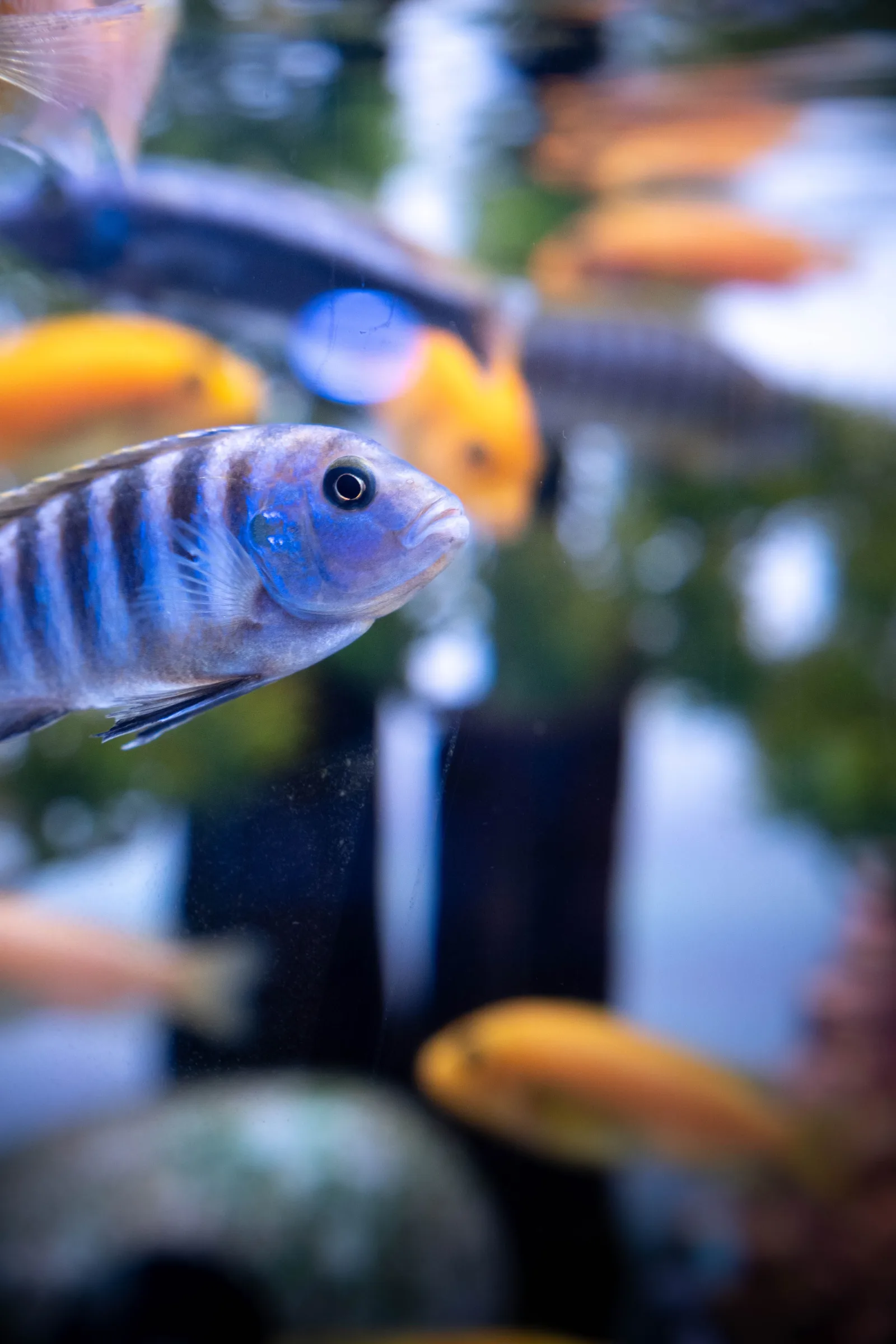
Identification: mbuna is a group, not one species
"Mbuna" is a Chitonga word adopted into the aquarium trade to describe the rock-dwelling cichlids of Lake Malawi, spanning multiple genera rather than one. The fish pictured above shows vertical blue-black barring consistent with Pseudotropheus demasoni Konings, 1994[1], a species also now catalogued under the newer name Chindongo demasoni following taxonomic revision — itself a useful reminder that mbuna taxonomy is actively studied and revised, not fixed. Colour saturation and fine detail that would fully confirm species-level identification from this photo alone aren't clearly resolved, so we're treating this as "a demasoni-type mbuna" rather than a confirmed identification, and this guide covers mbuna husbandry generally rather than one specific species' exact requirements.
P. demasoni specifically is endemic to a very small area — the Pombo and Ndumbi reefs off the Tanzanian shore of Lake Malawi[2] — which is typical of mbuna generally: many species have naturally tiny geographic ranges, tied to specific rocky reef systems rather than the whole lake.
Water parameters that matter most
This is the point most likely to trip up anyone applying general "cichlid" knowledge from a different region. Mbuna are rift-lake cichlids adapted to Lake Malawi's naturally hard, alkaline water, which is close to the opposite of what many popular South American cichlids — including the German blue ram covered in our German blue ram guide — actually need. Applying one region's water-chemistry advice to the other is a genuine risk, not a minor mismatch.
| Factor | Commonly reported range | Notes |
|---|---|---|
| Temperature | Roughly 24–28°C (76–82°F) | A tropical rift-lake species; consistency matters more than the exact figure. |
| pH | Roughly 7.5–8.5 | Hard and alkaline: a different target from soft-water South American cichlids, not a similar one. |
| General hardness | Roughly 10–18 dGH | Consistently hard water; many keepers add mineral supplementation to reach and hold this range. |
| Ammonia / nitrite | Zero | Same standard as any freshwater fish — see our ammonia and nitrite guides. |
| Nitrate | Kept low | Elevated nitrate is widely flagged as a contributing stress factor in digestive illness in this group — see "Feeding" below. |
Tank size, rockwork and layout
Mbuna live among rocky reefs in the wild, spending most of their time within a small territory around caves and crevices they defend. A tank of at least roughly 200 litres, longer and taller rather than just wide, gives a crowded group (see "Stocking" below) enough space to establish separate territories. Stack rockwork into caves and overhangs covering most of the tank floor. More hiding and territory-defining structure measurably reduces conflict, since it gives subordinate fish somewhere to retreat and break line of sight from a dominant individual.
Feeding: a strict herbivore diet and Malawi bloat
Mbuna are specialised algae grazers in the wild, with a digestive tract adapted for processing fibrous plant matter rather than dense animal protein. A diet built around spirulina-based flake or pellet, blanched vegetables and other plant-based foods suits that adaptation; foods built around bloodworm, tubifex or other high-protein ingredients are widely advised against as a staple diet for this group.
This connects to a serious, well-known condition in the hobby, commonly called "Malawi bloat": a swollen abdomen, often fatal without prompt attention. What exactly causes it is honestly still debated rather than settled. The traditional explanation blames high-protein food overwhelming a digestive system built for plant matter, while some more recent analysis points instead toward the protozoan parasites Hexamita or Spironucleus, which the Merck Veterinary Manual notes particularly affect cichlids, combined with poor water quality as the more likely primary driver[4]. We won't present either explanation as fully confirmed here. What both sides agree on, and what matters practically, is that a herbivore-appropriate diet suits this group's digestive anatomy regardless of which explanation for bloat is correct, alongside keeping nitrate and general water quality consistently low.
Stocking: why more fish means less aggression
This is the single most counter-intuitive thing to understand about keeping mbuna, and it runs against the instinct that fewer fish means less conflict. Specialist sources are consistent that keeping only two or three mbuna, particularly of one of the more aggressive species, tends to concentrate aggression onto a small number of individuals — a dominant fish relentlessly targeting one or two subordinates until only it remains, rather than the group settling into an equilibrium[3]. A larger, deliberately crowded group — commonly recommended at a dozen or more — spreads that same aggression across many more individuals and territories, which in practice produces calmer, more evenly distributed behaviour than a small group[3].
Mbuna are also, as a general rule, not suitable for a mixed community tank with peaceful or small fish, for two independent reasons: their territorial aggression, and their hard, alkaline water requirement being incompatible with most peaceful community species' needs. A dedicated species-only tank, or a tank mixing only other mbuna and similarly hard-water-tolerant, similarly robust Lake Malawi cichlids, is the standard, well-supported approach. See our guide to choosing tank mates for how adult size, temperament and water-parameter overlap apply generally.
Water stability considerations
Avoid adding mbuna to a tank that's still cycling or has recently shown signs of a cycle disruption. Given how directly elevated nitrate is linked to digestive illness risk in this group (see "Feeding" above), a stable, mature tank with a consistently low nitrate baseline matters more here than for many other freshwater fish.
Normal behaviour
- Defending a specific cave or rocky territory against other mbuna — normal, expected behaviour for this group, not a sign something's wrong.
- Frequent chasing and displaying within a crowded group — normal social/territorial activity when spread across many individuals; watch for one fish being singled out repeatedly rather than chasing being distributed generally.
- Near-constant grazing at rocks and surfaces — normal foraging behaviour for a specialised algae grazer.
- A female holding eggs or fry in her mouth — many mbuna are mouthbrooders; this is normal reproductive behaviour, not illness.
Warning signs and what to check first
None of the signs below confirms a specific problem on its own. Each has more than one possible explanation, and reacting immediately — especially by adding a product or a large water change — before checking the more likely causes can make things worse.
Swollen abdomen, loss of appetite, and pale, stringy faeces
What it might mean: Possible early signs of Malawi bloat; see "Feeding" above for the disputed cause.
What else could explain it: A female carrying eggs or fry, which is normal in mouthbrooding species and not the same as illness.
Check this first: Whether the fish is female and could be holding, recent diet, and nitrate levels.
Don't: Wait to see if it resolves on its own — this condition can progress quickly once established.
One individual being persistently targeted by others
What it might mean: An under-sized group concentrating aggression onto one fish; see "Stocking" above.
What else could explain it: Insufficient rockwork or hiding spots, even in an adequately sized group.
Check this first: How many mbuna you're actually keeping, and how much rockwork/territory is available.
Don't: Assume adding just one or two more fish solves it — the group may need to be substantially larger, not marginally so.
Torn fins or visible injuries
What it might mean: Territorial aggression, either from an under-sized group or a genuine incompatibility with a specific tankmate.
What else could explain it: Damage from rockwork during a territorial dispute rather than direct contact injury.
Check this first: Water quality, and whether one individual is consistently the target.
Don't: Assume minor fin damage in a crowded mbuna tank is automatically abnormal — some low-level wear is common, but persistent, worsening injury to one fish specifically isn't.
Not eating, or ignoring food it previously accepted
What it might mean: Stress, water-quality problems, or an early sign of digestive illness.
What else could explain it: Recent overfeeding, or being outcompeted by more assertive tankmates at feeding time.
Check this first: Water parameters, and whether the fish is actually unable to reach food. See our fish not eating guide for more.
Don't: Assume it will resolve on its own without checking the environment first.
Common husbandry mistakes
- Keeping only two or three mbuna, assuming fewer fish means less conflict, when a small group often concentrates aggression instead.
- Applying South American cichlid water-chemistry advice (soft, acidic water) to a different, hard-alkaline-water group.
- Feeding a protein-heavy diet built around bloodworm or tubifex, rather than a plant-based staple suited to this group's digestion.
- Mixing mbuna into a peaceful community tank, underestimating both the aggression and the water-chemistry mismatch.
- Under-providing rockwork and hiding spots, leaving subordinate fish with nowhere to retreat from dominant individuals.
What the aquarium cannot compensate for
- A larger tank alone doesn't fix an under-sized group — group size itself is what spreads aggression, not just available space.
- Good water quality doesn't offset a fundamentally mismatched water-chemistry target if mbuna are kept in soft, acidic water meant for a different cichlid group.
- Rockwork and hiding spots reduce but don't eliminate the risk of one individual being singled out in a too-small group.
- A plant-based diet supports general digestive health but is not a confirmed cure for Malawi bloat once established, given the genuine uncertainty over its cause.
When specialist help may be appropriate
Aquatic veterinary expertise specific to ornamental fish is less widely available than for common pets, but it exists, and a knowledgeable specialist retailer or aquatic-health specialist can sometimes help with a puzzling case.
Frequently asked questions
Why do mbuna need more tankmates to reduce aggression, not fewer?
Because a small group concentrates aggression instead of spreading it. Specialist sources are consistent that keeping only two or three mbuna, particularly of an aggressive species, tends to end with a dominant individual relentlessly targeting the others until only one remains. A larger, deliberately crowded group of a dozen or more gives that aggression many targets instead of one or two, which in practice produces calmer, more evenly distributed behaviour than a small group does.
Can mbuna live with peaceful community fish?
Not safely, as a general rule. Mbuna are intensely territorial, need hard, alkaline water very different from what most peaceful South American and Southeast Asian community species need, and are typically kept in a dedicated species-only tank for exactly that reason. Mixing water-chemistry needs this different, on top of the aggression, is a poor combination regardless of tank size.
What causes Malawi bloat, and is it caused by protein?
This is genuinely still debated rather than settled. The traditional explanation blames high-protein food overwhelming a digestive tract adapted for algae and plant matter; some more recent analysis instead points toward the protozoan parasites Hexamita or Spironucleus, combined with poor water quality, as the more likely primary driver. We won't present either as fully confirmed here. What isn't disputed is that a herbivore-appropriate, plant-based diet suits this group's digestive anatomy regardless of which explanation is correct, which is why it's recommended either way.
Is this fish definitely a demasoni cichlid?
We can't confirm that with full confidence from a photo alone, and we'd rather say so than overstate it. The barring pattern is consistent with Pseudotropheus demasoni (also catalogued under the newer name Chindongo demasoni), but colour saturation and detail that would fully confirm species-level identification aren't clearly resolved. This guide covers mbuna cichlid husbandry generally, which applies whether the specific fish pictured is demasoni or a closely related demasoni-type mbuna.
Do mbuna need the same water as South American cichlids like German blue rams?
No, and this is a genuinely important distinction, not a minor one. Mbuna are Lake Malawi rift-lake cichlids adapted to hard, alkaline water, while German blue rams and many other popular South American cichlids need soft, acidic water. Applying one group's water-chemistry advice to the other is a real risk, not just a suboptimal choice.
Sources and uncertainty
- Published
- 29 July 2026
- Last reviewed
- 6 August 2026
- Written and maintained by
- AquaPulse (Valeon Labs Ltd)
This guide covers mbuna as an ecological group of Lake Malawi cichlids rather than a single confirmed species, since the source photo's species-level identification can't be fully confirmed (see "Identification" above). It draws on a taxonomic reference database, a US federal species profile, a specialist hobbyist reference already used elsewhere on this site, and a veterinary reference source. On Malawi bloat specifically, we found genuine disagreement between the traditional protein-focused explanation and more recent analysis implicating Hexamita/Spironucleus and water quality, and have presented both rather than picking one. We'll update this page if we find something we've got wrong.
Good to know: This guide provides general informational guidance only. It is not a veterinary service and does not replace specialist or aquatic health advice for serious livestock health issues.
- [1] Integrated Taxonomic Information System (ITIS) — "Pseudotropheus demasoni Konings, 1994" (TSN 648872) Used as the taxonomic authority for species name and author citation, and noted alongside the newer synonym Chindongo demasoni.
- [2] USGS Nonindigenous Aquatic Species (NAS) database — "DeMason's Cichlid (Pseudotropheus demasoni)" Used for native range and endemic status (Pombo and Ndumbi reefs, Lake Malawi, Tanzania).
- [3] Seriously Fish — "Pseudotropheus demasoni" Specialist hobbyist reference source, already used elsewhere on this site. Used for water-parameter ranges, herbivorous diet and digestive adaptation, and stocking/aggression-management guidance. Not a peer-reviewed source.
- [4] Merck Veterinary Manual — "Parasitic Diseases of Fish" Used for Hexamita/Spironucleus and their particular association with cichlids, cited here as part of the disputed Malawi bloat causation discussion.
Where the science isn't settled: a confirmed species-level identification of the fish pictured, since the visual evidence doesn't fully resolve it (see "Identification" above); a single, settled explanation for Malawi bloat, since credible sources disagree on the primary cause; and a precise minimum group size, since recommendations we found varied and we didn't want to imply false precision beyond "substantially more than two or three."