Knowledge Centre · Species guidance
German blue ram care: wild-type vs Electric Blue, and what each needs
Mikrogeophagus ramirezi is a small, genuinely striking Amazon-basin dwarf cichlid sold under a confusing pile of names — ram, blue ram, German blue ram, Ramirez's dwarf cichlid — and, increasingly, under names describing a colour form rather than the species itself, like Electric Blue or gold ram. It's often marketed as beginner-friendly on the strength of its calm temperament, which undersells a real complication: wild-type rams are genuinely sensitive to water quality and need soft, warm, acidic conditions few community tanks naturally provide, while some heavily selected colour morphs carry their own, separate health trade-offs. This guide covers what the species actually needs, how the main colour forms differ in care and robustness, and which behaviour changes are worth checking.
Before adding a German blue ram
May be suitable when…
Your tank is mature and stable, holds warm (roughly 27–29°C), soft, slightly acidic water or you're prepared to work toward that, and your tankmates are calm, similarly sized community fish rather than boisterous or aggressive species.
Reconsider when…
Your tank is newly set up, your tap water is hard and alkaline with no plan to adjust it, or you're drawn to a heavily line-bred "balloon" form without having researched the welfare trade-offs described below.
Worth knowing: "hardy" and "beginner-friendly" are doing a lot of work in a lot of care sheets for a fish that specialist sources still describe wild-caught specimens of as suited mainly to experienced keepers[1].
Identification and colour morphs
Mikrogeophagus ramirezi (Myers & Harry, 1948) is one of two recognised species in the genus Mikrogeophagus, endemic to the Orinoco river basin's savannahs in Venezuela and Colombia[1]. It's a small dwarf cichlid, reaching only around 5–7 cm (2–3 in)[2], with males typically slightly larger and developing longer dorsal-fin extensions than females.
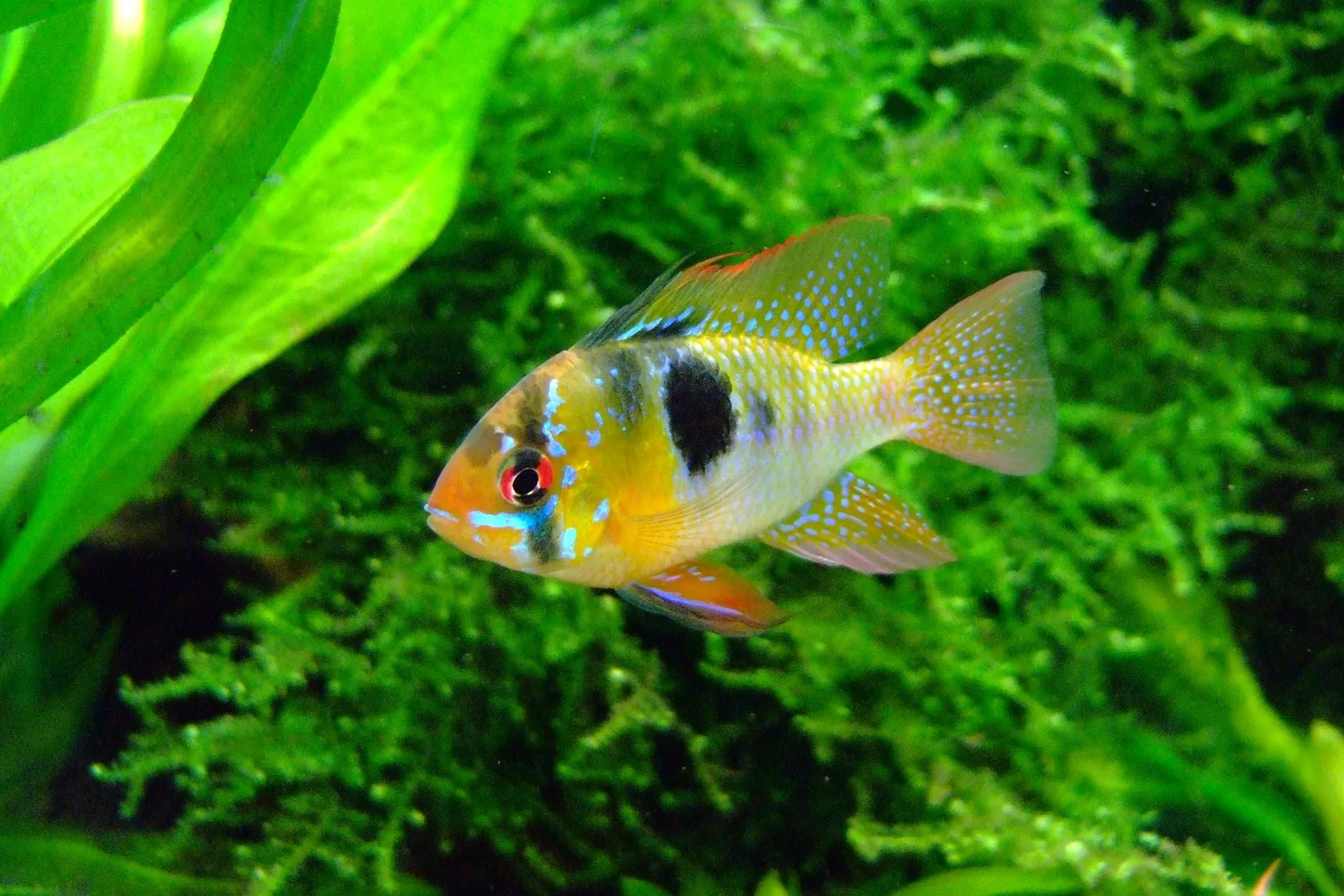
Wild-type colouration — a yellow-gold body deepening to blue-black toward the head, a distinctive black patch through the eye and cheek, a red-ringed eye, and iridescent blue spangling across the body and fins — is genuinely striking without any selective breeding involved. Most rams sold today, however, are captive-bred, and decades of ornamental selection have produced numerous colour and body-shape variants, discussed below.
Wild-type, Electric Blue and other selectively bred forms
This is worth understanding properly rather than treating every ram as interchangeable, because the differences aren't purely cosmetic.
Wild-type (pictured above) is the ancestral colouration and, genetically, the least altered form in the trade. Specialist sources consistently describe true wild-caught specimens as more demanding of water quality and diet than tank-bred stock, and arguably suited mainly to experienced keepers rather than a first cichlid[1] — but the vast majority of wild-type-coloured fish sold today are captive-bred, not wild-caught, and tend to be somewhat more adaptable as a result. Ask your retailer which you're actually buying if it matters to you.
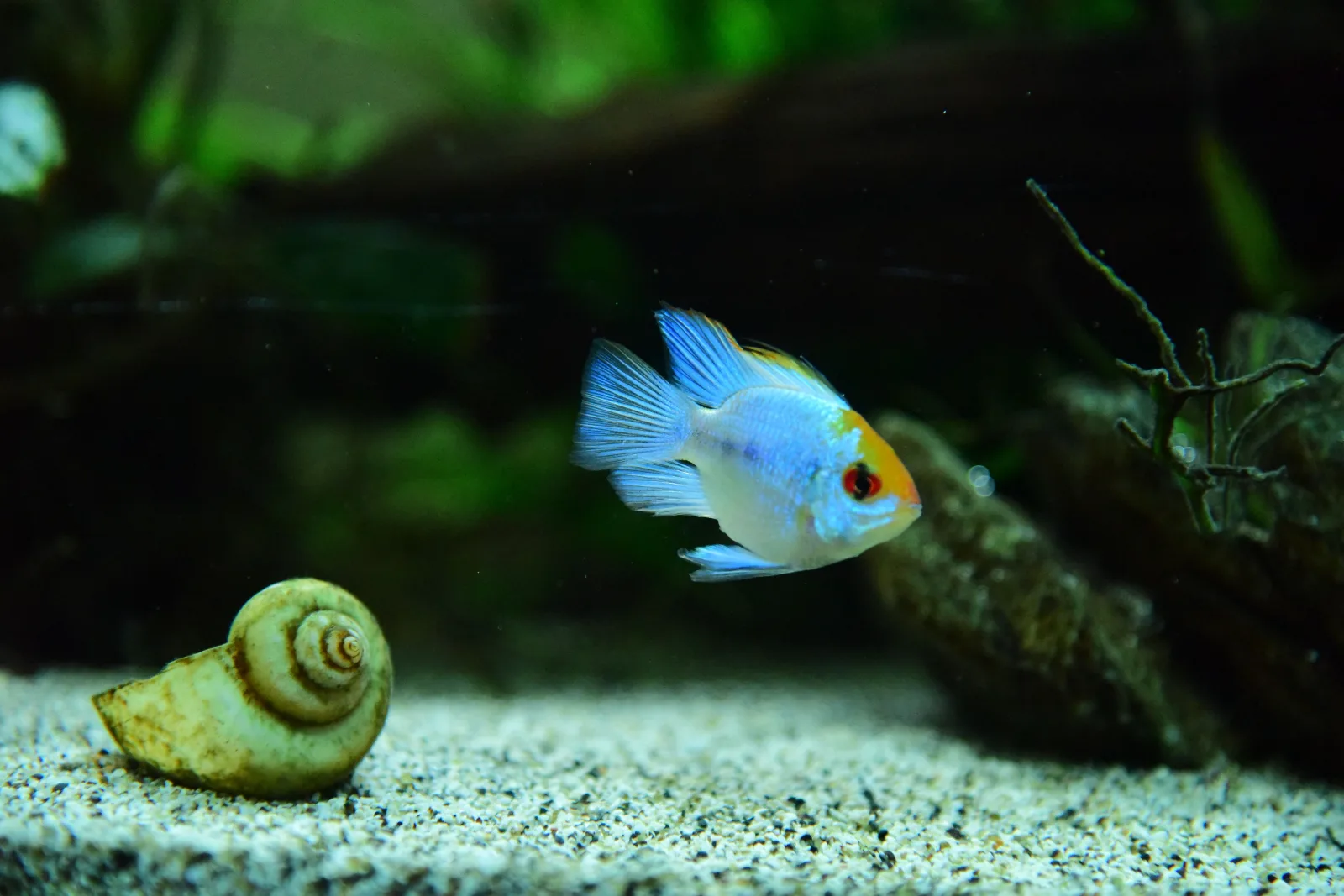
Electric Blue is a selectively bred colour morph developed mainly on Asian fish farms, prized for an iridescent, near-uniform sky-blue body that replaces most of the wild-type's yellow and black patterning. Temperament and general care requirements are reported as essentially the same as wild-type — it's the same species under selective colour pressure, not a different animal with different needs — though several hobbyist and specialist sources note that heavily selected colour morphs, including Electric Blue, can carry somewhat lower fertility and a higher incidence of health problems compared with less intensively selected wild-type-coloured stock. Treat that as a general pattern worth being aware of when choosing a breeder or retailer, not a reason to avoid the morph outright.
Gold and other colour-only morphs follow the same logic: cosmetic selection, same underlying species and care needs, with the same general caveat about breeding heavily line-bred stock.
Water parameters that matter most
This is where German blue rams most often go wrong in a general community tank, and it's the single biggest gap between how the species is marketed and what it actually needs.
| Factor | Commonly reported range | Notes |
|---|---|---|
| Temperature | Roughly 27–29°C (80–84°F) | Notably warmer than many community tropical fish tolerate comfortably long-term — check tankmates' needs overlap. Use the free Aquarium Heater Calculator for a sensible wattage range. |
| pH | Roughly 5.0–7.0 | Wild-type specimens are reported to prefer the softer, more acidic end of this range; well-adapted captive-bred stock is generally more tolerant toward neutral. |
| General hardness | Soft | Consistently reported as preferring soft water over hard, alkaline tap water common in many regions. |
| Ammonia / nitrite | Zero | Rams are widely described as extremely sensitive to water-quality lapses — see our ammonia and nitrite guides. |
| Nitrate | Kept low | No single numeric ceiling was well-supported enough to repeat here; see our nitrate guide for general management. |
Tank size and layout
A minimum tank volume of around 60 litres (roughly 15–16 US gallons), with a footprint length of at least 60 cm, is commonly recommended for a single ram or breeding pair — treated here as a widely used hobbyist convention rather than a specific welfare-study figure. A densely planted layout with driftwood, leaf litter and broken sightlines suits this species' naturally shy, structure-seeking behaviour far better than an open, bare tank, and gives a bonded pair somewhere to establish a territory without constant visual conflict with tankmates.
Because this species needs its own, genuinely different water chemistry from many popular community fish, adding it to an already-established general community tank set up around hard, neutral water is one of the more common ways expectations and reality diverge — see "Water parameters" above.
Diet and feeding
German blue rams are omnivorous, taking high-quality flake or pellet food readily, with regular offerings of frozen or live foods (daphnia, bloodworm, brine shrimp) supporting colour and condition noticeably well according to specialist sources[3]. They do not rely on algae and aren't marketed as an algae-control species; feeding is straightforward once water quality and temperature are correct, which is the part that actually determines appetite and health in this species more than diet composition does.
Tank mates and compatibility
Temperament is calm and non-aggressive toward similarly sized, peaceful fish, with aggression generally limited to territorial disputes between rams themselves, particularly around breeding. This makes them a popular dwarf cichlid for peaceful community setups — provided the rest of the community can actually tolerate the same warm, soft, acidic water this species needs, which rules out plenty of otherwise "peaceful" fish that prefer harder, cooler conditions.
Avoid boisterous or nippy tankmates, and larger or more assertive cichlids that might bully or outcompete a small, calm fish at feeding time. Compatible tankmates commonly cited include small peaceful tetras, rasboras, dwarf corydoras, and other calm, similarly warm-water-tolerant community species. As with any stocking decision, compatibility depends on your specific tank — a tetra species that tolerates 26°C without issue may struggle at the warmer end of a ram's preferred range, so checking every tankmate's actual tolerance against the ram's needs, rather than relying on a generic "peaceful community fish" list, is what determines whether the combination actually works long-term. See our guide to choosing tank mates for the broader framework, and use AquaPulse's Water Check to confirm your specific water chemistry genuinely suits both before you commit to a stocking plan.
Breeding and pair behaviour
German blue rams form monogamous pairs and are one of relatively few widely kept cichlids to show sustained biparental care: both parents typically guard eggs and fry, taking turns fanning the clutch and defending the territory, rather than one parent doing all the work[3]. A bonded, compatible pair in a suitably mature, stable tank will often spawn without much intervention, laying eggs on a flat surface, in a shallow depression, or occasionally on plant leaves.
Pairing isn't guaranteed just by putting a male and female together — incompatible pairs can show aggression rather than bonding, another reason a layout with visual breaks and multiple potential territories helps if you're introducing more than one individual.
Water stability considerations
Rams are consistently described across specialist and hobbyist sources as unusually sensitive to water-quality lapses for a commonly traded cichlid, with sudden ammonia, nitrite or temperature swings producing rapid, visible decline rather than the more gradual response some hardier species show. Avoid adding a ram to a tank that's still cycling or has recently shown a cycle disruption — this is one of the species where that general advice matters more than usual, not less.
Because this species prefers meaningfully different water chemistry from many community staples, large or sudden shifts between soft/acidic and hard/alkaline water — for example from an inconsistent water-treatment routine — are a genuine stress risk even when ammonia and nitrite both read zero.
Normal behaviour
- Calm, unhurried swimming low in the water column, often near cover — normal baseline activity for a settled ram.
- Colour deepening noticeably during courtship, breeding, or general good condition, and dulling somewhat under stress, illness, or a recent change — a genuinely useful general indicator, though not a substitute for checking water quality directly.
- A bonded pair remaining close together and defending a shared territory, particularly once eggs or fry are present.
- Digging or rearranging fine substrate around a chosen spawning site — normal breeding-related behaviour, not distress.
- Brief flaring or chasing between two rams establishing territory — normal within limits; sustained, one-sided aggression is not (see "Warning signs" below).
Warning signs and what to check first
None of the signs below confirms a specific problem on its own. Each has more than one possible explanation, and reacting immediately — especially with a large water change or a new product — before checking the more likely causes can make things worse.
Sudden, pronounced colour loss or paling
What it might mean: Given this species' sensitivity, a water-quality problem is a genuine possibility worth checking first.
What else could explain it: Recent stress from a water change, a new tankmate, or handling, which typically resolves within a day or two.
Check this first: Ammonia, nitrite and temperature immediately, given how quickly this species can decline.
Don't: Wait to see if it "passes" before testing — this is one of the species where checking promptly matters more than usual.
Rapid or laboured breathing
What it might mean: Ammonia, nitrite, or a temperature that's drifted outside this species' preferred range.
What else could explain it: Low dissolved oxygen, particularly at the warmer end of its temperature range, where water holds less oxygen generally.
Check this first: Full water parameters and current temperature against the range above.
Don't: Assume it's "just the warm water" without testing — both explanations need ruling out.
Loss of appetite
What it might mean: Stress, water-quality problems, or a temperature outside its normal range.
What else could explain it: A recent tankmate change, or normal reduced appetite around active breeding.
Check this first: How many feeds have actually been refused, water parameters, and temperature. See our fish not eating guide for more.
Don't: Keep changing foods repeatedly before checking the environment first.
One ram of a pair persistently chasing or attacking the other
What it might mean: An incompatible pairing rather than normal courtship, particularly if one-sided and sustained.
What else could explain it: Normal, brief territorial establishment that settles within a day or so.
Check this first: Whether the behaviour is easing over a day or two, and whether the pursued fish has anywhere to retreat to.
Don't: Assume any two rams will pair successfully just because they're the same species and opposite sex.
Common mistakes, and why rams die
- Adding a ram to a general hard-water community tank set up for fish with very different water-chemistry needs.
- Buying on a "hardy, beginner-friendly" label alone, without checking whether your specific water and tankmates actually suit it.
- Keeping the tank too cool, assuming standard tropical-community temperatures are warm enough — see the range above.
- Adding it to an uncycled or recently disrupted tank, given how sensitive this species is to ammonia and nitrite specifically.
- Buying a balloon-form ram without researching the body-shape welfare trade-offs described above.
- Assuming any male-female pair will bond, rather than watching for genuine incompatibility.
What the aquarium cannot compensate for
- A larger tank cannot substitute for the specific soft, warm, slightly acidic water chemistry this species needs.
- Good filtration cannot compensate for tankmates whose own temperature or water-chemistry needs genuinely conflict with a ram's.
- Selective breeding for colour cannot undo the structural welfare cost of selective breeding for a shortened, balloon body shape — these are separate traits with separate consequences.
- No amount of stability elsewhere fixes a genuinely incompatible breeding pair — that's an individual-animal issue, not a water-parameter one.
When specialist help may be appropriate
Aquatic veterinary expertise specific to ornamental fish is less widely available than for common pets, but a knowledgeable specialist retailer or aquatic-health specialist can sometimes help with a genuinely puzzling case.
Frequently asked questions
What's the difference between an Electric Blue ram and a German blue ram?
Colour only. Electric Blue is a selectively bred colour morph of the same species, Mikrogeophagus ramirezi, developed mainly on Asian fish farms for an iridescent, near-uniform sky-blue body — it isn't a different animal with different needs. Temperament and general care requirements are reported as essentially the same as wild-type, though several hobbyist and specialist sources note that heavily selected colour morphs, including Electric Blue, can carry somewhat lower fertility and a higher incidence of health problems compared with less intensively selected wild-type-coloured stock.
Is a German blue ram really a good beginner fish?
Widely marketed as one, and captive-bred stock in a mature, correctly set-up tank genuinely can do well for a newer keeper. The gap is between "easy once conditions are right" and "tolerant of getting conditions wrong" — this species sits firmly in the first category and not the second, which is a meaningfully different claim than most care sheets imply.
What is a balloon ram, and is it safe to keep?
A balloon ram is produced by selecting for a shortened, rounded body shape caused by spinal curvature, not just colour. That curvature is widely reported to compress internal organs, impair swimming, and increase susceptibility to swim bladder problems, and is associated with a shorter typical lifespan than standard-bodied rams. This is a body-shape welfare issue of the same kind seen in other heavily line-bred ornamental fish, worth knowing before buying one, whatever colour it's paired with.
Can German blue rams live in a normal community tank?
Only if the rest of the community can genuinely tolerate the same warm, soft, acidic water this species needs, which rules out plenty of otherwise "peaceful" fish that prefer harder, cooler conditions. Temperament itself is calm and non-aggressive toward similarly sized, peaceful fish, so compatibility usually comes down to water-chemistry overlap rather than behaviour — check every tankmate's actual tolerance against the ram's needs rather than relying on a generic "peaceful community fish" list.
What water temperature and pH does a German blue ram need?
Roughly 27–29°C (80–84°F) and a pH of roughly 5.0–7.0, notably warmer and softer than many community tropical fish tolerate comfortably long-term. Wild-type specimens are reported to prefer the softer, more acidic end of that pH range; well-adapted captive-bred stock is generally more tolerant toward neutral. Treat these as a practical starting range from specialist sources rather than a single precise scientific target.
Sources and uncertainty
- Published
- 26 July 2026
- Last reviewed
- 4 August 2026
- Written and maintained by
- AquaPulse (Valeon Labs Ltd)
This guide draws primarily on a specialist hobbyist reference source for taxonomy, native range and water-parameter guidance, supplemented by fish-database and hobbyist-breeding sources for colour-morph and breeding behaviour, since no dedicated peer-reviewed welfare study of captive colour morphs in this species appears to be publicly available. We've distinguished cosmetic colour selection (Electric Blue, gold) from body-shape selection (balloon form) throughout, since the welfare implications genuinely differ between the two. We'll update this page if we find something we've got wrong.
Good to know: This guide provides general informational guidance only. It is not a substitute for specialist aquatic-health advice.
- [1] Seriously Fish — "Mikrogeophagus ramirezi (Ram)" Specialist hobbyist reference source. Used for taxonomy, native range, water-parameter guidance, and the note that wild-caught stock is more demanding than captive-bred fish. Not a peer-reviewed source.
- [2] FishBase — "Mikrogeophagus ramirezi, Ram cichlid" Species database reference, used for general biology and size confirmation.
- [3] Aquarium Co-Op — "Care Guide for German Blue Rams" Specialist hobbyist/trade source, used for feeding, pairing and breeding behaviour reporting. Not a scientific authority.
- [4] Light.fish — "Balloon Rams: Care, Appearance & Types, Behavior & More" Hobbyist-editorial source, used for the balloon-form body-shape welfare discussion (spinal curvature, organ compression, shortened lifespan). Not a peer-reviewed source.
What we deliberately left out: a precise fertility or health-problem statistic for Electric Blue or other colour morphs, since sources describe this qualitatively ("somewhat lower fertility," "more health problems") without a specific figure we could verify; a single confirmed lifespan number for balloon-form rams, since reported figures vary by source; and a specific pH or hardness figure claimed as universally "safe," since sources vary meaningfully between wild-type and well-adapted captive-bred stock.