Knowledge Centre · Marine & reef
Blue tang care: what changed in 2025, and what didn't
Paracanthurus hepatus is a demanding, large-growing fish that's easy to buy small and hard to house properly as an adult: it commonly reaches around 30cm (12in), needs considerably more swimming space than its size in a shop tank suggests, and carries a genuinely higher disease risk around acclimation than most reef fish. Two things about it are also more current than most existing coverage. Captive-bred blue tangs reached stable, commercial-scale availability for the first time in January 2025 — nine years after the species was first bred in captivity at all, a milestone that quietly happened right as Finding Dory was released. And a peer-reviewed study directly tested, and didn't support, the popular assumption that the film itself drove a surge in demand. Tank size, water parameters, social structure and disease risk are covered first below, with both of those more recent stories covered afterward.
Before you buy
May suit you when…
You have or are genuinely planning a large tank — 100 gallons (roughly 380L) or more — you can source or confirm captive-bred stock, and you want an active, algae-grazing swimmer rather than a small reef-tank centrepiece.
Reconsider when…
Your tank is under around 100 gallons, or your plan for the adult it becomes is a vague intention to "upgrade later" rather than a tank you already have or a concrete, funded timeline — a compact juvenile in the shop is not a preview of the space it will need as an adult reaching up to 30cm (12in).
Worth knowing: captive-bred blue tangs reached stable, commercial-scale availability for the first time in January 2025 — not their first-ever captive breeding, which happened back in 2016, but the point where sourcing one has become realistic. Ask your retailer directly whether their stock is captive-bred rather than assuming it is (or isn't).
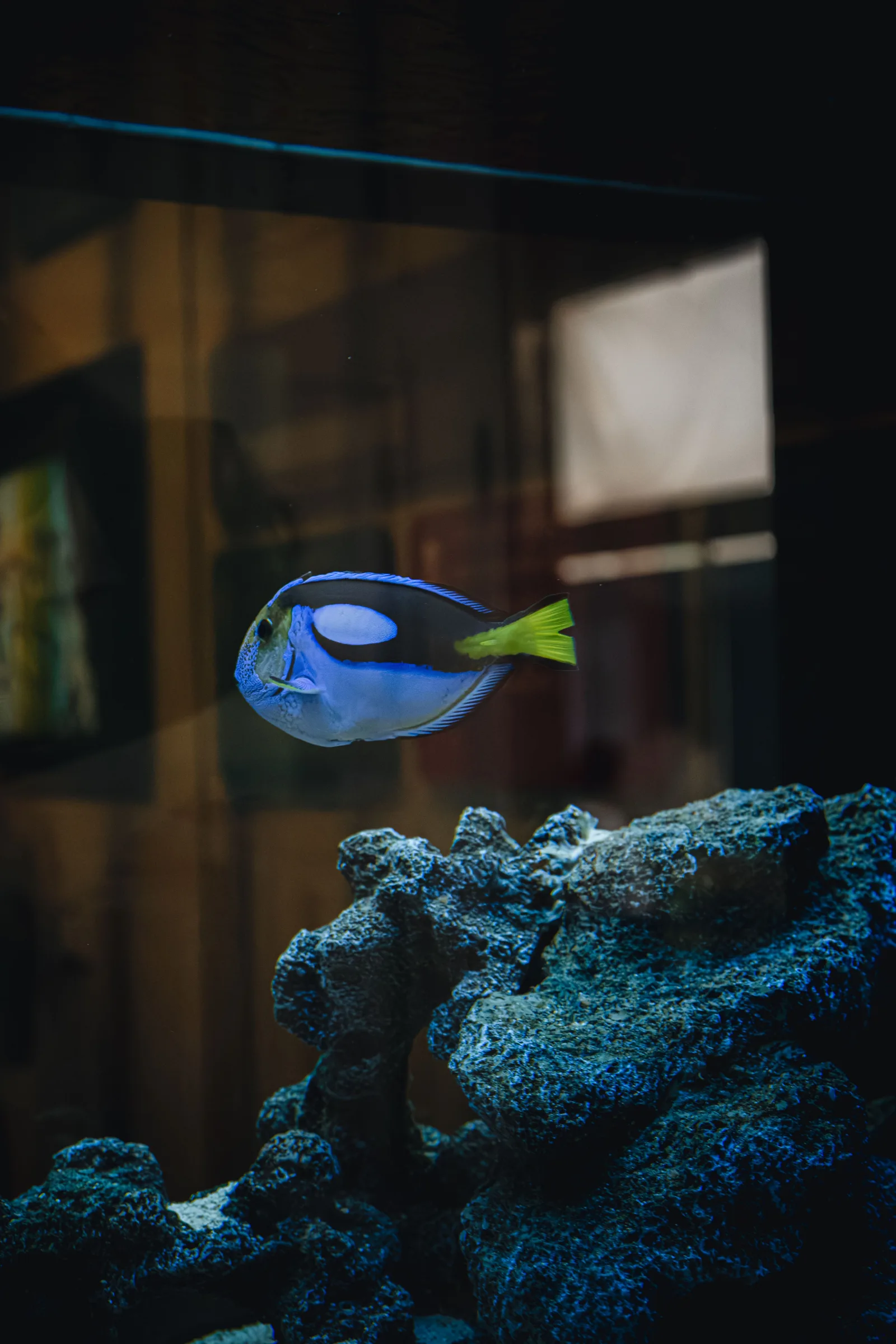
Tank size
Adult blue tangs reach up to around 30cm (12 inches)[1] and remain fast, wide-ranging swimmers even in captivity, which is why recommended minimums run considerably larger than a similarly-sized but less active reef fish would need. Commonly cited figures range from 100 to 125 gallons (roughly 380–475 litres) as an absolute minimum for a single adult, with some specialist sources recommending 180 gallons or a long, low layout specifically to give the fish open swimming distance rather than just water volume[2][3]. A small or young specimen may look comfortable in a smaller tank for a while, but sizing for the adult it will become — not the juvenile in front of you at the shop — is the safer approach for a fish that's a genuine long-term commitment, not just a large one.
Water parameters
| Parameter | Widely reported range |
|---|---|
| Temperature | 24–28°C (75–82°F) |
| Specific gravity | 1.023–1.025 |
| pH | 8.1–8.4 |
| Ammonia / nitrite | 0, as with any species |
| Nitrate | Standard reef-safe range; many keepers prioritise the lower end rather than the higher levels some hardier reef fish tolerate, given this species' greater sensitivity to stress generally |
These sit within standard reef-tank ranges rather than requiring anything species-specific — see our salinity and specific gravity guide for testing and maintaining the specific gravity reading.
Social structure: juvenile vs adult
Wild blue tangs show a clear shift in social behaviour as they grow. Juveniles and subadults are frequently found in small, loose groups sheltering around isolated Pocillopora coral heads, using both the group and the coral's branching structure as protection while they're still vulnerable[1]. Adults behave differently: they're most often reported singly or in pairs, ranging more widely over reef slopes and lagoons, and are considerably more territorial toward their own species than the juvenile grouping behaviour might suggest[1]. That shift matters directly for stocking a home aquarium: a small group of juveniles bought together won't necessarily stay peaceful as they mature, and the more widely recommended approach for most home tanks is one blue tang per tank, rather than assuming juvenile schooling behaviour will hold as the fish grows.
Diet
Blue tangs are primarily herbivorous grazers in the wild, and a captive diet should reflect that rather than the more flexible omnivorous diet suited to many community marine fish. Offer nori or other seaweed sheets clipped in the tank, alongside a high-quality herbivore-formulated pellet or flake, and supplement with occasional meaty frozen food such as mysis shrimp[2][3]. A tank without enough naturally grazable algae or a deliberate feeding routine can leave a blue tang undernourished even while it's accepting food, since grazing is as much a behavioural need as a nutritional one for this species.
Disease risk and quarantine
Blue tangs are widely reported among the more marine-ich-susceptible species commonly kept in the hobby, and this isn't only a hobbyist impression: a 2025 clinical study of a marine-ich outbreak during aquarium quarantine found tangs and their surgeonfish relatives (family Acanthuridae) among the groups suffering the most severe gill and skin damage, compared with families such as wrasses that cleared the parasite more readily[7]. The commonly cited explanation for why is a comparatively thin mucus coat: tangs generally rely on speed rather than a heavy protective coat to avoid parasites in the wild, and the stress of capture, transport and a new tank can suppress that defence further right when the fish needs it most[2]. This isn't a reason to avoid the species, but it is a reason to take quarantine seriously rather than treat it as optional — see our quarantine tank guide for setting one up, and our marine ich guide for recognising and treating an outbreak, including the fallow-period approach marine ich specifically requires.
Tank mates
Generally peaceful toward non-tang species and reef-safe with most corals and invertebrates, though its herbivorous grazing means soft coral polyps and prized macroalgae can occasionally attract unwanted attention. Blue tangs are typically intolerant of other tangs and similarly-shaped surgeonfish sharing a tank, particularly in anything smaller than a genuinely large system, given the territoriality adult blue tangs show toward their own kind[1][2]. See our choosing a protein skimmer guide and starting a saltwater aquarium guide for the equipment and setup a tank this size typically needs before stocking.
The 2025 captive-breeding shift
Paracanthurus hepatus was first bred in captivity in 2016, when researchers at the University of Florida's Tropical Aquaculture Laboratory, working with Rising Tide Conservation, adapted larval-rearing techniques developed at Hawaii Pacific University's Oceanic Institute for yellow tangs — a breakthrough announced on 20 July 2016, days before Finding Dory's US release[6]. For the years after that, captive-bred blue tangs remained a sporadic, small-batch presence in the trade rather than a reliable option. That changed in January 2025, when the Biota Group announced it had reached stable, commercial-scale production, built on the same underlying larval-rearing approach refined over roughly five years[5]. It isn't yet the default at every retailer — wild-caught blue tangs remain common in the trade — but for the first time, a buyer who specifically wants a captive-bred blue tang has a genuine, reliable option to look for, not just an occasional one. Ask directly rather than assuming; captive-bred stock isn't always labelled clearly at the point of sale, and captive-bred origin doesn't reduce the tank-size or long-term-care requirements above — it changes sourcing, not husbandry.
The Finding Dory myth
When Pixar's Finding Dory made Paracanthurus hepatus instantly recognisable in 2016, a widely repeated assumption followed: that the film would drive a surge in demand and pressure on wild populations. A peer-reviewed study published in Ambio tested that assumption directly against US import records and aquarium-visitation data from before and after the film's release — two concrete indicators of actual demand, rather than attention — and found no measurable increase attributable to Finding Dory[4]. Online searches for the species did rise for a few weeks after release, so interest genuinely spiked; it's the leap from that interest to increased buying and collection that the data didn't support. That doesn't mean the aquarium trade has no effect on wild blue tang populations; collection pressure remains a real and separate consideration. But the specific "the movie caused a demand spike" claim, repeated widely in casual reporting at the time, doesn't hold up against the data actually collected to test it.
Common mistakes
- Buying a blue tang for a tank under 100 gallons on a vague promise to "upgrade later" — a plan that's easy to make and easy to not follow through on. The tank needs to already exist or be genuinely imminent, not aspirational.
- Assuming every blue tang for sale is captive-bred now that stable commercial-scale availability exists — ask your retailer directly rather than assuming either way.
- Treating quarantine as optional for a species this susceptible to marine ich, particularly right after the stress of transport.
- Adding a second tang or closely related surgeonfish to anything but a genuinely large tank, expecting juvenile grouping behaviour to continue into adulthood.
- Feeding a general omnivore diet without dedicated grazing material, undernourishing a fundamentally herbivorous species.
Frequently asked questions
What size tank does a blue tang need?
Commonly cited minimums range from 100 to 125 gallons (roughly 380–475 litres) for a single adult, with some specialist sources recommending 180 gallons or a long, low layout for genuinely comfortable adult swimming space. Blue tangs are fast, wide-ranging swimmers even in captivity and are a genuine long-term commitment, so size for the adult the fish will become rather than the juvenile in the shop.
Can I keep more than one blue tang together?
One per tank is the generally recommended approach for most home aquariums. Juveniles are sometimes seen in loose groups in the wild, sheltering together around coral heads, but adult blue tangs are considerably more territorial toward their own species, and that juvenile grouping behaviour isn't a reliable guide to how the same fish will get along once they mature in a closed system.
Can I buy a captive-bred blue tang?
Yes — though it's worth understanding what's actually new. Blue tangs were first bred in captivity in 2016, but captive-bred stock remained a sporadic, small-batch presence in the trade for years afterward. What changed is that the Biota Group announced stable, commercial-scale availability in January 2025, after roughly five years refining the larval-rearing techniques the species needs. Wild-caught blue tangs are still common, so ask your retailer directly rather than assuming a fish is captive-bred — and captive-bred origin doesn't reduce the tank size or long-term care a blue tang needs.
Are blue tangs endangered because of Finding Dory?
No. Peer-reviewed research published in Ambio compared US import and aquarium-visitation data from before and after Finding Dory's 2016 release and found no measurable increase in blue tang demand attributable to the film, even though online searches for the species did rise for a few weeks afterward — interest spiked, but it didn't translate into more fish being imported or displayed. Collection pressure on wild reef fish is a genuine, separate concern, but the specific claim that the movie itself caused a demand spike doesn't hold up against the data collected to test it.
How AquaPulse can help
Most of a blue tang's serious risk period is front-loaded — the weeks around acclimation and quarantine, when a compromised mucus coat and transport stress leave it more exposed to marine ich than most tankmates — rather than something that creeps up gradually the way calcium or salinity drift does elsewhere on this site. That makes the useful record a different shape: not a long trend line, but a clear note of when the fish arrived, how quarantine actually went, and what your regular readings looked like at the time.
AquaPulse doesn't watch the fish or diagnose ich for you — it can't, and it isn't trying to. It gives quarantine dates, water readings and notes a shared place to live, so if something changes weeks after a blue tang joins your display, you're checking it against your own tank's actual record instead of memory. If something looks wrong right now, the free Emergency Diagnosis tool can help you prioritise what to check first. Find AquaPulse on the App Store or Google Play; Water Check has more detail.
Sources and uncertainty
- Published
- 8 August 2026
- Last reviewed
- 8 August 2026
- Written and maintained by
- AquaPulse (Valeon Labs Ltd)
This guide draws on FishBase for wild distribution, size and social-behaviour data, two peer-reviewed studies (one on the Finding Dory demand question, one on comparative marine-ich susceptibility by fish family), trade-press reports for the 2016 and 2025 captive-breeding milestones, and specialist marine-aquarium hobbyist sources for practical tank size, water parameters and diet, since no single source covers all of this together. Water parameter and tank-size figures are presented as widely reported ranges rather than a single precise requirement. We'll update this page if we find something we've got wrong.
Good to know: This guide provides general informational guidance only. It is not a substitute for specialist aquatic advice, particularly around disease diagnosis and treatment, which is genuinely beyond this guide's scope.
- [1] FishBase — "Paracanthurus hepatus, Palette surgeonfish" Established specialist reference. Used for wild distribution, depth range, and the juvenile-grouping vs adult-solitary/paired social behaviour shift.
- [2] Saltwater Aquarium Blog — "Blue Tang Fish Care Guide: Size, Facts, Photos, Tank Mates" Specialist marine-aquarium hobbyist source. Used for tank size, diet, marine-ich susceptibility and tang-on-tang territoriality. Not a scientific authority; presented as widely reported hobby consensus.
- [3] Fishlore — "Blue Tang Care - Paracanthurus hepatus" Specialist marine-aquarium hobbyist source. Used to cross-check tank size and diet against a second independent hobbyist source. Not a scientific authority; figures presented as widely reported hobby convention.
- [4] Veríssimo, Anderson & Tlusty (2020), "Did the Movie Finding Dory Increase Demand for Blue Tang Fish?", Ambio 49, 903–911 Peer-reviewed primary research. Used for the finding that Finding Dory's release did not produce a measurable increase in blue tang import demand.
- [5] CORAL Magazine — "Biota Announces Commercial Availability of Captive-Bred Blue Hippo Tangs" Trade-press report on a named commercial aquaculture operation. Used for the January 2025 shift to stable, commercial-scale captive-breeding and its roughly five-year development timeline.
- [6] CORAL Magazine — "Breeding Pacific Blue Hepatus Tangs: A Short History" Trade-press report, corroborated by the University of Florida IFAS announcement it covers. Used for the 20 July 2016 first successful captive breeding of the species, and its timing just before Finding Dory's release.
- [7] Denk, Boylan, Just, Sommer & Clarke (2025), "An Outbreak of Cryptocaryon irritans in Aquarium Quarantine — New Variations of an Old Theme", Journal of Fish Diseases 48, e14084 Peer-reviewed clinical outbreak study. Used for family-level (Acanthuridae) marine-ich susceptibility relative to other reef-fish families; the outbreak analysed multiple species across several families, not blue tangs in isolation.
What we deliberately left out: a specific maximum lifespan figure — reported estimates for this species range widely, from a few years to two decades or more, depending heavily on husbandry quality, and we found no single study we'd treat as settling it for aquarium conditions specifically; and a claim about what share of blue tangs sold today are captive-bred versus wild-caught, since no source we found quantifies that split reliably this soon after the 2025 milestone.