Knowledge Centre · Starting a saltwater aquarium
Starting a saltwater aquarium: how to set it up and cycle it safely
A saltwater aquarium follows the same underlying nitrogen cycle as a freshwater one, but needs its biological filter established while also getting salinity, live or dry rock, and water purity right from the start. The safest approach mirrors freshwater fishless cycling: mix purified water to the correct salinity, dose an ammonia source into an empty, filtered, heated tank, and test regularly until ammonia and nitrite both convert to nitrate reliably, before any animal goes in. Expect it to commonly take several weeks, sometimes longer, particularly if you're curing live rock at the same time. Once genuinely cycled, add fish gradually, and treat reef-keeping — corals, lighting and dosing — as a deliberate later step rather than an automatic extension of day one. The sections below walk through what to prepare, salinity and rock, the cycling process itself, and how to add your first livestock. Not sure saltwater is the right starting point? Our freshwater vs saltwater comparison lays out the real cost, maintenance and learning-curve differences before you buy equipment for one or the other.
At a glance
What's actually different from freshwater
The same nitrogen-cycle biology applies, but you're also managing salinity, a marine salt mix, live or dry rock, and usually a protein skimmer.
The safest way to start
Mix purified water to the correct salinity, cycle fishless with rock and filtration running, and confirm with testing before adding any livestock.
Sensible immediate response
If livestock are already in an uncycled tank, test ammonia, nitrite and salinity daily and be ready for a prompt, salinity-matched partial water change.
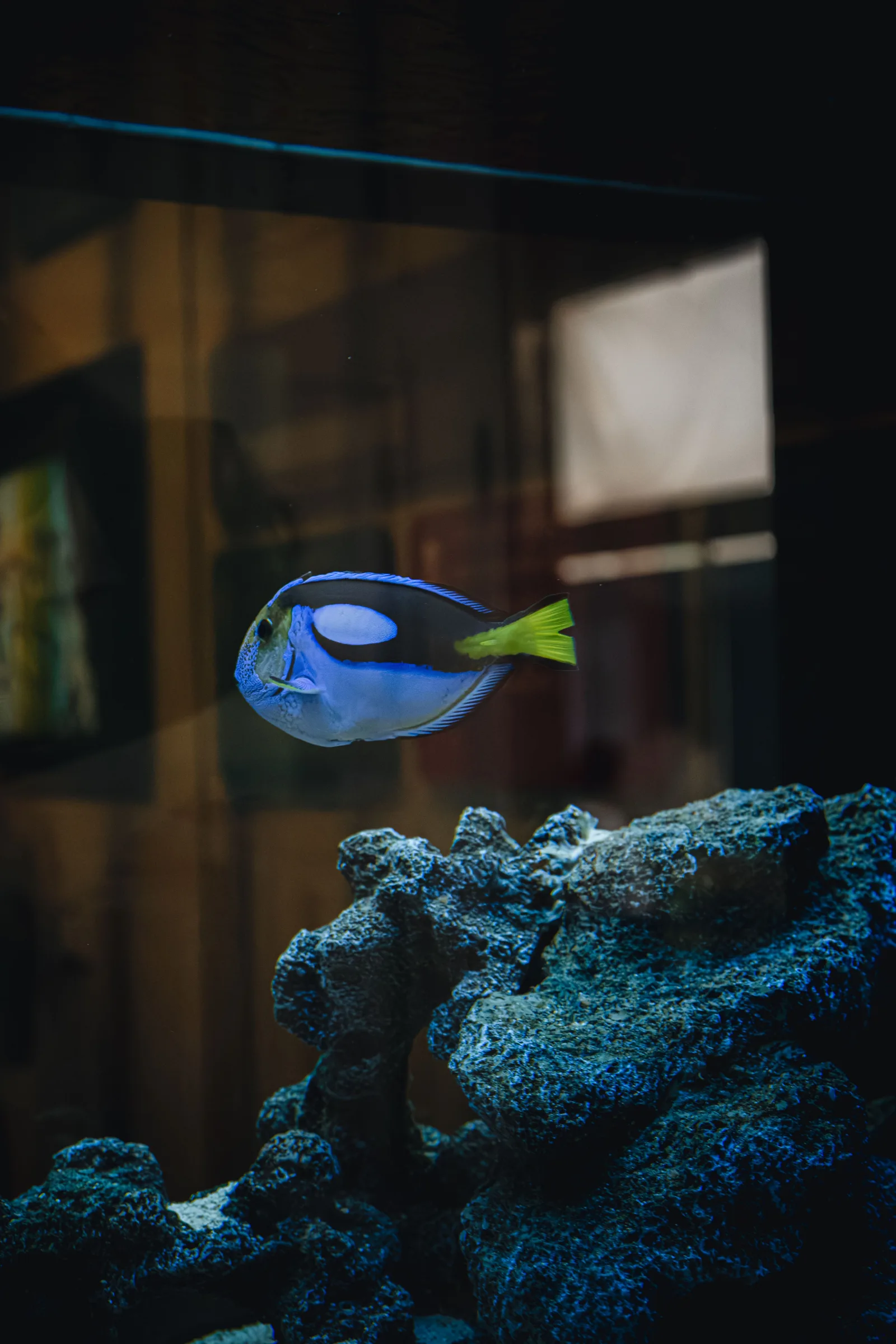
Why a saltwater tank needs a different approach
The biology of cycling itself doesn't change: bacteria living on filter media, rock and other surfaces convert ammonia into nitrite and then into far less harmful nitrate in marine systems just as they do in freshwater ones[3]. See our guide to the aquarium nitrogen cycle for that underlying process in full, and our decision guide to whether a tank is genuinely cycled, which covers the marine path (including curing live rock) specifically, for judging whether your tank is actually ready.
What genuinely differs is everything you're managing around that biology. Seawater is a complex mixture of dissolved salts, so marine systems are set up and adjusted using a purpose-made marine salt product rather than the plain sodium chloride sometimes used for minor freshwater salinity adjustments[5]. Most saltwater setups also include rock as both décor and a major surface for biological filtration, commonly run a protein skimmer to remove dissolved organic waste by adsorbing it onto fine air bubbles before it breaks down further[4], and rely on purified water as a starting point to avoid introducing tap-water contaminants a marine system tends to be more sensitive to. Marine fish are also generally less tolerant of sudden shifts in salinity or water quality than many freshwater species, partly because of the physiological work involved in maintaining fluid balance against a saltier environment[2].
What to set up before you start
As with a freshwater tank, cycling happens inside a system that's already running as it would with livestock, minus the livestock itself. Have the following in place and operating before you begin:
Not sure of your tank's volume yet? Use the free Aquarium Calculator to work out litres or gallons from its dimensions and its approximate water weight using saltwater's density, not freshwater's — useful for checking a stand or floor can take the load before you fill it.
- Purified water — typically from a reverse-osmosis/deionising (RO/DI) unit or bought pre-made, used as the base for mixing saltwater rather than tap water, to avoid introducing contaminants a marine system is generally more sensitive to.
- A marine salt mix, added to purified water and dissolved fully before it touches your tank or any livestock.
- A hydrometer or refractometer to measure salinity as specific gravity — see the next section for target ranges and why a refractometer is generally the more accurate of the two.
- A running filter and, in most setups, a protein skimmer, sized appropriately for your tank. The free Aquarium Filter Turnover Calculator can help you check your filter's flow rate against your tank's volume, and its guidance covers marine and reef turnover conventions specifically. See our choosing a protein skimmer guide for HOB vs in-sump and sizing by bioload.
- A heater and thermometer, set to your intended stocking temperature. The free Aquarium Heater Calculator supports marine and reef tanks directly and gives a sensible wattage range to shop from.
- Live rock or dry rock, and typically live or dry sand, already in place — see live rock, dry rock and biological filtration below for how these differ.
- A liquid test kit that measures ammonia, nitrite and nitrate — the same low-concentration precision issue with test strips applies here as in freshwater.
- An ammonia source for fishless cycling, dosed and tracked according to its own instructions.
Understanding salinity and specific gravity
Salinity is usually measured in one of two ways: specific gravity (a ratio compared with pure water, shown as a decimal like 1.025) or parts per thousand (ppt, a more direct concentration measure). Natural seawater sits at roughly 35 ppt, close to a specific gravity of about 1.025–1.026 at typical aquarium temperatures. A refractometer is generally considered more accurate and consistent than a swing-arm hydrometer, though either can work if properly calibrated and maintained.
Commonly used starting ranges in the hobby are roughly 1.020–1.024 for a fish-only tank and 1.024–1.026 for a reef tank, closer to natural seawater to suit corals and other invertebrates. These are widely repeated conventions rather than a single scientifically mandated figure, and — much like temperature or pH elsewhere on this site — keeping your salinity stable matters at least as much as which exact number within a sensible range you choose. Marine fish and invertebrates depend on a stable external salinity to manage their internal fluid balance, and sudden swings are more consequential for them than for most freshwater species[2].
Practical implications of this: always mix new saltwater to match your tank's existing salinity before a water change, check salinity alongside temperature when acclimating new livestock, and top up evaporated water with plain purified water rather than pre-mixed saltwater — only the water evaporates, not the dissolved salt, so topping up with saltwater will gradually push salinity upward. See our salinity and specific gravity guide for refractometer calibration, target ranges by setup type, and correcting a drifted reading safely, and our Saltwater Mixing Calculator for scaling your salt mix to the batch size you need.
Live rock, dry rock and biological filtration
Rock in a saltwater tank isn't just décor — its porous surface is a major site for the bacteria that carry out biological filtration, similar to the role filter media and substrate play in a freshwater tank.
Live rock is rock that's already carrying bacteria and other organisms from the ocean or an established system. It can give biological filtration a head start, but organisms on and inside it inevitably die during collection and transport, and that die-off releases ammonia that needs to be dealt with before the rock is safe in a stocked display — a process usually called curing. Curing typically involves keeping the rock in a separate container with a heater and circulation running, performing regular water changes, and testing until ammonia and nitrite consistently read at or near zero.
Dry (or "dead") rock avoids that die-off, and the risk of unwanted pests sometimes present on live rock, but starts essentially biologically inert — it takes longer to become fully mature since the bacterial colony has to establish from nothing, often helped along with a bacterial supplement or a small amount of live rock or media seeded from an established system. Many modern saltwater setups favour dry rock for exactly this predictability, accepting a longer initial wait in exchange for fewer surprises.
Either path leads to the same fishless-cycling process described below — the difference is mainly how much of the ammonia load comes from curing rock rather than (or in addition to) a dosed ammonia source.
Cycling, step by step
Set up
-
Mix your saltwater and fill the tank
Dissolve marine salt mix fully into purified water before it enters the tank, and check specific gravity with your hydrometer or refractometer before moving on.
-
Add your rock and sand, and start the filter, skimmer and heater
Get everything running continuously from this point on — the bacteria you're growing need constant flow and oxygen, and a skimmer helps manage organic load from the outset, especially if you're curing live rock.
-
Test salinity, ammonia, nitrite and nitrate once, before dosing anything further
If you're using live rock, expect ammonia from die-off already; if you're starting with dry rock and no livestock yet, this establishes your genuine baseline.
Establish ammonia-to-nitrite
-
Dose an ammonia source if needed
If curing live rock is already producing ammonia, you may not need to add more until die-off subsides. Otherwise, dose a product intended for fishless cycling, following its own instructions, and record what you added and when.
-
Test ammonia and nitrite every few days
Watch for ammonia beginning to fall as the first bacterial population establishes, and don't be concerned if nitrite starts appearing and rising at this stage — that's expected, not a setback.
-
Keep re-dosing as needed once die-off has settled
Once live rock die-off has largely finished (or if you started with dry rock), keep the bacterial colony fed with a dosed ammonia source until it's consistently converting a full dose.
Establish nitrite-to-nitrate
-
Expect nitrite to rise before it falls
A second, slower-establishing bacterial population converts nitrite into nitrate. As in freshwater systems, ammonia-oxidising and nitrite-oxidising microorganisms typically establish at different rates, so a nitrite spike after ammonia has started clearing is normal, not a sign anything has gone wrong[3].
-
Keep testing through the nitrite stage
Continue testing ammonia and nitrite regularly and watch for nitrate appearing — its presence is evidence the full sequence is working, not just the first stage.
Confirm completion
-
Dose a full amount and test 24 hours later
A tank is typically considered close to fully cycled once a full dose of ammonia reads back at zero for both ammonia and nitrite within about 24 hours, with nitrate present, and salinity is stable at your target.
-
Do a salinity-matched partial water change before adding any livestock
Mix replacement saltwater to the same specific gravity as your tank before use. This brings accumulated nitrate down to a sensible starting level and gives you a clean baseline before the tank has to support animals.
A simple testing schedule while you wait
There's no fixed calendar date when a saltwater tank finishes cycling, and curing live rock can add real variability on top of the usual range — testing is what tells you where you actually are.
| Stage | What you're likely to see | What to do |
|---|---|---|
| Early / rock die-off | Ammonia present, possibly from curing rock as well as any dosing; salinity settling at target | Test every 2–3 days; keep filtration, skimmer and heater running continuously |
| Ammonia converting | Ammonia starting to fall; nitrite beginning to appear | Keep testing both; don't be concerned by the nitrite reading |
| Nitrite peak | Ammonia consistently at or near zero; nitrite at its highest | Test every 2–3 days; nitrate should start appearing soon |
| Nitrite converting | Nitrite starting to fall; nitrate rising and clearly present | Continue testing; you're approaching completion |
| Cycled | A full ammonia dose reads zero for ammonia and nitrite within ~24 hours, with nitrate present and salinity stable | Confirm against your method's completion criteria, do a salinity-matched water change, then add livestock gradually |
Adding your first fish
Once your tank is genuinely cycled, add livestock gradually rather than fully stocking on day one[1] — the same principle that applies to freshwater tanks applies here, and marine bioload can be less forgiving of a sudden jump.
- Add a small first group, then wait one to two weeks, testing ammonia and nitrite throughout, before adding more.
- Acclimate new arrivals carefully, matching both temperature and salinity before release — drip acclimation over an extended period is widely used in the marine hobby specifically because sudden salinity shock is a real and consequential risk for marine fish[2].
- Test after every addition, not just during the original cycling process — a bioload increase can produce a small, temporary rise even in an otherwise stable tank.
- Hold off on more livestock if a reading appears, and treat it the same way you would in any stocked tank — see our ammonia and nitrite guides.
- Use the free Water Change Assistant if you need to work out how much water to change to bring a reading down — it supports saltwater and reef contexts directly.
Thinking about a reef tank?
Everything above applies whether you're planning a fish-only system or a reef, since the underlying cycling process is the same. Corals and other reef invertebrates bring additional considerations that go meaningfully beyond this guide's scope, including:
- Lighting suited to photosynthetic corals, which is a different requirement from lighting chosen just to view fish.
- Calcium, alkalinity and magnesium, which corals draw down as they build their skeletons, and which need monitoring and dosing or supplementing separately from the ammonia/nitrite/nitrate picture this guide focuses on.
- A longer settling period before adding corals than a fish-only tank would need — many reef keepers wait additional weeks to months beyond a basic cycle for the system to mature and stabilise.
- Coral-specific acclimation, including gradual adjustment to your tank's lighting as well as its water, not just a drip acclimation for salinity and temperature.
Treat reef-keeping as a deliberate next step you research specifically, not an automatic extension of finishing a fish-only cycle. See our reef chemistry guide and reef lighting guide once you're ready to take that step.
Common saltwater new-tank mistakes
- Using tap water to mix saltwater or to top off evaporation, introducing contaminants a marine system is generally more sensitive to than a freshwater one.
- Topping up evaporated water with pre-mixed saltwater rather than plain purified water, which gradually pushes salinity above your target.
- Adding fish or corals before curing live rock has genuinely finished, based on how the rock looks rather than what ammonia and nitrite testing shows.
- Skipping a protein skimmer to save cost, then finding water quality harder to manage once the tank is stocked.
- Not matching salinity (as well as temperature) when acclimating new arrivals or preparing water for a change.
- Adding corals as soon as ammonia and nitrite read zero, without allowing the additional maturation time reef systems generally benefit from.
- Buying rock or livestock from an unfamiliar source without checking for visible pests or disease first.
Signs of trouble and when to get help
If livestock are already present while your tank is still establishing, watch for gasping at the surface, rapid or laboured breathing, unusual hiding, loss of balance, or appetite loss — all of which can indicate ammonia, nitrite or salinity-related stress. Test immediately if you see any of these, and don't wait for a scheduled test.
If you suspect an already-cycled tank has lost its bacterial colony — for example after a power cut, an overly aggressive filter or skimmer clean, or certain medications — see our dedicated guide to recognising and responding to a possible cycle crash, which applies to marine systems as well as freshwater ones.
Setting yourself up for the long term
- Keep a simple written record of your salinity, dosing and test results while cycling — there's more to track than in a freshwater start, and it's easy to lose the pattern from memory alone.
- Decide your intended stocking, temperature and target specific gravity before you start, so you're not adjusting several things at once later.
- Once livestock are added, settle into a regular water-change routine using salinity-matched saltwater, rather than reacting only when a reading looks wrong.
- Keep testing periodically even once the tank feels established, including salinity — a stable environment is something you maintain by checking it, not something you set up once and stop monitoring.
Frequently asked questions
How is starting a saltwater aquarium different from a freshwater one?
The underlying nitrogen cycle is the same biology in both cases, so the core process of establishing a bacterial colony before adding livestock doesn't change. What's different is everything around it: you're mixing purified water to a specific salinity with a marine salt product rather than using tap water, usually curing or maturing rock as part of the process, and commonly running a protein skimmer alongside your filter. Marine fish and invertebrates are also generally less tolerant of sudden changes in salinity and water quality than many freshwater species.
Do I need live rock, or can I start with dry rock?
Either can work. Live rock already carries bacteria and other organisms, which can speed up establishing biological filtration, but it usually needs curing first to deal with organic matter that died during transport. Dry (or "dead") rock avoids that die-off and the pest hitchhikers that sometimes come with live rock, but takes longer to become biologically mature since it's starting from nothing. Many modern saltwater setups use dry rock combined with a bacterial supplement or seeded media for a more predictable start.
What specific gravity should I aim for?
There's no single number that's correct for every system, but commonly used starting ranges are roughly 1.020–1.024 for a fish-only tank and 1.024–1.026 for a reef tank, close to natural seawater. These are widely used conventions rather than a strict scientific rule, and keeping your salinity stable over time matters at least as much as which exact figure within a sensible range you choose.
Do I need a protein skimmer from day one?
Not strictly, but most fish-only and reef setups run one, and it's worth planning for from the start rather than adding later. A protein skimmer removes dissolved organic waste before it breaks down further, reducing the load on your biological filtration and generally supporting clearer, more stable water — particularly valuable in a more heavily stocked or reef system.
How long does a saltwater tank take to cycle?
As with freshwater, there's no fixed timeline — it commonly takes several weeks, and can take longer if you're also curing live rock at the same time, since that process needs to finish releasing its own ammonia before the tank's readings settle. Testing ammonia, nitrite and nitrate is what actually confirms progress, not a date on a calendar.
Can I add corals as soon as the tank is cycled?
Most reef keepers wait longer than a fish-only tank would need, often giving the system additional weeks to months to mature and stabilise before adding corals, since coral health depends on more than just ammonia and nitrite reading zero. Reef-keeping involves its own considerations around lighting, calcium, alkalinity and magnesium that go beyond this guide's scope — treat it as a deliberate next step rather than an automatic extension of a fish-only cycle.
How AquaPulse can help
Salinity needs to stay stable over the weeks a saltwater tank takes to mature, not just correct on the day you first mix it, and drift is easy to miss unless you're actually tracking it rather than assuming yesterday's careful mix is still holding. Test with your own kit as you go, and log your readings and some context about your tank — including that it's a saltwater or reef setup — in AquaPulse. That's especially worth doing while any rock you're using finishes curing and ammonia and nitrite are still settling, so you're watching your own tank's progress instead of assuming it's still sitting where you left it.
If something looks wrong while your tank is cycling right now, the free Emergency Diagnosis tool can help you prioritise what to check first. Water Check works from the information you enter — it doesn't take automatic readings and isn't a substitute for testing your water with a reliable kit, or for professional or veterinary advice when livestock are seriously or persistently unwell. Get AquaPulse on the App Store or Google Play to try it, or see the Water Check feature page for more detail.
Sources and editorial information
- Published
- 25 July 2026
- Last reviewed
- 8 August 2026
- Written and maintained by
- AquaPulse (Valeon Labs Ltd)
This guide is written and maintained by the AquaPulse team at Valeon Labs Ltd. It draws on published aquatic-science, veterinary and aquaculture-engineering references rather than a single author's personal experience, and we paraphrase and link to those sources rather than reproducing their wording. Specific gravity ranges given here reflect widely repeated conventions within the marine aquarium hobby rather than a single official standard; we've been explicit about that distinction throughout. We'll update this page if the sources it's based on change, or if we find something we've got wrong.
Good to know: This guide provides general informational guidance only. It is not a veterinary service and does not replace specialist or aquatic health advice for serious livestock health issues.
- [1] RSPCA — "Choosing an Aquarium for Pet Fish" Used for the welfare case for fishless cycling before adding livestock, and for adding fish gradually rather than fully stocking a new tank at once.
- [2] Merck Veterinary Manual — "Management of Aquarium Fish" Used for osmoregulation in marine fish and why sudden or sustained salinity change and skin injury carry more consequence for saltwater species specifically.
- [3] Hovanec & DeLong (1996), "Comparative Analysis of Nitrifying Bacteria Associated with Freshwater and Marine Aquaria," Applied and Environmental Microbiology Used for confirming the same nitrogen-cycle biology, including staggered establishment of ammonia- and nitrite-oxidising bacteria, applies to marine as well as freshwater aquaria.
- [4] "Protein Skimming, Flotation, Coagulation and Flocculation," in Aquaculture Engineering (Wiley) Used for how protein skimmers (foam fractionators) remove dissolved organic waste by adsorption onto fine air bubbles, reducing load on downstream biological filtration.
- [5] Merck Veterinary Manual — "Environmental Diseases of Aquatic Animals in Aquatic Systems" Used for why marine systems require an artificial sea salt product to adjust salinity, rather than the simple sodium chloride sometimes used in freshwater systems.