Knowledge Centre · Marine & reef
Clownfish care: you don't need an anemone
Amphiprion ocellaris is the fish most people picture when they think "clownfish," and it's one of the more genuinely beginner-friendly marine species — but two persistent assumptions get in the way: that it needs an anemone to thrive, and that any two clownfish make a safe pair. Neither holds up. Tank and water requirements, why captive-bred stock is the hardier as well as the more responsible choice, the anemone question properly answered, and the size-based hierarchy that quietly decides which fish in a group turns female — read on for all four.
Before you buy
May suit you when…
You have a cycled marine tank of at least 20 gallons (roughly 75L), you're planning to buy captive-bred stock, and you're happy with a single pair rather than a larger group.
Reconsider when…
You're specifically hoping to recreate the wild anemone partnership without researching anemone care separately — anemones have their own, generally more demanding husbandry requirements than clownfish do, and adding one purely because "clownfish need it" is based on a myth, not a genuine need.
Worth knowing: almost every clownfish sold in shops today is captive-bred, not wild-caught, and has never seen an anemone. That's good news for both the fish and the reef it would otherwise have been collected from.
Captive-bred vs wild-caught
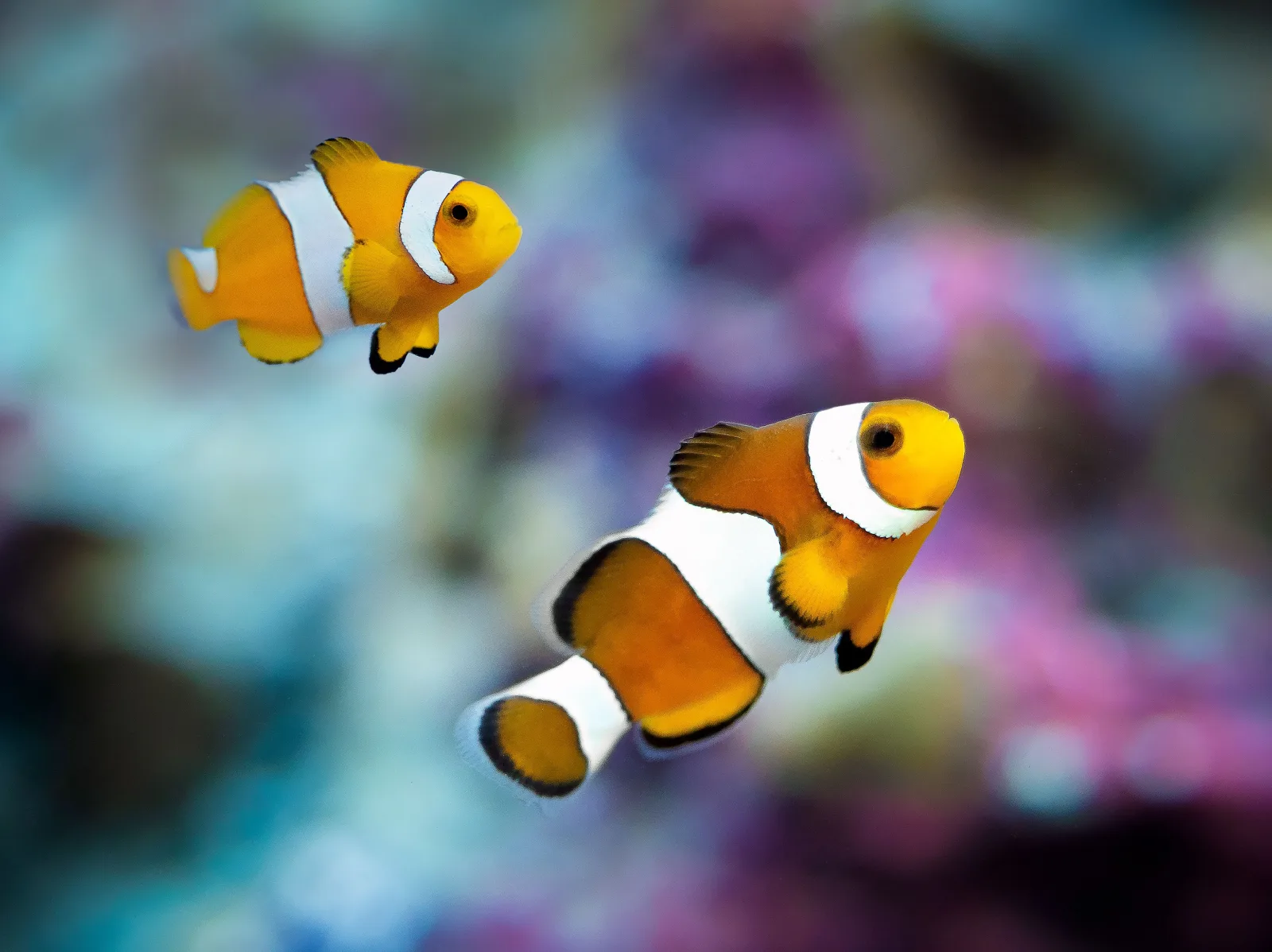
Amphiprion ocellaris was among the first marine ornamental species successfully bred in captivity, and captive-bred stock now makes up the large majority of clownfish sold in the trade[1]. This matters beyond sourcing ethics: captive-bred clownfish are widely reported to be hardier and better adjusted to aquarium conditions than wild-caught individuals, having never experienced the collection and transport stress wild-caught marine fish go through. Buying captive-bred, generally straightforward to confirm with your retailer, is both the more responsible choice and the more reliable starting point for a new keeper.
The anemone myth
In the wild, Amphiprion ocellaris forms a genuine symbiotic relationship with certain sea anemone species, most commonly Heteractis magnifica and Stichodactyla gigantea[1]. That relationship is real, but it doesn't translate into a husbandry requirement: the vast majority of clownfish sold today are captive-bred and have never encountered an anemone, and they live long, healthy lives without one[1]. An anemone is a genuinely optional addition for keepers who specifically want the natural display behaviour — not something to add purely on the assumption your clownfish needs it, particularly since anemones generally carry their own, more demanding lighting and water-stability requirements than clownfish do on their own.
Tank size
Widely cited minimums start around 20 US gallons (roughly 75 litres) for a single pair, with some sources recommending 30 gallons (roughly 115 litres) or larger for better long-term stability[2]. Clownfish aren't a large species, but a genuinely stable marine system — adequate filtration, room for equipment, and enough water volume to buffer against rapid parameter swings — benefits from more volume than the species' own modest size might suggest, consistent with marine tanks generally being less forgiving of a small water volume than an equivalent freshwater setup.
Water parameters
| Parameter | Widely reported range |
|---|---|
| Temperature | 24–27°C (75–80°F) |
| Specific gravity | 1.024–1.026 |
| pH | 8.0–8.4 |
| Ammonia / nitrite | 0, as with any species |
| Nitrate | Generally kept under roughly 20 ppm |
These sit within standard reef-tank ranges rather than requiring anything species-specific — see our salinity and specific gravity guide for testing and maintaining the specific gravity reading, and our nitrate guide for keeping that reading in check.
Social structure and sex change
Clownfish are protandrous sequential hermaphrodites: every individual starts life male, and sex is socially controlled rather than fixed from birth[3]. A group lives in a strict size-based dominance hierarchy — the largest individual is the breeding female, the second-largest is the breeding male, and any smaller individuals present are non-breeding juveniles[3]. If the female dies, the breeding male transitions to female to replace her, and the next-largest fish in the group is promoted to breeding male[3]. This isn't hobbyist folklore; it's documented in peer-reviewed research on the species.
Group size and pairing
A single pair is the standard, reliable group size for most home tanks, and it directly follows from the hierarchy above: two similarly-sized adult clownfish introduced together have no clear size-based ranking to settle into, and are widely reported to fight, sometimes seriously, as they contest it. The generally recommended approach is buying two juveniles of visibly different size at the same time and raising them together, letting the natural size gap establish the female/male roles without conflict. Adding a third adult later to an established pair is generally discouraged for the same reason.
Diet
Omnivorous and generally unfussy, accepting high-quality marine flake, pellet and frozen foods (mysis shrimp and brine shrimp are commonly used) without the feeding difficulties some marine species present. A varied diet including some meaty frozen food alongside a quality flake or pellet is a reasonable general approach, consistent with feeding guidance across most community-friendly marine fish.
Tank mates
Generally peaceful toward other species, though established pairs can become territorial around a chosen anemone or coral "host" spot if one is present. Reef-safe with corals and most invertebrates, making them a genuinely common first fish for a reef tank rather than only a fish-only setup. See our choosing a protein skimmer guide and starting a saltwater aquarium guide for the equipment and setup a tank like this typically needs before stocking.
Common mistakes
- Buying an anemone purely because "clownfish need it," when the vast majority of captive-bred clownfish have never needed one and anemones bring their own, often steeper, husbandry demands.
- Adding two similarly-sized adult clownfish together expecting an automatic pair, risking serious aggression as they contest rank.
- Choosing wild-caught over captive-bred stock without checking, missing the hardier, more responsible option.
- Undersizing the tank based on the fish's modest adult size alone, without accounting for the wider marine-system stability a small water volume struggles to provide.
- Adding a third adult clownfish to an already-established pair, disrupting a settled hierarchy.
Frequently asked questions
Do clownfish need an anemone to survive?
No. In the wild, Amphiprion ocellaris forms a genuine symbiotic relationship with certain sea anemone species, but the vast majority of clownfish sold today are captive-bred and have never encountered one. Captive-bred clownfish live long, healthy lives without an anemone — it's a genuinely optional addition some reef keepers choose for the display or the natural behaviour, not a husbandry requirement.
Should I buy wild-caught or captive-bred clownfish?
Captive-bred, where available — which is most of the time, since Amphiprion ocellaris was one of the first marine species successfully bred in captivity and captive-bred stock now dominates the trade. Captive-bred clownfish are widely reported to be hardier and better adjusted to aquarium life than wild-caught individuals, and buying captive-bred avoids the collection pressure and transport stress wild-caught marine fish are subject to.
How many clownfish can I keep together?
A single pair is the standard, reliable group size for most home tanks. Clownfish live in a strict size-based hierarchy with one dominant female and one breeding male, and adding same-sized adults together risks serious, sometimes fatal aggression as they contest rank. A mismatched-size juvenile pair, bought together and raised in the same tank, is the generally recommended way to establish a stable pair without that conflict.
Can clownfish change sex?
Yes — clownfish are protandrous sequential hermaphrodites, meaning every individual starts life male and the dominant fish in a group can develop into a female. If the female in an established pair dies, the male will typically transition to female, and the next-largest fish in the group takes over as the breeding male. This is well documented in peer-reviewed research on the species.
Keeping a record instead of trusting appearances
Clownfish are one of the hardier marine species, which is exactly why their tank's water quality is easy to stop watching closely — a fish that isn't showing obvious distress doesn't mean the reading behind it is still where it should be, and reef tankmates are typically far less forgiving of drift than the clownfish themselves. AquaPulse's Water Check keeps specific gravity, ammonia, nitrite and nitrate somewhere you can compare them against each other for the whole tank, not just against how the clownfish happens to be behaving that day.
Water Check doesn't read your water for you or monitor it continuously — it works from the readings you test and enter yourself, and isn't a substitute for a reliable test kit or for specialist advice if livestock are seriously or persistently unwell. For the plain-language explainer without the app, see the Water Check feature page.
Sources and uncertainty
- Published
- 8 August 2026
- Last reviewed
- 8 August 2026
- Written and maintained by
- AquaPulse (Valeon Labs Ltd)
This guide draws on peer-reviewed research on Amphiprion protandrous hermaphroditism and social hierarchy for the sex-change and grouping content, and specialist marine-aquarium hobbyist sources for practical tank size, water parameters and captive-bred availability, since no single source covers both the biology and the aquarium-husbandry side together. Water parameter figures are presented as widely reported ranges rather than a single precise requirement. We'll update this page if we find something we've got wrong.
Good to know: This guide provides general informational guidance only. It is not a substitute for specialist aquatic advice, particularly around introducing an anemone, which involves husbandry considerations genuinely beyond this clownfish-focused guide's scope.
- [1] Saltwater Aquarium Blog — "Ocellaris Clownfish Care: Size, Lifespan, Types & More" Specialist marine-aquarium hobbyist source. Used for captive-bred vs wild-caught prevalence and hardiness, and the anemone-species/symbiosis background. Not a scientific authority; presented as widely reported hobby consensus.
- [2] Fishstores.org — "Clownfish Care Guide: Species, Tank Setup & Buying Tips" Specialist marine-aquarium hobbyist source. Used for tank size and water parameter ranges. Not a scientific authority; figures presented as widely reported hobby convention.
- [3] Scientific Reports — "Sex Change in Clownfish: Molecular Insights from Transcriptome Analysis" Peer-reviewed primary research (Nature Publishing Group). Used for protandrous hermaphroditism and the size-based social hierarchy governing sex change in Amphiprion species.
What we deliberately left out: a specific maximum lifespan figure, since hobbyist sources vary and we found no dedicated longevity study to confirm one for aquarium conditions specifically; and detailed anemone-keeping husbandry, since anemones have genuinely different, more demanding requirements that deserve their own dedicated treatment rather than a brief mention here.