Knowledge Centre · Species guidance
Corydoras catfish care: one name for 150 species with different needs
"Corydoras" isn't one fish. It's a genus of more than 150 described species, commonly sold under a single loose label with broadly similar but not identical needs. Two things matter more than most in-store advice suggests. These are social, shoaling fish that need a proper group to do well, not a pair or trio. And their barbels, the whisker-like sensory feelers they forage with, are soft, sensitive tissue that sharp or dirty substrate can damage in a way that doesn't reliably grow back. Avoiding that substrate mistake is the single most consequential thing in this guide.
Before adding Corydoras
May be suitable when…
You can provide smooth sand or rounded, well-maintained fine gravel, a proper group of at least six of the same species, and calm tankmates that won't consistently outcompete them for sinking food.
Reconsider when…
Your substrate is sharp or coarse gravel you're not prepared to replace, you're planning to keep only one or two, or your tank is dominated by fast, boisterous fish that will out-feed a slow bottom forager.
Worth knowing: "Corydoras care" advice online is often written for one specific species and applied to all of them. Where you know which species you actually have, it's worth checking that species' own requirements rather than relying on a genus-wide number alone.
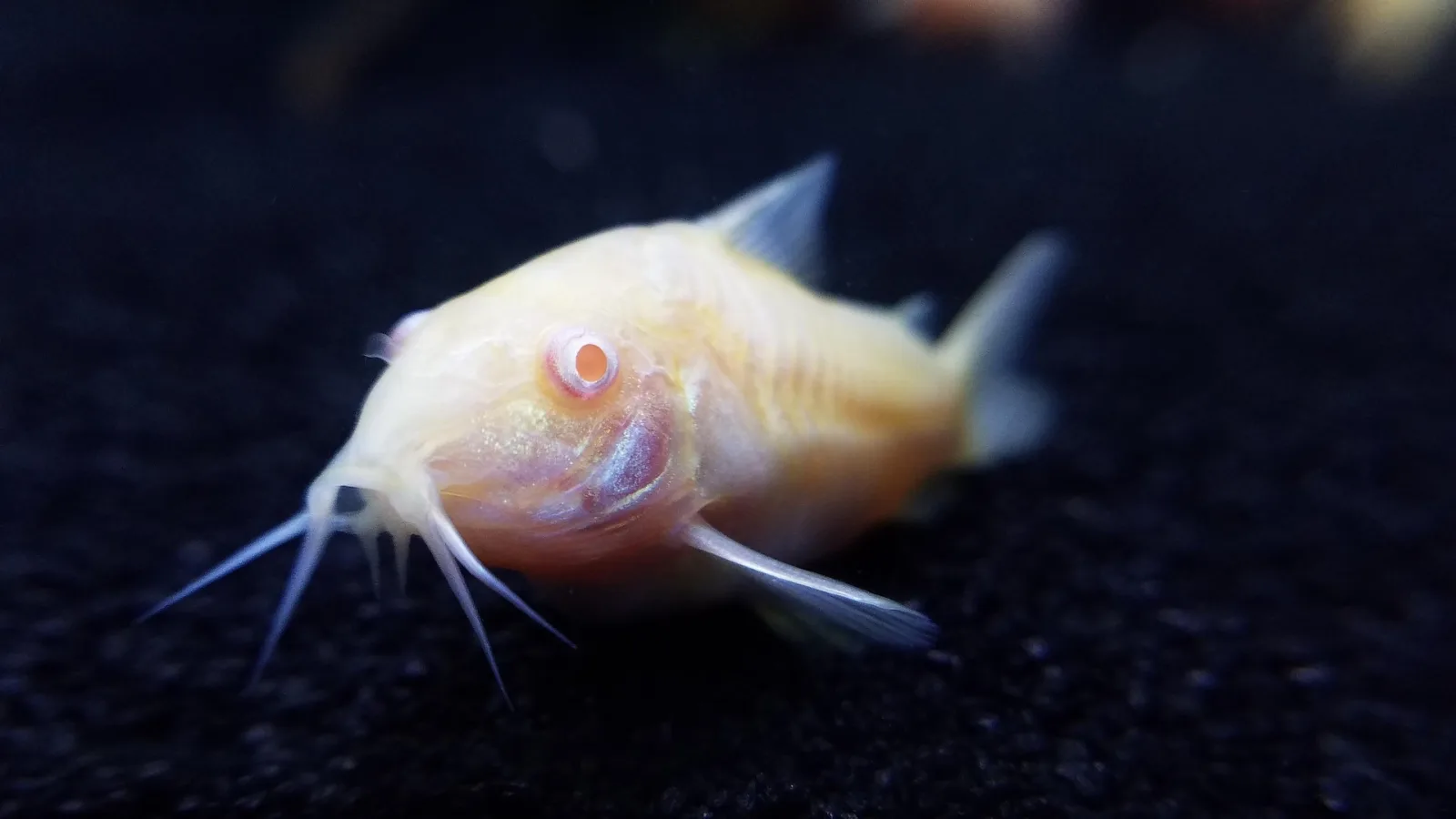
Identification: one genus, over 150 species
Corydoras is a genus of armoured catfish in family Callichthyidae[1], and specialist reference Seriously Fish describes it as one of the largest catfish genera, with over 150 valid described species[2]. Most fish sold simply as "corydoras" or "cory catfish" in general retail are a specific species, most often the bronze cory (Corydoras aeneus) or one of a handful of other widely bred species — but the generic label rarely says which. The albino strain pictured above is most likely bred from C. aeneus[1], the species most commonly bred for this colour form in the trade, though colouration alone can't confirm that with certainty.
This matters beyond curiosity: as covered in "Water parameters that matter most" below, documented care requirements vary between species within this genus, so advice that's accurate for one species isn't automatically accurate for all of them.
Water parameters that matter most
| Factor | Commonly reported range | Notes |
|---|---|---|
| Temperature | Roughly 22–26°C (72–79°F) generally | Varies by species: specialist sources give roughly 20–23°C for some cooler-water species and nearer 24–26°C for warmer-tolerant species such as C. sterbai[2]. |
| pH | Roughly 6.0–7.5 | Consistency matters more than hitting an exact figure. |
| General hardness | Soft to moderate | Most widely traded species are adaptable captive-bred stock. |
| Ammonia / nitrite | Zero | Same standard as any freshwater fish — see our ammonia and nitrite guides. |
| Nitrate | Kept low | No genus-wide numeric ceiling in the sources we reviewed was well-supported enough to repeat here — see our nitrate guide for general guidance. |
Tank setup and substrate: the barbel-safety decision
Corydoras spend much of their time foraging along the substrate, using their barbels — soft, sensitive, whisker-like feelers around the mouth — to locate food by touch. That constant contact makes substrate choice a genuine welfare decision, not a cosmetic one, and specialist reference Seriously Fish is explicit that this genus is sensitive to poorly maintained or dirty substrate, which can lead to barbel infection and loss[2].
It's worth being clear that there are two distinct risks here, not one, and cleanliness alone only addresses the second:
- Mechanical wear. Sharp or coarse-edged gravel can physically abrade barbels through ordinary day-to-day rooting and foraging, regardless of how clean it's kept.
- Infection-related erosion. Dirty or poorly maintained substrate, even if smooth, is associated with barbel infection and loss[2].
Smooth sand, or rounded fine gravel kept properly clean, is the more consistently recommended choice because it avoids both risks together. Once barbels are significantly worn or eroded, they don't reliably grow back to their original length, which is why prevention through substrate choice matters far more here than any treatment applied afterward. See our choosing an aquarium substrate guide for how this compares against other substrate options for the rest of a mixed-stocking tank.
Feeding behaviour and diet
Corydoras are bottom-feeding omnivores, and a sinking wafer or pellet formulated for bottom-dwellers is a more reliable way to feed them than food designed to be eaten at the surface or in open water. A varied diet that occasionally includes appropriately sized frozen or live foods (such as bloodworm or daphnia) is commonly recommended alongside a staple sinking food.
A common practical problem isn't diet composition so much as competition: in a community tank with fast, bold, mid- or top-swimming fish, sinking food can be intercepted before it reaches the bottom, leaving corydoras under-fed even when plenty of food goes into the tank. Feeding after lights-out, or in a spot away from more competitive tankmates, is a commonly recommended way to reduce this.
Shoal size and tank mates
This is the other point worth taking as seriously as substrate choice. Corydoras are highly social, shoaling fish, and specialist and hobbyist sources are consistent that a group of at least six of the same species is a sensible minimum, with confidence and natural behaviour generally improving further in larger groups[2]. A single individual, or a pair or trio, is more prone to hiding and appearing withdrawn than a proper group: behaviour that's sometimes mistaken for the species simply being shy or nocturnal, when under-stocking is a more likely explanation.
Beyond their own species, calm, similarly bottom-or-open-water-tolerant community fish that won't outcompete them for sinking food or disturb the substrate excessively are generally a good match. See our guide to choosing tank mates for a broader framework on working through a stocking decision like this one. Before adding a proper group, it's worth confirming your water chemistry is actually stable; AquaPulse's Water Check can help with that.
Water stability considerations
Avoid adding corydoras to a tank that's still cycling or has recently shown signs of a cycle disruption. As substrate-dwelling fish, they're also in close, constant contact with anything settling on the tank floor, which makes routine substrate maintenance part of ongoing water-quality care for this genus specifically, not just general good practice — see our water-change guide for pacing that safely.
Normal behaviour
- Periodic rapid dashes to the surface to gulp air, then diving back down: normal, well-documented behaviour for this genus. Peer-reviewed research on Corydoras aeneus found the fish absorbs oxygen through its intestinal lining after gulping air at the surface, releasing the used air through the vent as it descends[3]. It isn't dependent on this the way a true air-breather is, but does it periodically even in well-oxygenated water.
- Resting in loose piles or clusters with other corydoras, particularly when settled and comfortable — normal social behaviour, not illness.
- Constant rooting and sifting through substrate while foraging — normal, and part of why substrate choice matters as much as it does.
- Brief bursts of activity followed by long resting periods, especially outside of feeding times — normal for this genus generally.
Warning signs and what to check first
None of the signs below confirms a specific problem on its own. Each has more than one possible explanation, and reacting immediately — especially by adding a product or a large water change — before checking the more likely causes can make things worse.
Shortened, frayed or missing barbels
What it might mean: Mechanical wear from sharp substrate, or infection-related erosion from dirty substrate — see "Tank setup and substrate" above for the distinction.
What else could explain it: Damage during transport or from aggressive tankmates is less common but possible.
Check this first: Substrate texture and cleanliness, and whether the damage is progressing or stable.
Don't: Expect barbels to fully regrow once already significantly eroded — the priority is stopping further damage, not reversing it.
Hiding constantly or rarely seen out in the open
What it might mean: An under-sized group — a pair or trio rather than a proper shoal — is a common, often-overlooked cause. See "Shoal size and tank mates" above.
What else could explain it: Water-quality problems, or ordinary nocturnal variation between individual fish.
Check this first: How many of the same species you're actually keeping, and general water parameters.
Don't: Assume the species is simply shy without ruling out group size first.
Clamped fins, redness, or general lethargy
What it might mean: A recognised general indicator of bacterial or water-quality-related stress in aquarium fish[4].
What else could explain it: Recent transport, a new tank, or a recent water change.
Check this first: Ammonia, nitrite and current temperature. See our clamped fins guide for the general picture across species.
Don't: Wait several days before testing water if this appears suddenly.
Not eating, or thinner-looking than tankmates
What it might mean: Being consistently outcompeted for sinking food by faster tankmates, rather than illness. See "Feeding behaviour and diet" above.
What else could explain it: Water-quality problems, or a genuine health issue if the whole group is affected.
Check this first: Whether other tankmates are intercepting food before it reaches the bottom, and water parameters. See our fish not eating guide for more.
Don't: Assume adding more food solves it without checking whether it's actually reaching them.
Common husbandry mistakes
- Using sharp or coarse gravel, underestimating how much barbel damage results from ordinary daily foraging on it.
- Keeping too few — a pair or trio rather than a proper group of six or more of the same species.
- Applying advice written for one Corydoras species to a different one, particularly around temperature, without checking the actual species kept.
- Feeding only surface or open-water food, without a sinking staple reaching the substrate.
- Reading normal air-gulping as a water-quality emergency, or, conversely, dismissing a genuine change in frequency as always normal.
What the aquarium cannot compensate for
- Keeping the water pristine doesn't offset sharp substrate — the mechanical wear risk to barbels is separate from the infection risk.
- A larger tank alone doesn't fix an under-sized group; six or more of the same species is about shoal size, not floor space.
- Once barbels are significantly eroded, water-quality improvements won't reliably restore them — prevention is what matters here.
- Adding more food doesn't help if faster tankmates are intercepting it before it reaches the substrate.
When specialist help may be appropriate
Aquatic veterinary expertise specific to ornamental fish is less widely available than for common pets, but it exists, and a knowledgeable specialist retailer or aquatic-health specialist can sometimes help with a puzzling case.
Frequently asked questions
Why don't Corydoras barbels grow back?
Barbels are soft, sensitive sensory tissue, not fin material, and once they're eroded down through mechanical wear or infection, specialist and hobbyist sources are consistent that they don't reliably regrow to their original length. That's what makes substrate choice a genuine, largely irreversible welfare decision rather than a minor preference — prevention, through smooth sand or well-maintained fine gravel, matters far more than any after-the-fact fix.
How many Corydoras do I actually need to keep together?
At least six of the same species, and this is worth taking seriously rather than treating as a rough suggestion. A pair or trio is consistently described across specialist and hobbyist sources as more prone to hiding and stress than a proper group, since these are genuinely social, shoaling fish. If you already have fewer than six, adding more of the same species rather than a different one is generally the better fix.
Is it normal for my Corydoras to dart to the surface for air?
Yes, this is well-documented, normal behaviour for this genus, not a sign of oxygen problems on its own. Peer-reviewed research on Corydoras aeneus found the fish gulps air at the surface and absorbs oxygen through its intestinal lining, releasing the used air through the vent as it dives back down. It isn't dependent on this the way a true air-breather is, but will do it periodically even in well-oxygenated water. A sudden, marked increase in how often it happens alongside other tankmates showing distress is worth checking against water quality rather than assumed normal.
Do all Corydoras species need the same water temperature?
No, and this is a common source of mismatched advice online. Corydoras is a large genus of more than 150 described species, and documented temperature preferences vary meaningfully between them — some cooler-water species are best kept around 20–23°C, while others such as Corydoras sterbai are more warm-water-tolerant and often kept nearer 24–26°C. If you know which species you have, it's worth checking its specific requirements rather than relying on a single genus-wide number.
Can Corydoras live on sharp gravel if I clean it regularly?
Regular cleanliness helps with the infection-related risk to barbels, but it doesn't address the separate mechanical risk: sharp or coarse-edged gravel can physically wear barbels down through everyday rooting and foraging, regardless of how clean it's kept. Smooth sand or rounded, fine gravel avoids both risks at once, which is why it's the more consistently recommended substrate for this genus rather than clean-but-sharp gravel.
Sources and uncertainty
- Published
- 29 July 2026
- Last reviewed
- 6 August 2026
- Written and maintained by
- AquaPulse (Valeon Labs Ltd)
This guide covers Corydoras as a genus rather than a single species, since that's how the fish is overwhelmingly sold and searched for. It draws on a taxonomic reference database, a specialist hobbyist reference already used elsewhere on this site, a peer-reviewed physiology study, and a veterinary reference source. Because species-level advice varies within this genus, we've deliberately kept numeric ranges general and flagged where individual species differ rather than presenting one set of numbers as universal. We'll update this page if we find something we've got wrong.
Good to know: This guide provides general informational guidance only. It is not a veterinary service and does not replace specialist or aquatic health advice for serious livestock health issues.
- [1] Integrated Taxonomic Information System (ITIS) — "Corydoras aeneus" (TSN 164292) and "Callichthyidae" (TSN 164279) Used as the taxonomic authority for family placement and for Corydoras aeneus specifically, the species most commonly bred for the albino strain shown in this guide's photo.
- [2] Seriously Fish — Corydoras species profiles (genus overview, substrate/barbel notes and per-species parameters) Specialist hobbyist reference source, already used elsewhere on this site. Used for genus size, shoaling behaviour, substrate and barbel sensitivity, and documented temperature variation between individual species. Not a peer-reviewed source.
- [3] Kramer, D.L. & McClure, M. (1980), "Aerial respiration in the catfish, Corydoras aeneus (Callichthyidae)," Canadian Journal of Zoology, 58(11) Peer-reviewed study, used for the mechanism and normalcy of surface air-gulping and intestinal respiration in this genus.
- [4] Merck Veterinary Manual — "Disorders and Diseases of Fish" Used for general bacterial/stress-related warning signs (clamped fins, redness, lethargy) applicable across aquarium fish.
Claims we chose not to repeat: a specific named "red blotch" or "wasting disease" diagnosis sometimes described for this genus, since the sources repeating it were hobbyist blogs and retailer pages we couldn't verify against a veterinary or peer-reviewed source; and a single genus-wide temperature figure, since documented preferences vary by species and repeating one number risked being wrong for a meaningful share of the species sold under this name.