Knowledge Centre · Species guidance
Bristlenose pleco care: the juvenile mix-up that ends in an outgrown tank
"Bristlenose pleco" almost always means a fish in the genus Ancistrus, sold and bred commercially on a huge scale. The exact species behind the most common commercial form remains unresolved: genetic data has ruled out the species it was long assumed to be, without confirming a replacement[1]. That taxonomic gap doesn't affect care, but a much more consequential mix-up does. "Pleco" at a pet shop can also mean a common pleco (Hypostomus or Pterygoplichthys species) capable of outgrowing almost any home aquarium, and the two are sometimes mislabelled or sold side by side as identical-looking small juveniles. Telling them apart while they're still small is the single most useful thing this guide can do for you.
Before adding a bristlenose pleco
May be suitable when…
You can offer a tank of at least 75–100 litres (20–26 US gallons) with driftwood and a running, well-oxygenated filter, and you're prepared to feed more than just algae once it's grazed the tank clean.
Reconsider when…
You bought a small "pleco" without confirming the species and genus, your tank has little water flow or oxygenation, or you're expecting it to survive on algae alone in a tank with limited plant/algae growth.
Worth knowing: a genuine bristlenose stays modest in size for a catfish, but a mislabelled common pleco bought at the same size will not — see "Identification" below before you buy.
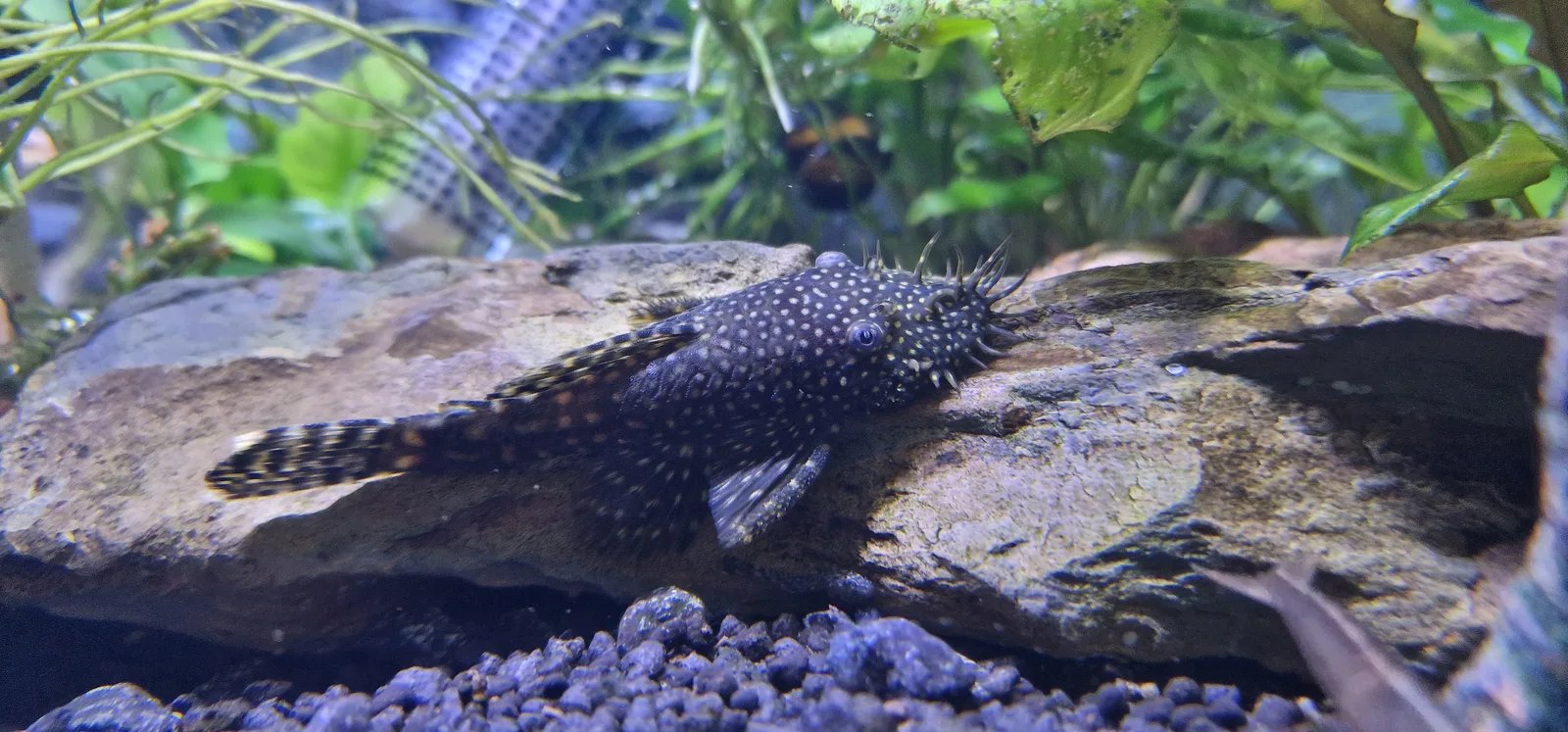
Identification: why "bristlenose" and "common pleco" matter
The bristlenose catfish most widely bred and sold in the aquarium trade was, from the late 1990s until 2008, commonly labelled Ancistrus sp. "3," then considered closely related to the Argentinian species Ancistrus cirrhosus. Genetic data has since indicated this link doesn't hold, leaving its precise species identity unresolved — possibly even a hybrid origin from commercial breeding[1]. Several line-bred ornamental forms exist, including albino, piebald and long-finned ("veiltail"/"butterfly") varieties of the same underlying fish[1]. None of this taxonomic uncertainty changes day-to-day care.
What does change everything is confusing it with a common pleco. "Pleco" is used loosely in the trade to cover dozens of unrelated species, including Hypostomus plecostomus and various Pterygoplichthys species sold as "common," "sailfin" or "Colombian" plecos — all of which are documented as reaching 30–60 cm (12–24 in) or more as adults[2], dramatically larger than a bristlenose's roughly 10–15 cm (4–6 in). As juveniles, small specimens of both can look broadly similar to an inexperienced buyer — flattened body, sucker mouth, mottled colouring — and mislabelling or generic "assorted pleco" tagging in shops is a genuine, recurring problem. Before buying, confirm the actual species or at minimum the genus, since a 5 cm juvenile sold simply as "pleco" gives you very little information about how large it will eventually get.
Sex is visually distinguishable in mature bristlenose: males develop the branching, antler-like odontodes ("bristles") across the snout that give the fish its name, while females and juveniles have few or none.
| Bristlenose (Ancistrus sp.) | Common pleco (Hypostomus/Pterygoplichthys spp.) | |
|---|---|---|
| Adult size | Roughly 10–15 cm (4–6 in)[1] | Roughly 30–60 cm (12–24 in) or more[2] |
| Realistic minimum tank | 75–100 litres (20–26 US gal) | Several hundred litres once mature — unsuitable for most home aquaria |
| Snout bristles | Adult males develop branching bristles; females/juveniles usually don't | None — no species in this group grows bristles |
| As a juvenile | Can look near-identical to a young common pleco to an inexperienced buyer | Can look near-identical to a young bristlenose to an inexperienced buyer |
| Breeding in a home tank | Straightforward, cave-spawning; happens readily, sometimes unintentionally | Rare in home aquaria; not a typical accidental-breeding concern |
If you already own a "pleco" and aren't sure which, the bristles are the fastest visual check on a mature male, but the single most reliable long-term indicator is growth rate: a fish that's still growing steadily past 15 cm isn't a bristlenose. If you're deciding between a bristlenose and the similarly sized rubber lip pleco rather than ruling out a common pleco, see our Rubber Lip Pleco vs Bristlenose Pleco comparison for how the two actually differ.
Size, growth and lifespan
Bristlenose plecos are usually sold as juveniles around 2.5–5 cm (1–2 in), which is part of why size confusion with a common pleco happens so easily — at that stage there's little visible difference. Growth continues steadily for the first year or so, with males developing their characteristic bristles at around 6 months as they approach sexual maturity, and most individuals reaching close to their adult size of 10–15 cm within 12–18 months given adequate food and space.
Lifespan estimates vary considerably across hobbyist sources, commonly reported anywhere from around 5 years up to 12 years or more with consistent care[1]; we haven't found a dedicated longevity study that pins this down more precisely, so treat any single figure you see quoted elsewhere with some caution. Water quality, diet and stress are the factors most consistently linked to living toward the shorter or longer end of that range.
One myth worth correcting directly: a bristlenose does not reliably "grow to the size of its tank" as a safe, benign limit. A fish that stops growing in an undersized or poorly maintained tank is far more likely showing the effects of chronic stress and poor water quality than being conveniently size-capped, and stunted growth in fish is generally associated with shortened lifespan and poorer health, not a harmless space-saving trait. Size the tank for the fish's genuine adult size, not the other way around.
Water parameters that matter most
Bristlenose plecos are reasonably adaptable within a tropical range, but consistency matters more than hitting an exact number. Treat the figures below as a practical starting range from specialist sources, not a single scientific target.
| Factor | Commonly reported range | Notes |
|---|---|---|
| Temperature | Roughly 23–27°C (73–81°F) | A tropical Amazon-basin range; avoid running consistently below this for a supposedly "hardy" fish. |
| pH | Roughly 6.5–7.5 | Reasonably adaptable; stability matters more than the exact figure. |
| General hardness | Soft to moderately hard | Tolerant of a range; extremes in either direction are more relevant than the midpoint. |
| Ammonia / nitrite | Zero | Same standard as any freshwater fish — see our ammonia and nitrite guides. |
| Dissolved oxygen / flow | Well-oxygenated, moderate to strong flow | This species is reported to prefer well-oxygenated water reminiscent of flowing Amazon tributaries — see "Habitat" below. |
Tank size, driftwood and flow
A single specimen or breeding pair is commonly recommended a minimum tank footprint of around 60 × 30 cm (roughly 75–100 litres depending on height), treated here as a widely used hobbyist convention rather than a figure from a specific welfare study[1]. A filter providing moderate to strong flow, and good oxygenation, is more consistently emphasised for this species than for many community fish, reflecting its native, flowing-water habitat.
Driftwood or bogwood is close to essential, not decorative: bristlenose plecos are strongly associated with rasping at wood surfaces, and while research on related wood-eating loricariid catfish increasingly suggests they're not true wood-digesters in the way termites or beavers are — more likely gaining some benefit from microbial activity in the gut, with wood itself contributing less nutritionally than once assumed[3][4] — the behaviour itself is well documented and widely recommended for digestive and enrichment reasons regardless of the exact mechanism. Include caves, dense cover and enough surface area, since males become notably territorial around a chosen cave (see "Breeding" below).
Diet: does it eat algae, plants or wood?
Does it eat algae? Yes, and it's commonly sold on this basis, but algae alone will not sustain a bristlenose long-term in most tanks — there simply isn't enough of it once the fish has grazed a tank down, and expecting an "algae eater" to need no further feeding is one of the more common ways this species is quietly underfed. Does it eat plants? Generally no: it's widely regarded as safe for planted tanks, grazing biofilm from leaves rather than eating the leaves themselves, though very soft-leaved species occasionally show some grazing damage.
In practice, a bristlenose's diet is best thought of as mostly plant-based with occasional protein, not purely algae: a sinking algae wafer or pellet as the daily staple, blanched vegetables (courgette, cucumber, shelled peas) offered a few times a week, and occasional frozen or live protein (bloodworm, brine shrimp) once or twice a week rather than as a regular staple. Provide driftwood continuously rather than as an occasional treat, given how consistently this species is documented gnawing at wood surfaces[1]. Feeding primarily after lights-out suits its largely nocturnal activity pattern (see "Normal behaviour" below), though it will graze during the day in a settled tank too, and a wafer left to sit overnight is a reasonable way to check it's actually getting fed once algae alone stops being enough.
Tank mates and compatibility
Bristlenose plecos are generally peaceful toward other species and are a common, low-conflict addition to a wide range of community tanks. The main compatibility considerations are intraspecific rather than with other fish: males are territorial around caves, particularly during breeding, and two males in a tank without enough separate cave options can conflict over the same spot. Multiple females, or a single male with several females, generally works better in a modestly sized tank than multiple males.
Toward other species, genuine aggression is uncommon, though a bristlenose sharing a small tank with another bottom-dwelling, cave-seeking species (some other catfish or loaches) can occasionally compete over the same limited hiding spots. Compatibility here depends on your specific tank's layout and cave availability as much as species pairing: two peaceful bottom-dwellers with only one cave between them can still conflict, while the same two fish in a tank with several caves usually won't. If you're planning your stocking, thinking through how many hiding spots your layout actually offers, not just which species are generally described as "peaceful," is the more useful check. See our guide to choosing tank mates for how adult size, temperament and bioload apply generally across a mixed community. Before adding one, it's worth confirming your water quality and flow can actually support this species' relatively heavy bioload; AquaPulse's Water Check and Filter Turnover Calculator both help with that check.
Breeding and cave behaviour
Bristlenose plecos are cave spawners and breed readily in home aquaria given a suitable cave, reasonable water quality and a compatible pair, making them among the more straightforward catfish to breed on purpose or by accident. The male guards a cave, and after spawning takes over guarding the eggs and, initially, the free-swimming fry, fanning them and defending the cave entrance. This male-led guarding behaviour is a distinctive, frequently observed part of keeping this species rather than a rare event.
If you don't want fry, removing extra caves and keeping a single-sex or carefully managed group reduces the likelihood of unplanned breeding, though eggs and fry can still appear in an established community tank without obvious warning.
Water stability and bioload
Is bristlenose bioload actually high? Relative to its physical size, yes. Specialist sources consistently describe it as a heavier waste producer than many similarly sized community fish, and the reason is behavioural rather than mysterious: it's grazing and eating almost continuously rather than in a couple of discrete meals, and a plant-heavy diet passes through faster and in greater volume than the more concentrated diet of many small fish. This doesn't make it delicate, but it does mean a peaceful temperament shouldn't be mistaken for a low-impact addition — filtration and water-change routines sized for the rest of your community may need adjusting upward once one is added. Use the free Aquarium Filter Turnover Calculator to check your filter's flow is adequate for the fuller stocking, and see our water-changes guide for routine adjustments.
Avoid adding a bristlenose to a tank that's still cycling or has recently shown a cycle disruption — a heavier bioload species is a poor first addition to an unstable system.
Normal behaviour
- Largely nocturnal activity, hiding by day and grazing/exploring more visibly after lights-out — normal, not a sign it's unwell or hiding from a problem.
- Near-constant rasping at wood, décor and glass — the core expected behaviour, not a sign of distress.
- A male guarding a cave entrance, sometimes aggressively toward anything approaching — normal territorial behaviour, particularly around breeding.
- Colour darkening or lightening somewhat with mood, lighting and substrate colour — a normal camouflage response, not automatically illness.
- Resting motionless against glass or décor for extended periods during the day — normal daytime inactivity for a nocturnal species.
Warning signs and what to check first
None of the signs below confirms a specific problem on its own. Each has more than one possible explanation, and reacting immediately before checking the more likely causes can make things worse.
Visible weight loss, a sunken belly, or ribs becoming visible
What it might mean: Insufficient food, particularly if you're relying on algae alone once it's been grazed down.
What else could explain it: Competition from tankmates at feeding time if food is only offered during the day, when this species is less active.
Check this first: What you're actually feeding beyond algae, and whether feeding after lights-out changes how much it eats.
Don't: Assume "it's an algae eater" means it needs no other food — see "Diet" above.
Clamped fins, unusual hiding, or resting on its side
What it might mean: Poor water quality or stress — a general, non-specific sign of illness common across species.
What else could explain it: Normal daytime resting posture for a nocturnal fish, which can look unusual to someone unfamiliar with the species.
Check this first: Ammonia, nitrite and temperature, and whether the behaviour persists into its normally active period after dark.
Don't: Judge activity level by daytime observation alone — check after lights-out too.
Gasping at the surface or rapid gill movement
What it might mean: Low dissolved oxygen, which this species is reported to be somewhat more sensitive to than many community fish given its flowing-water origin.
What else could explain it: Ammonia or nitrite exposure, which can produce similar breathing changes. See our fish gasping at the surface guide for the general picture.
Check this first: Water parameters and current flow/surface agitation, not just oxygen alone.
Don't: Assume more flow alone fixes it without testing water quality first.
A male aggressively guarding a cave and chasing tankmates
What it might mean: Normal breeding/territorial behaviour, especially if eggs or fry are present.
What else could explain it: Genuine incompatibility if the behaviour is constant and unrelated to any cave or breeding activity.
Check this first: Whether a cave, eggs or fry are actually present, and whether other tankmates have somewhere else to retreat to.
Don't: Remove the male immediately if this is clearly cave-guarding — it usually settles once fry disperse or are removed.
Common mistakes
- Buying a small "pleco" without confirming species or genus, risking an eventual common pleco far too large for the tank — see "Identification" above.
- Feeding algae only, without supplementing once existing algae is grazed down.
- Skipping driftwood entirely, removing a behaviourally important, widely recommended part of its environment.
- Underestimating its bioload when sizing filtration for the rest of the tank.
- Keeping multiple males in a tank without enough separate caves, inviting territorial conflict.
- Judging activity level from daytime observation alone, missing that it's considerably more active after dark.
What the aquarium cannot compensate for
- A well-run tank cannot make a bristlenose suitable if what you actually bought was a common pleco — that's a stocking decision that needs correcting at the identification stage, not the water-quality stage.
- Good filtration cannot substitute for actual food once algae is exhausted.
- No amount of water-quality management resolves territorial conflict between two males competing for the same single cave.
- Strong flow alone cannot compensate for genuine ammonia or nitrite exposure — both need checking, not just one.
When specialist help may be appropriate
Aquatic veterinary expertise specific to ornamental fish is less widely available than for common pets, but a knowledgeable specialist retailer or aquatic-health specialist can sometimes help with a puzzling case.
Frequently asked questions
What size and lifespan should I expect from a bristlenose pleco?
Most bristlenose plecos reach roughly 10–15 cm (4–6 in) as adults, usually within 12–18 months given adequate food and space. Lifespan is commonly reported in the region of 5 to 12 years or more with consistent water quality and diet, though estimates vary across sources and we haven't found a dedicated longevity study to confirm a precise figure.
What's the difference between a bristlenose and a common pleco?
Size, mainly. A bristlenose tops out at around 10–15 cm, while a common pleco (Hypostomus or Pterygoplichthys species) can reach 30–60 cm or more — several times larger, and unsuitable for most home aquaria once grown. As small juveniles the two can look very similar, so confirming the actual species before buying matters more than judging by size at the point of sale.
What do bristlenose plecos eat?
A mostly plant-based diet with occasional protein: a sinking algae wafer or pellet daily, blanched vegetables a few times a week, and occasional frozen or live protein once or twice a week. Algae alone isn't enough once a tank has been grazed down, which is one of the more common ways this species is quietly underfed.
Is bristlenose pleco bioload really that high?
Relative to its size, yes. It grazes and eats almost continuously rather than in a couple of meals, and its largely plant-based diet passes through in greater volume than a more concentrated diet. A peaceful temperament shouldn't be mistaken for a low-impact addition — filtration and water-change routines may need adjusting upward once one is added.
Can bristlenose plecos live in cold water?
Not safely as a long-term setup. Despite a reputation for hardiness, this is a tropical species needing a stable temperature of roughly 23–27°C (73–81°F), and an unheated room in most climates runs cooler than that for at least part of the year. "Hardy" here means tolerant of a range of water chemistry, not a substitute for a heater.
Sources and uncertainty
- Published
- 26 July 2026
- Last reviewed
- 6 August 2026
- Written and maintained by
- AquaPulse (Valeon Labs Ltd)
This guide draws on a specialist hobbyist reference source for taxonomy and day-to-day husbandry, a U.S. federal non-indigenous species profile for size/range context on related large plecos, and peer-reviewed research on wood-eating loricariid catfish digestion. Where the exact species identity of the commercial bristlenose remains unresolved, we've said so rather than assigning a species name we can't support. We'll update this page if we find something we've got wrong.
Good to know: This guide provides general informational guidance only. It is not a substitute for specialist aquatic-health advice.
- [1] Seriously Fish — "Ancistrus sp. '3' (Common Bristlenose Catfish)" Specialist hobbyist reference source. Used for taxonomic history, ornamental varieties, tank size and driftwood/diet recommendations. Not a peer-reviewed source.
- [2] U.S. Geological Survey, Nonindigenous Aquatic Species — "Bristlenosed catfish (Ancistrus sp.)" Species Profile Used for general size-range context distinguishing bristlenose catfish from much larger, commonly confused pleco species.
- [3] German, D.P. & Bittong, R.A., "Digestive enzyme activities and gastrointestinal fermentation in wood-eating catfishes," Journal of Comparative Physiology B (via PMC) Peer-reviewed research on digestive physiology in wood-eating loricariid catfish, used for the wood-consumption behaviour and its debated nutritional role.
- [4] "Inside the guts of wood-eating catfishes: can they digest wood?" Journal of Comparative Physiology B (Springer) Peer-reviewed research, used for the more recent view that wood-eating loricariids function more as detritivores than true wood-digesters.
Where the evidence runs out: a confirmed scientific species name for the common commercial bristlenose (the sources available describe its identity as unresolved, not settled on any particular name); a precise minimum tank volume backed by a specific welfare study rather than hobbyist convention; a specific bioload/waste figure, since we found consistent qualitative reporting of "heavier than similarly sized fish" but no precise comparative measurement; and a single confident lifespan figure, since estimates across the sources we reviewed ranged from around 5 to well over 12 years with no dedicated longevity study to settle on one.