Knowledge Centre · Species guidance
Freshwater angelfish care: the peaceful juvenile that grows into a predator
Pterophyllum scalare is almost always sold and marketed as a peaceful "community fish," and at the small juvenile size most people buy it, that's fair. It's also a cichlid, a family widely known for territoriality and opportunistic predation. As it grows into a mid-sized adult, the same tankmates it seemed to tolerate as a juvenile, particularly small schooling fish, can become something it will eat. Its own long, trailing fins make it a target for fin-nipping species too. Planning stock around the fish it becomes, not the fish it is in the shop, is the single biggest thing that determines whether this works out.
Before adding an angelfish
May be suitable when…
You can provide a properly tall, mature, stable tank, you're planning tankmates sized and chosen for what the angelfish will become as an adult, and you're prepared for a fish that can live for years and grow to a real, deep-bodied cichlid size.
Reconsider when…
You want a mixed community that includes small schooling fish like neon tetras, your tank is wide and shallow rather than tall, or you already keep known fin-nipping species such as tiger barbs.
Worth knowing: the size and temperament of an angelfish at the point of sale says very little about the size and temperament it will reach as an adult — stocking decisions made around the juvenile are a common source of problems months later.
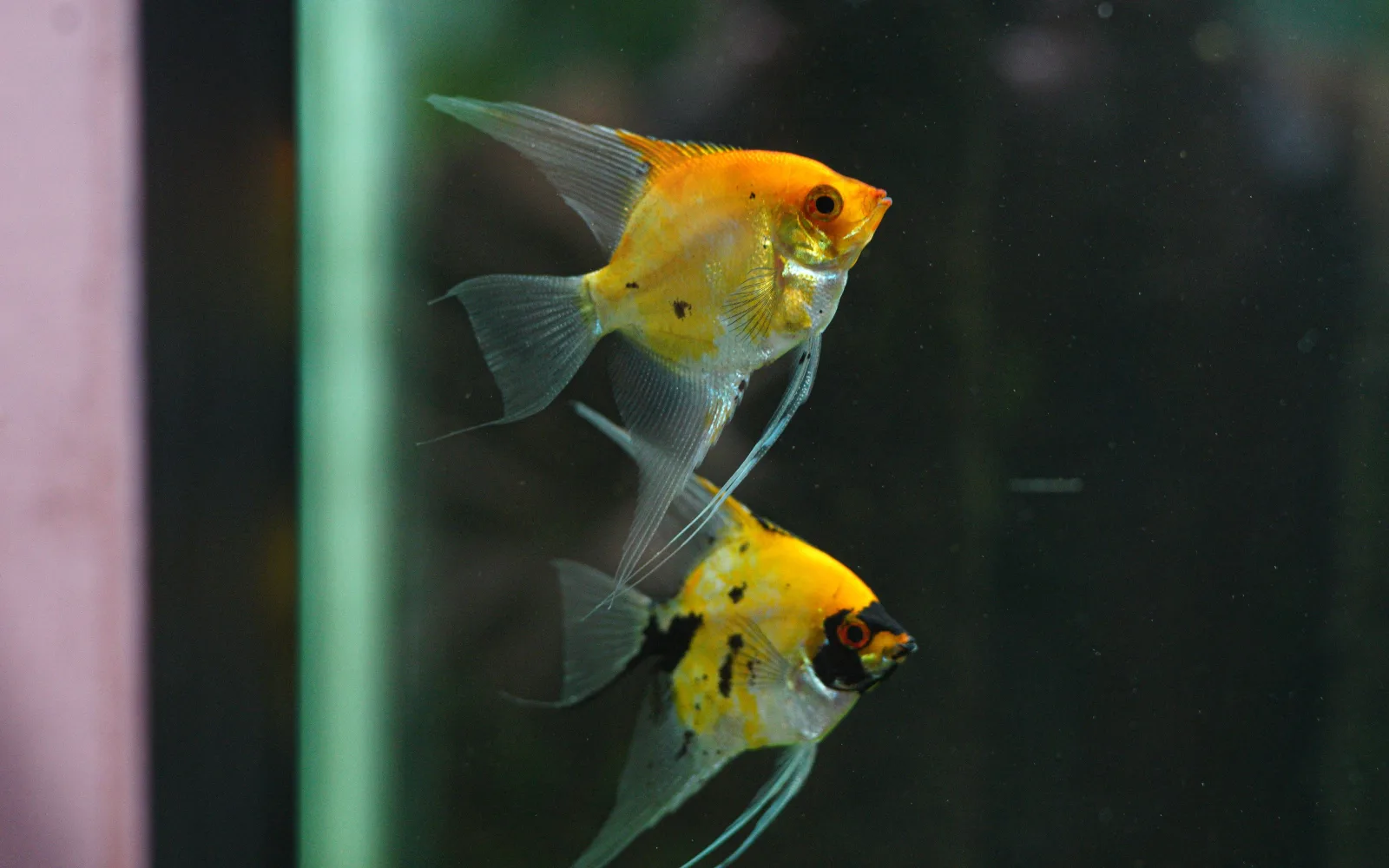
Identification and naming caveats
Pterophyllum scalare (Lichtenstein, 1823) is a cichlid in genus Pterophyllum, family Cichlidae[1]. Almost every angelfish sold in the aquarium trade today is a captive-bred, selectively bred ornamental strain (silver, marble, koi, black, gold, veil-finned and many other named forms) rather than the plainer wild-type colouration. That multi-generation captive breeding also tends to make trade stock somewhat more tolerant of a wider range of water conditions than wild-caught fish, though it doesn't remove the need for stable, good-quality water covered below.
Two identification points are worth being clear about. First, "angelfish" without qualification is ambiguous online: this guide covers the freshwater cichlid Pterophyllum scalare, not any of the unrelated saltwater reef fish in family Pomacanthidae that also go by "angelfish." The two aren't closely related and have completely different care requirements. Second, within Pterophyllum itself, the much less commonly kept Altum angelfish (Pterophyllum altum) is a distinct, larger-bodied, taller species with more demanding water requirements, sometimes confused with or mislabelled as P. scalare in the trade. If you're not certain which you have, treat this guide's water-parameter ranges as a starting point rather than a confirmed match, since a true Altum angel is more sensitive to variation.
Water parameters that matter most
Wild P. scalare populations are native to the Amazon basin across Peru, Colombia and Brazil, inhabiting slow-moving, often densely vegetated rivers and floodplains[3]. Trade stock is overwhelmingly captive-bred and more adaptable than that native water chemistry would suggest, but the ranges below are still a sensible target.
| Factor | Commonly reported range | Notes |
|---|---|---|
| Temperature | Roughly 24–30°C (75–86°F) | A tropical range; an unheated room is rarely warm enough year-round. |
| pH | Roughly 6.0–8.0 | Wider tolerance than the more acidic native water, reflecting generations of captive breeding[2]. Consistency matters more than hitting an exact figure. |
| General hardness | Soft to moderately hard | Native water is soft and acidic[3]; trade stock is generally more flexible. |
| Ammonia / nitrite | Zero | Same standard as any freshwater fish — see our ammonia and nitrite guides. |
| Nitrate | Kept low | No angelfish-specific numeric ceiling in the sources we reviewed was well-supported enough to repeat here — see our nitrate guide for general guidance. |
Tank size and why height matters most
An adult angelfish's body is tall and laterally compressed, almost disc-shaped, with long, trailing dorsal and anal fins that extend well beyond the body itself. That shape means the usual way of thinking about tank size, mostly in terms of floor space or total volume, can be seriously misleading here: a wide, shallow tank with generous floor area but limited height is a poor fit even if its total volume looks adequate on paper.
Specialist reference Seriously Fish considers tank dimensions smaller than roughly 100 x 40 x 50cm (length x width x height) too small for adult P. scalare, noting that some large colour strains grow tall enough to need real room to manoeuvre[2]. The 50cm height figure is the part most worth double-checking against a tank you already own or are considering, since plenty of small and mid-sized aquariums are shorter than that. As a practical check: if an adult angelfish's body depth plus its trailing fin span could plausibly approach or exceed your tank's height, it's undersized for this species regardless of its footprint.
Feeding behaviour and diet
P. scalare is an omnivore in the wild, documented as feeding on a mix of plankton, insect and crustacean larvae, plant matter and worms[3]. In the aquarium, a quality commercial cichlid pellet or flake forms a reasonable base diet, and a varied diet that occasionally includes appropriately sized frozen or live foods (such as bloodworm or brine shrimp) is commonly recommended alongside it, though we found no single authoritative source specifying an exact required ratio.
Feeding a modest amount once or twice daily, rather than as much as the fish will accept, is the more cautious general approach shared with most aquarium fish. See "Why 'community fish' undersells it" below for how an adult's own predatory feeding behaviour, not just its formal diet, affects stocking decisions.
Why "community fish" undersells it
This is the single most important thing to understand before choosing tankmates. Angelfish are typically sold small, calm and inexpensive, and are routinely included on generic "peaceful community fish" lists on that basis. But P. scalare is a mid-sized cichlid that can reach around 15cm in body length[2], and cichlids as a family are widely recognised for territorial and opportunistic predatory behaviour. A juvenile angelfish that seems entirely peaceful alongside small tankmates is not a reliable preview of how it will behave once grown.
Specifically, hobbyist and retail sources are remarkably consistent on this point even without a formal study behind it: small schooling fish such as neon tetras, ember tetras or similarly tiny species are frequently reported eaten by adult angelfish, sometimes within a day of being introduced to an established angelfish's tank. Fish raised together from a similarly small size sometimes escape this, apparently because the angelfish doesn't come to regard familiar tankmates as food in the same way — but this isn't a guarantee, and it doesn't help with any small fish added later. The safer general approach is choosing tankmates that will still be too large to fit in an adult angelfish's mouth once both are fully grown, not ones that happen to coexist peacefully today.
Tank mates, fin vulnerability and pairing
Compatibility with this species runs in both directions. As covered above, an adult angelfish can be a genuine predation risk to small tankmates. At the same time, its own long, trailing fins make it a frequent target for fin-nipping species: tiger barbs are the most commonly cited example, widely and consistently reported across hobbyist sources as likely to persistently nip at an angelfish's fins regardless of tank size, causing stress, injury and, over time, ongoing damage. Choosing tankmates that are neither small enough to be prey nor prone to fin-nipping is a narrower list than a generic "peaceful community fish" search suggests. Other fish sold as algae eaters can pose a related but different risk. Chinese algae eaters are documented as sometimes rasping the body slime of slow, broad-sided fish including angelfish as they mature, which is a poor pairing regardless of tank size; see our Chinese algae eater guide for that species' own well-documented behaviour change.
Sexing angelfish reliably is difficult before sexual maturity, and even experienced keepers often can't do it with confidence outside of spawning, when the breeding tube (narrower and more pointed in males, broader and blunter in females) becomes the most commonly cited reliable indicator. Bonded pairs are territorial, particularly around spawning, and will defend a chosen surface against other fish, including other angelfish. One peer-reviewed laboratory study found egg counts varying considerably with female size, from the low hundreds in smaller females up to around a thousand or more in larger ones, which is worth knowing before assuming every spawning will look the same[4]. Jaw-to-jaw "lip-locking" and fin-nipping between two angelfish can be either genuine aggression establishing social hierarchy or part of courtship behaviour between a forming pair, and the two are easy to confuse from the outside; sustained one-sided chasing or a fish being kept away from food points more toward aggression than courtship. See our guide to choosing tank mates for the broader framework behind a stocking decision like this. Working through a stocking or pairing decision like this is also a good moment to confirm your water chemistry is actually stable, which is exactly what AquaPulse's Water Check is for.
Water stability considerations
Avoid adding angelfish to a tank that's still cycling or has recently shown signs of a cycle disruption. As a mid-to-long-lived, slower-maturing fish, an angelfish spends a long time in your tank relative to many smaller community species, which makes a stable, mature system more valuable, not less, before adding one.
Normal behaviour
- Swimming in a slow, deliberate, upright posture — normal for this body shape, not a sign of buoyancy trouble on its own.
- Establishing and defending a territory, particularly around a chosen flat surface or plant leaf — normal, especially in a bonded pair, though it's worth monitoring how other tankmates are affected.
- Jaw-to-jaw contact ("lip-locking") between two angelfish — can be either social sparring or courtship; see "Tank mates, fin vulnerability and pairing" above for how to tell them apart.
- Colour that darkens or develops stress bars (vertical banding) during stress, illness, aggression or after a change, and returns to normal once settled, is a useful general indicator, though not a substitute for checking water quality directly.
- Periods of stillness or hovering in one spot — usually normal, particularly if the fish responds normally when approached or fed.
Warning signs and what to check first
None of the signs below confirms a specific problem on its own. Each has more than one possible explanation, and reacting immediately — especially by adding a product or a large water change — before checking the more likely causes can make things worse.
Small pits or erosion around the head and lateral line
What it might mean: Commonly called hole-in-the-head disease. The Merck Veterinary Manual notes cichlids, including angelfish, are particularly susceptible, and that the condition is often associated with the protozoan parasites Hexamita or Spironucleus[5].
What else could explain it: Whether these parasites are the actual cause, or an opportunistic secondary infection that takes hold once water quality, nutrition or stress have already weakened the fish, is still debated rather than settled. We won't present one side as confirmed here.
Check this first: Water quality (ammonia, nitrite, nitrate), diet variety, and whether the change is progressing or stable.
Don't: Assume it will resolve untreated, or reach for medication before checking water quality and diet first.
Ragged or shortening fin edges
What it might mean: Fin rot, an opportunistic bacterial or fungal infection typically taking hold on already-stressed or damaged fin tissue[5].
What else could explain it: Physical damage from a fin-nipping tankmate (see "Tank mates, fin vulnerability and pairing" above) or decor.
Check this first: Ammonia, nitrite and nitrate immediately, and whether any tankmate is showing fin-nipping behaviour toward it.
Don't: Assume the cause is purely medical without ruling out a tankmate first.
Persistent dark colouring or vertical stress bars
What it might mean: A recognised general stress indicator, often linked to water quality, aggression from a tankmate, or a recent change.
What else could explain it: Brief colour darkening shortly after transport, a new tank, or a water change, which usually resolves within a day or two.
Check this first: Ammonia, nitrite, temperature, and whether another fish is harassing it.
Don't: Wait several days before testing water if this appears suddenly and doesn't fade.
Not eating, or ignoring food it previously accepted
What it might mean: Stress, water-quality problems, or, if brief, sometimes simply normal appetite variation.
What else could explain it: Recent overfeeding, a diet change, or being outcompeted by faster tankmates at feeding time.
Check this first: How many feeds have actually been refused (not just one), water parameters, and whether it's actually able to reach food. See our fish not eating guide for more.
Don't: Immediately switch foods repeatedly — check the environment and feeding competition first.
A smaller tankmate has gone missing
What it might mean: If a small schooling fish has simply vanished without explanation, predation by an adult angelfish is a realistic possibility worth considering. See "Why 'community fish' undersells it" above.
What else could explain it: Hiding somewhere in decor, or, less commonly, a water-quality issue affecting that fish specifically.
Check this first: Whether the missing fish was notably smaller than your angelfish, and whether this has happened more than once.
Don't: Assume it must be hiding indefinitely without a thorough visual check.
Common husbandry mistakes
- Choosing a wide, shallow tank based on floor space or volume alone, without checking whether it's actually tall enough for an adult's body depth and fin span.
- Stocking small schooling fish alongside an angelfish based on how it behaves as a juvenile, rather than planning for the predator it can become as an adult.
- Housing angelfish with known fin-nipping species such as tiger barbs, underestimating how persistent that behaviour typically is.
- Reading normal territorial or courtship jaw-to-jaw contact as outright fighting (or vice versa) without watching for the more reliable signs described above.
- Assuming pitting around the head will resolve on its own rather than checking water quality and diet.
What the aquarium cannot compensate for
- A larger tank reduces crowding stress but doesn't remove an adult angelfish's predatory instinct toward fish small enough to eat.
- Good water quality doesn't prevent fin damage from a persistent fin-nipping tankmate — that's a stocking decision, not a water-parameter one.
- A varied diet supports general health but is not a confirmed treatment for hole-in-the-head disease on its own, given the genuine uncertainty over its cause.
- Filtration alone cannot resolve aggression between two angelfish competing over territory or a mate.
When specialist help may be appropriate
Aquatic veterinary expertise specific to ornamental fish is less widely available than for common pets, but it exists, and a knowledgeable specialist retailer or aquatic-health specialist can sometimes help with a puzzling case.
Frequently asked questions
Do angelfish really eat neon tetras and other small fish?
Often, yes, once they're grown. This isn't scientific literature so much as remarkably consistent hobbyist and retail experience: a fully grown angelfish is a mid-sized cichlid with a mouth large enough to take a neon tetra or similarly small fish whole, and it's an opportunistic predator by nature. Fish raised alongside an angelfish from a similarly small size are sometimes tolerated as familiar tankmates, but that isn't a reliable safeguard, and newly added small fish are the ones most consistently reported as being eaten.
How tall does my tank need to be for angelfish?
Taller than most standard tanks marketed by volume alone. Specialist reference Seriously Fish considers tank dimensions smaller than roughly 100 x 40 x 50cm too small for adult angelfish, and that 50cm height figure is the part most easily overlooked, since an adult's body depth plus trailing fin span can approach that measurement on its own. A wide, shallow tank with plenty of floor space but limited height is a poor fit for this species even if its total volume looks generous.
Are my angelfish fighting or mating when they lock lips?
Both behaviours look similar and are easy to confuse. Angelfish use a broadly similar jaw-to-jaw contact both to spar over social hierarchy and, in a bonded pair, as part of courtship and spawning behaviour. Sustained, one-sided chasing, fin damage or a fish being kept away from food are more consistent with genuine aggression than courtship; a pair that settles down together, cleans a flat surface and eventually produces eggs is more consistent with mating.
How can I tell if my angelfish is male or female?
Not reliably until it's sexually mature, and even then not always easily. Body shape and forehead profile are sometimes cited as clues but aren't consistent enough to rely on alone. The most commonly cited reliable method is comparing the breeding tube that becomes visible during spawning: narrower and more pointed in males, broader and blunter in females. Outside of spawning, many keepers simply can't sex their angelfish with confidence, including experienced breeders.
What is the pitting on my angelfish's head that I've read about?
This is most likely what's commonly called hole-in-the-head disease, a condition the Merck Veterinary Manual notes particularly affects cichlids, including angelfish. Whether the Hexamita/Spironucleus parasites often found in affected fish are the actual cause, or an opportunistic secondary infection taking hold once water quality, nutrition or stress have already weakened the fish, is genuinely still debated in veterinary and scientific literature. Either way, it's a recognised condition worth checking water quality and diet over rather than assuming it will resolve on its own, and specialist or veterinary input is reasonable for a persistent or worsening case.
Sources and uncertainty
- Published
- 29 July 2026
- Last reviewed
- 6 August 2026
- Written and maintained by
- AquaPulse (Valeon Labs Ltd)
This guide draws on a taxonomic reference database, a US federal ecological risk assessment, a specialist hobbyist reference already used elsewhere on this site, a peer-reviewed laboratory study, and a veterinary reference source, alongside consistent hobbyist and retail consensus for the predation and fin-nipping behaviour described, which we've deliberately framed as widely reported experience rather than formal research findings. We'll update this page if we find something we've got wrong.
Good to know: This guide provides general informational guidance only. It is not a veterinary service and does not replace specialist or aquatic health advice for serious livestock health issues.
- [1] Integrated Taxonomic Information System (ITIS) — "Pterophyllum scalare (Lichtenstein, 1823)" (TSN 169845) Used as the taxonomic authority for species name, author citation and family/genus placement.
- [2] Seriously Fish — "Pterophyllum 'scalare' – Angelfish" Specialist hobbyist reference source, already used elsewhere on this site. Used for maximum size, recommended minimum tank dimensions, and general water-parameter tolerance of trade stock. Not a peer-reviewed source.
- [3] US Fish & Wildlife Service — "Ecological Risk Screening Summary: Freshwater Angelfish (Pterophyllum scalare)" Used for native range, wild habitat description and documented wild diet.
- [4] "Fecundity, growth, and survival of the angelfish Pterophyllum scalare (Perciformes: Cichlidae) under laboratory conditions" (via PubMed) Peer-reviewed study, used for general reproductive biology. Accessed via abstract/database record, not full text; see "Precision we couldn't reach" below regarding age-to-maturity specifics.
- [5] Merck Veterinary Manual — "Parasitic Diseases of Fish" Used for hole-in-the-head disease (hexamitiasis), its particular association with cichlids including angelfish, and the genuine scientific uncertainty over whether Hexamita/Spironucleus are a primary cause or opportunistic secondary infection. Also used, alongside general veterinary consensus, for fin rot as an opportunistic bacterial/fungal condition.
Precision we couldn't reach: a specific age-to-sexual-maturity figure, since sources we reviewed ranged from around six months to roughly a year and we couldn't verify which was better supported; precise claims about exactly how quickly a small fish gets eaten by an adult angelfish (a commonly repeated "within 24 hours" figure appears across hobbyist sources but isn't something we could trace to a verifiable study); and an exact required ratio of pellets to live/frozen food, since no source we reviewed gave one we'd consider well-supported enough to repeat as a rule.