Knowledge Centre · Species guidance
Chinese algae eater care: why it stops eating algae as it grows
Gyrinocheilus aymonieri is usually bought as a small juvenile with a straightforward job: clear the algae. For the first few months, it genuinely does that job well. The part that doesn't make it onto most in-store labels is that this is a diet and behaviour shift tied to growth, not a training or environmental failure on your part — as it matures, it needs progressively more protein than algae alone provides, and a meaningful number of adults are reported to start feeding on the body slime of slower, broad-sided tankmates instead, sometimes alongside genuine territorial aggression toward other bottom-dwellers, including its own species. This guide explains what's actually happening as it grows, why it's so often confused with a much better community candidate, and what a realistic long-term plan for keeping one looks like.
Before adding a Chinese algae eater
May be suitable when…
You're prepared to keep it long-term in a larger, spacious tank, ideally as the only individual of its kind, with a protein-inclusive diet planned in from the start rather than added later as a reaction.
Reconsider when…
You want a peaceful, purely algae-focused community fish, your tank includes slow-moving, broad-sided fish like angelfish, discus or goldfish, or you were sold this fish while asking for a "Siamese algae eater" (see "Identification" below).
Worth knowing: the aggression this species is known for isn't a training problem or bad luck — it's a well-documented, growth-linked change in diet and territoriality that most buyers are never told about at point of sale.
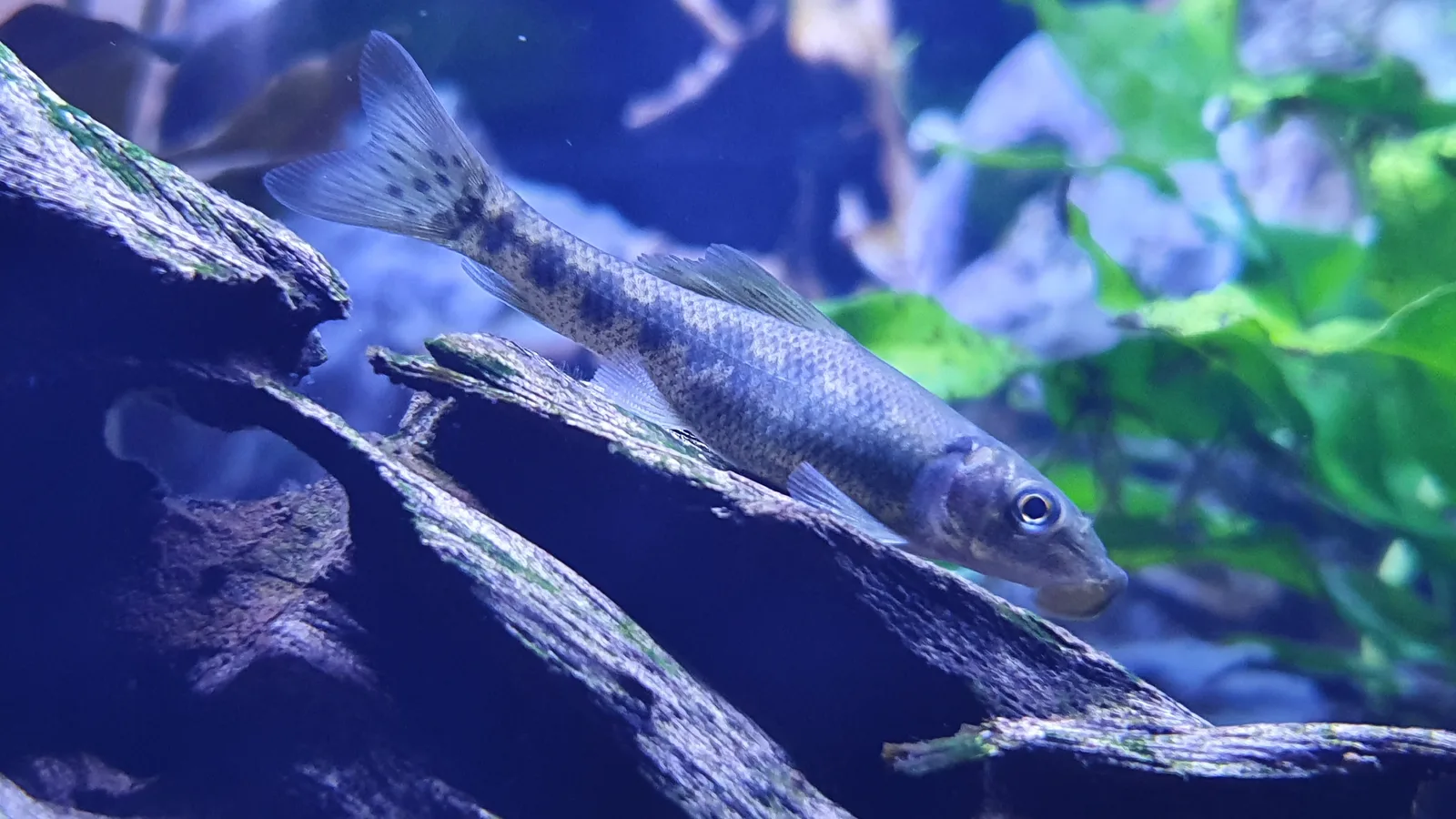
Identification: this is not the Siamese algae eater
Gyrinocheilus aymonieri (ITIS TSN 163888[1]), native to fast-flowing streams in Thailand, Vietnam, Cambodia and Laos[2], is genuinely useful and genuinely misunderstood in roughly equal measure. Most of the misunderstanding traces back to one specific point of confusion: it is a completely different species from the Siamese algae eater (Crossocheilus siamensis and related species), a smaller, more consistently peaceful fish widely regarded as the better community algae-control choice. The two are frequently mixed up in the trade — sold under overlapping names, displayed side by side, and genuinely difficult to distinguish as small juveniles — and pet shops have been documented selling Chinese algae eaters as Siamese algae eaters to buyers who specifically asked for the calmer species[4].
As adults, the differences become clear: Siamese algae eaters stay smaller (roughly 5–10 cm/2–4 in) with a slim, silver-grey body and a single dark horizontal stripe, and remain active algae grazers into adulthood. Chinese algae eaters grow larger (commonly 10–15 cm/4–6 in, occasionally more), have a more elongated body and a distinctive ventral sucker mouth used to grip surfaces while grazing, and — critically — undergo the diet and behaviour shift described below[4]. If you asked for "an algae eater" without a species name, there's a genuine chance you came home with this one by mistake. See our Siamese algae eater guide for a fuller identification checklist if you're not sure which one you actually have, or our Siamese algae eater vs Chinese algae eater comparison for the two species set directly side by side.
Water parameters that matter most
As a species from fast-flowing hill streams, water movement and oxygenation matter here more than for many community fish. Treat the figures below as a practical starting range, not a single scientific target.
| Factor | Commonly reported range | Notes |
|---|---|---|
| Temperature | Roughly 22–27°C (72–81°F) | A moderate tropical range; stability matters more than the exact figure. |
| pH | Roughly 6.0–8.0 | Reasonably adaptable within this range. |
| Dissolved oxygen / flow | Well-oxygenated, moderate to strong flow | Reflects its native fast-flowing stream habitat[3]. |
| Ammonia / nitrite | Zero | Same standard as any freshwater fish — see our ammonia and nitrite guides. |
Tank size and layout
Given its adult size and territorial adult behaviour, a considerably larger tank than its juvenile size suggests is genuinely necessary — specialist sources commonly recommend at least 40–75 US gallons (roughly 150–280 litres) for one adult kept long-term, well beyond what many buyers set up expecting a small "clean-up" fish. Rockwork, driftwood and open swimming space with good flow suit its native fast-water habitat; overcrowding a small tank with this species is specifically flagged by hobbyist sources as a driver of worse aggression, not just a general stocking issue.
Diet: juvenile vs adult behaviour
Does it eat algae? As a juvenile, yes, enthusiastically — this is the entire basis of its reputation and the reason it's sold so widely. Does that continue into adulthood? Only partially, and this is the single most important thing to understand before buying one. As it matures and its own nutritional needs shift toward more protein, algae intake alone typically becomes insufficient, and if it isn't offered enough protein-rich food, a meaningful proportion of adults are reported to begin attacking the sides of larger, slower, broad-bodied fish — angelfish, discus and goldfish are the most frequently mentioned targets — to feed on their body slime, sometimes attaching to a fish's flank with its sucker mouth to do so.
This isn't random meanness or a training failure. It's a documented, growth-linked dietary shift, and the practical response is straightforward: from a young age, supplement algae with sinking pellets, blanched vegetables and occasional protein (frozen or live foods), rather than waiting until slime-feeding behaviour has already started and trying to correct it afterward.
Tank mates and compatibility
This is the species' defining compatibility challenge, and it's worth being direct about it: adult Chinese algae eaters are widely described as semi-aggressive and increasingly territorial with age, and are specifically documented as intolerant of their own species — two housed together will typically fight, and even a single individual can become a problem for slow, broad-sided tankmates as described above. Fast-moving, non-slime-target-shaped fish (many active community species) are generally at much lower risk than deep-bodied, slow swimmers.
Compatibility here depends heavily on your specific stocking, not just this species' general temperament rating: a Chinese algae eater in a spacious tank of fast, robust fish with no obvious slime-feeding targets may cause little visible trouble, while the same fish in a tank with angelfish or discus is a genuinely poor combination regardless of tank size. If you already own this fish and are trying to work out whether your current tankmates are actually at risk, thinking through which of your fish are slow, broad-sided and similar in size to a full-grown adult is more useful than a generic compatibility chart. See our guide to choosing tank mates for that broader framework. AquaPulse's Water Check can help you confirm your water quality is stable while you plan any stocking changes.
Better alternatives for genuine algae control
If what you actually want is a peaceful fish that keeps eating algae throughout its life, several better-suited options exist and are worth researching directly rather than defaulting to whatever a shop labels "algae eater":
- True Siamese algae eater (Crossocheilus siamensis/langei) — smaller, consistently peaceful, and remains a reliable algae grazer into adulthood, though genuinely rarer in the trade than fish sold under that name.
- Amano shrimp — a peaceful invertebrate algae grazer with no comparable aggression risk; see our Amano shrimp care guide.
- Nerite snails — effective, peaceful algae grazers whose larvae can't survive in freshwater, avoiding both the aggression and population concerns some other "clean-up crew" animals carry.
None of these is a drop-in replacement in every respect — each has its own care needs — but all three avoid the specific problem this guide is about: an animal whose usefulness for the job you bought it for declines as it grows. Whichever grazer you choose, it works best alongside addressing lighting and nutrients directly — see our guide to algae in aquariums for the types of algae and how to bring each under control.
Water stability considerations
Avoid adding a Chinese algae eater to a tank that's still cycling or has recently shown a cycle disruption. Given the species' preference for well-oxygenated, flowing water, also check surface agitation and flow rate if you see breathing difficulty, rather than assuming water chemistry alone explains it — see "Warning signs" below.
Normal behaviour
- Near-constant grazing on hard surfaces via the ventral sucker mouth, especially as a juvenile — the core expected behaviour when young.
- Resting motionless, gripping décor or the glass with the sucker mouth — normal, not distress.
- Increasing territoriality with size and age, including chasing other bottom-dwellers away from a claimed area — an expected developmental change, not sudden ill temper.
- Attaching briefly to tankmates as it matures — worth monitoring closely rather than dismissing as harmless, since this is the early sign of the slime-feeding pattern described above.
- Strong preference for current and open swimming space — seeking out flow is normal, not a sign of restlessness.
Warning signs and what to check first
None of the signs below confirms a specific problem on its own. Each has more than one possible explanation, and reacting immediately before checking the more likely causes can make things worse.
Attaching to or repeatedly following a specific tankmate
What it might mean: The onset of slime-feeding behaviour, particularly toward a slow, broad-sided fish — a genuine welfare risk for the targeted fish.
What else could explain it: Brief, incidental contact while grazing algae from the same surface a fish happens to be near.
Check this first: Whether it's repeated and targeted rather than incidental, and what protein you're currently feeding.
Don't: Wait for visible injury to the targeted fish before increasing protein feeding or separating them.
A targeted fish developing patchy, damaged-looking skin or a stressed, faded colour
What it might mean: Repeated slime-feeding damage from a Chinese algae eater tankmate, which can also increase infection risk on the affected fish.
What else could explain it: A separate skin condition or parasite unrelated to the Chinese algae eater — see our white spots on fish guide and fish flashing guide for other causes.
Check this first: Whether attachment/following behaviour has actually been observed, alongside water quality.
Don't: Assume it's automatically a parasite without ruling out a tankmate behaviour cause first.
Gasping at the surface or rapid gill movement
What it might mean: Low dissolved oxygen, given this species' preference for well-oxygenated water, or ammonia/nitrite exposure.
What else could explain it: Insufficient current/surface agitation even when water chemistry tests clear.
Check this first: Ammonia, nitrite, temperature and current flow. See our fish gasping at the surface guide for the general picture.
Don't: Adjust only flow, or only chemistry, without checking both.
Two Chinese algae eaters fighting
What it might mean: Normal, expected intraspecific aggression — this species is widely documented as intolerant of its own kind.
What else could explain it: Little else; this is close to a certainty rather than one possibility among several.
Check this first: Whether you can safely rehome one rather than continuing to house them together.
Don't: Expect this to resolve on its own with a bigger tank alone — more space helps but doesn't reliably eliminate the aggression.
Common mistakes, and why people buy the wrong fish
- Buying it while asking for a "Siamese algae eater", without confirming the actual species — see "Identification" above.
- Choosing it purely because a shop's generic "algae eater" tank had one in it, without researching what the specific species becomes as an adult.
- Keeping it with angelfish, discus, goldfish or other slow, broad-sided fish, the group most frequently targeted for slime-feeding.
- Feeding algae only, rather than proactively adding protein from a young age.
- Keeping two or more together, inviting near-certain intraspecific conflict.
- Underestimating the adult tank size it actually needs, based on how small it looks at purchase.
What the aquarium cannot compensate for
- A larger tank reduces but doesn't reliably eliminate aggression between two Chinese algae eaters housed together.
- Good water quality cannot prevent slime-feeding behaviour if protein intake remains insufficient as the fish matures.
- No amount of space substitutes for simply not housing this species with slow, broad-sided fish it's known to target.
- Choosing this species cannot be corrected by better care alone if what you actually wanted was a small, consistently peaceful algae grazer — see "Better alternatives" above.
When specialist help may be appropriate
Aquatic veterinary expertise specific to ornamental fish is less widely available than for common pets, but a knowledgeable specialist retailer or aquatic-health specialist can sometimes help with a genuinely puzzling case, particularly repeated injury to a targeted tankmate.
Frequently asked questions
Is a Chinese algae eater the same as a Siamese algae eater?
No — they're different species that are frequently confused and mixed up in the trade. Siamese algae eaters (Crossocheilus siamensis/langei) stay smaller, remain peaceful, and keep eating algae into adulthood. Chinese algae eaters (Gyrinocheilus aymonieri) grow larger, become territorial, and shift away from an algae-only diet as they mature.
Does a Chinese algae eater eat algae as an adult?
Only partially. As a juvenile it eats algae enthusiastically, but as it matures its nutritional needs shift toward more protein, and algae alone typically becomes insufficient. Without added protein from a young age, a meaningful proportion of adults are reported to begin feeding on the body slime of slower, broad-sided tankmates instead.
What temperature do Chinese algae eaters need?
Roughly 22–27°C (72–81°F), a moderate tropical range gathered from multiple specialist hobbyist sources. Stability matters more than hitting an exact figure, and given this species' native fast-flowing stream habitat, well-oxygenated water with moderate to strong flow matters as much as temperature.
Can you keep two Chinese algae eaters together?
Not reliably. This species is widely documented as intolerant of its own kind, and two housed together will typically fight. A larger tank reduces but doesn't eliminate this — it isn't a stocking-density problem that more space alone resolves.
What's a better alternative for genuine algae control?
A true Siamese algae eater, Amano shrimp or a Nerite snail are all better suited to peaceful, long-term algae control, since none carries this species' growth-linked aggression and slime-feeding risk. Each has its own care needs, so it's worth researching the specific replacement rather than defaulting to whatever a shop labels "algae eater."
Sources and uncertainty
- Published
- 26 July 2026
- Last reviewed
- 11 August 2026
- Written and maintained by
- AquaPulse (Valeon Labs Ltd)
This guide draws on a taxonomic reference database, a U.S. federal non-indigenous species profile, a specialist hobbyist reference source, and multiple independent hobbyist accounts of the slime-feeding and identification-confusion issues discussed throughout, since we found no dedicated peer-reviewed behavioural study of adult dietary shift in this species. Where a claim reflects widely repeated hobbyist observation rather than a controlled study, we've treated it as well-supported anecdotal consensus, not as settled science. We'll update this page if we find something we've got wrong.
Good to know: This guide provides general informational guidance only. It is not a substitute for specialist aquatic-health advice.
- [1] Integrated Taxonomic Information System (ITIS) — "Gyrinocheilus aymonieri" (TSN 163888) Used as the taxonomic authority for species name and classification.
- [2] U.S. Geological Survey, Nonindigenous Aquatic Species — "Chinese algae-eater (Gyrinocheilus aymonieri)" Species Profile Used for native range and general species biology.
- [3] Seriously Fish — "Gyrinocheilus aymonieri (Sucking 'Loach')" Specialist hobbyist reference source. Used for native habitat description, tank size, and diet/behaviour guidance. Not a peer-reviewed source.
- [4] Fishlore — "Identifying the Siamese Algae Eater" Specialist hobbyist source, used for the documented pattern of Chinese algae eaters being sold as Siamese algae eaters, and the visual differences between the species.
What we deliberately left out: a precise age or size threshold at which slime-feeding behaviour reliably begins, since sources describe a general growth-linked pattern (commonly around 10–13 cm) rather than a fixed, confirmed figure; and a specific percentage of adults that go on to show this behaviour, since we found consistent qualitative reporting but no controlled study quantifying it.