Knowledge Centre · Species guidance
Betta fish care: surviving a bowl isn't thriving
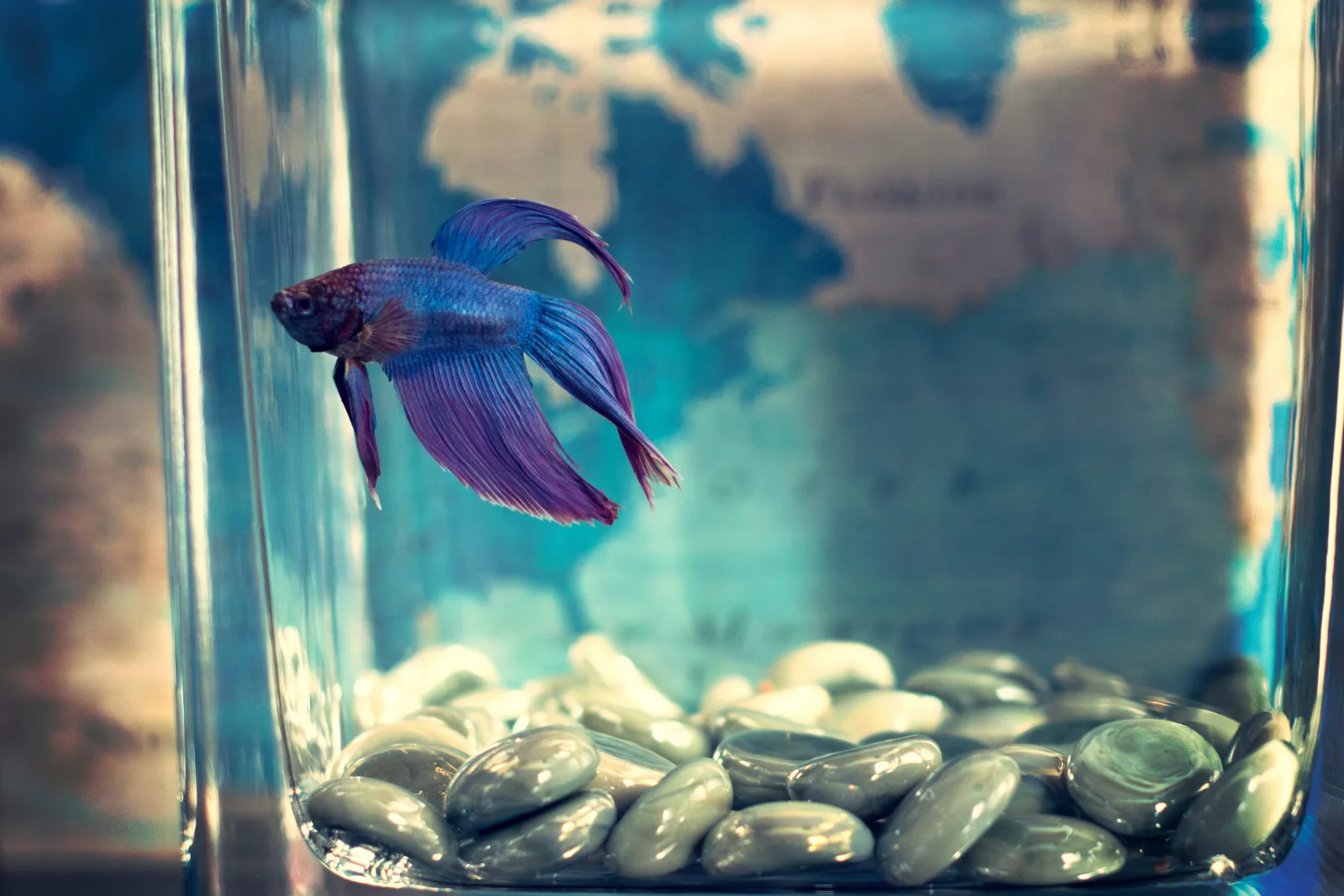
A betta can survive in a bowl. Its labyrinth organ lets it gulp air at the surface and tolerate water with almost no dissolved oxygen, which is exactly why bowls, vases and unheated tanks get marketed as acceptable homes for it. That tolerance says nothing about ammonia, nitrite, temperature or space. Two peer-reviewed studies on this species found bettas swam less, and showed more resting and abnormal behaviour, in small, bare containers than in larger, furnished ones. Surviving a bowl and doing well in one turn out to be different claims: only the first is true.
Before adding a betta
May be suitable when…
You can provide a heated, filtered tank of around 19–20 litres (5 US gallons) or more, furnished with plants and hiding spots, with gentle rather than strong water flow, kept as a single betta rather than alongside another male.
Reconsider when…
You're planning a bowl, vase or other small, unheated, unfiltered container, or housing it with another male betta, fin-nipping species, or very fast, boisterous tankmates without enough space to establish its own territory.
Worth knowing: the labyrinth organ that lets a betta breathe air at the surface has nothing to do with whether its water quality, temperature or space are actually adequate.
Identification and naming caveats
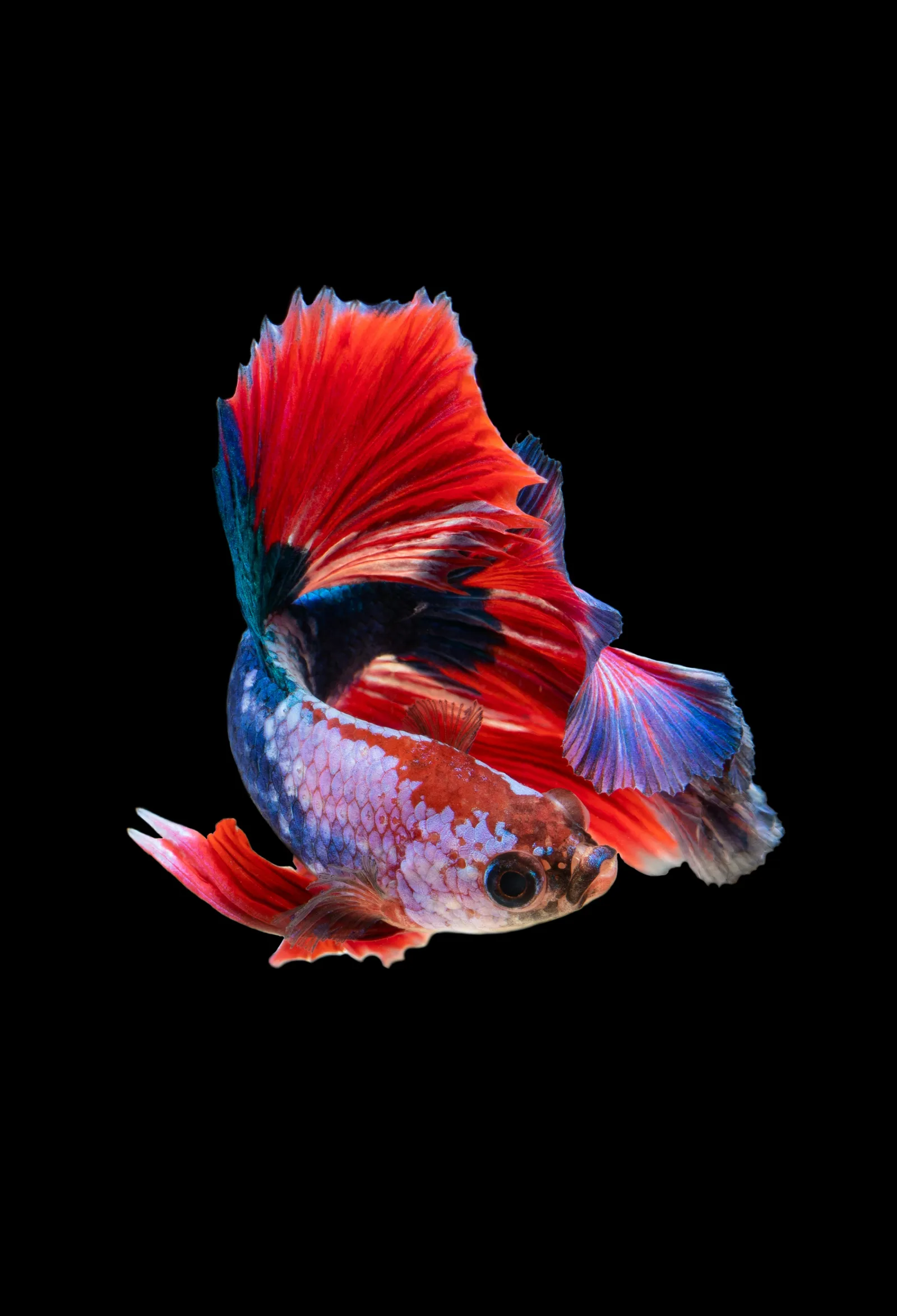
Betta splendens Regan, 1910 is a member of family Osphronemidae, within suborder Anabantoidei — the labyrinth fishes[1]. Almost every betta sold in the aquarium trade is a domestic ornamental strain, the product of long-term selective breeding for finnage, colour and, historically, fighting ability, rather than a wild-type animal. Wild-caught B. splendens looks noticeably different: slimmer-bodied, shorter-finned and more subdued in colour than the long-finned, brightly coloured strains typically sold as pets[2].
The common name "Siamese fighting fish" reflects a long history of selective breeding in Thailand (historically Siam) for enhanced male-on-male aggression, used in organised contests[2]. That history is real, but treat specific dates or founder anecdotes you see repeated online with some caution — we couldn't independently verify the precise historical details behind most of the popular retellings, so we've kept this section to what's well-established rather than repeating unverified specifics.
"Labyrinth organ" refers to a folded, highly vascularised structure in the suprabranchial cavity, derived from the gill arch, that lets the fish gulp atmospheric air at the surface and extract oxygen from it directly[3]. B. splendens can use its gills or its labyrinth organ, so it isn't dependent on air-gulping the way some other labyrinth fish are — but it will use the surface adaptation whenever dissolved oxygen is low, which is precisely what makes it possible to sell and keep this fish in conditions that would suffocate most other tropical fish. That tolerance is a survival adaptation, not evidence that those conditions are good for it (see "What the aquarium cannot compensate for" below).
The aquarium conditions that matter most
Wild B. splendens populations are native to the Chao Phraya river basin of central Thailand, extending into parts of Cambodia and Vietnam. They inhabit still or slow-moving, often densely vegetated water: rice paddies, roadside ditches, swamps and slow streams, sometimes low in dissolved oxygen[4]. That connects directly to the low-oxygen tolerance discussed above, but it describes shallow, vegetated, areally extensive wetland habitat, not a small, static, isolated container. Nothing in the sources we reviewed supports treating "puddle" habitat as equivalent to a bowl.
| Factor | Commonly reported range | Notes |
|---|---|---|
| Temperature | Roughly 24–28°C (76–82°F) | A true tropical range: see "Tank size, furnishing and why they measurably help" below for why an unheated room usually isn't warm enough. |
| pH | Roughly 6.0–8.0 | Consistency matters more than hitting an exact figure. |
| General hardness | Soft to moderately hard | One peer-reviewed study found water hardness affects reproductive outcomes specifically, not just general comfort[5]. |
| Ammonia / nitrite | Zero | Same standard as any freshwater fish — see our ammonia and nitrite guides. |
| Nitrate | Kept low | No betta-specific numeric ceiling in the sources we reviewed was well-supported enough to repeat here — see our nitrate guide for general guidance. |
Tank size, furnishing and why they measurably help
Tank-size advice for bettas varies more than it should, and it's worth being upfront about that disagreement rather than presenting one figure as settled. Animal-welfare organisations have published different minimums depending on the branch: recommendations we found ranged from around 10 litres as an absolute floor up to 20 litres or more as an ideal[6]. Specialist hobbyist and retail sources vary further still.
More useful than any single organisation's number: two independent, peer-reviewed behavioural studies published in the welfare-science journal Animal Welfare in 2024 tested this question directly on this species, and both point the same way. One compared containers from a 0.5-litre bowl up to a 208-litre aquarium and found bettas swam significantly less in the bowl than in any larger container, with environmental enrichment (gravel, rocks, live plants) increasing swimming further[7]. The other compared tanks from 1.5 litres up to 19.3 litres, furnished and unfurnished, and found fish were significantly more active and showed less resting and abnormal, repetitive behaviour in the larger, furnished tank. Notably, furnishing mattered on its own: a large but bare tank still produced more abnormal behaviour than a smaller, furnished one[8].
Taken together, that's a reasonably consistent, evidence-based picture. Aim for roughly 19–20 litres (5 US gallons) or more (a figure that happens to match commonly cited hobbyist practice as well as the better-performing conditions in both studies), furnished with plants, decor and hiding spots, rather than treating either size or furnishing alone as sufficient. A bare tank of the right volume is a real improvement over a bowl, but it isn't the same as a properly furnished one.
Filtration is generally recommended for water-quality control, but see "Water stability considerations" below for why flow rate specifically needs care with this species.
Feeding behaviour and diet
Wild bettas are carnivorous, taking mosquito larvae, small insects, insect eggs and tiny crustaceans rather than grazing on plant matter or algae. A quality commercial betta pellet, particularly one built around insect-based protein, is a reasonable approximation of that natural diet; a varied diet that occasionally includes appropriately sized live or frozen foods (such as daphnia or brine shrimp) is commonly recommended alongside pellets, though we found no single authoritative source specifying an exact required ratio.
Overfeeding is a genuine, well-recognised risk with this species, and it connects directly to buoyancy problems: a swollen gut can press on the swim bladder and affect a fish's ability to control its position in the water, and dry pellets that expand after swallowing can make this worse. Feeding a small amount once or twice daily, rather than as much as the fish will accept, is the more cautious approach. Some hobbyist sources also recommend an occasional fasting day and feeding softer foods like daphnia if bloating occurs — we'd flag that as common hobbyist practice rather than a clinically validated treatment, since we didn't find veterinary research specifically supporting it. See our swim bladder disorder guide for more on recognising and responding to buoyancy problems generally.
Social and compatibility considerations
Male-male aggression in this species is well-documented: two male bettas housed together will typically fight, sometimes seriously, and shouldn't be kept in the same tank[3]. It's worth correcting a common assumption here too. Females aren't automatically peaceful by default. A peer-reviewed study found that selective breeding for winning male fighters has also correlated with heightened aggression in females of the same lines[9], so "it's a female, so it'll be fine with others" isn't a safe assumption on its own.
Groups of females kept together (sometimes called a "sorority") are described across hobbyist sources as sometimes viable in a large, densely planted tank with several fish and close monitoring for a bullied or dominant individual. This isn't guaranteed to work, and can require removing an individual fish if it doesn't settle; we treat it as hobbyist consensus rather than a welfare-research-backed recommendation. One of the studies cited above also found that even a large aquarium doesn't guarantee peaceful cohabitation between two males, reducing but not eliminating aggressive displays[8] — a useful caution against assuming "just use a bigger tank" solves compatibility on its own.
General tankmate compatibility varies considerably by individual fish temperament, not just species, so treat any "safe tankmate" list you see elsewhere as a starting point to research further, not a guarantee. Bright, long-finned or very active tankmates are commonly reported as higher-risk choices. See our guide to choosing tank mates for a broader framework on working through a stocking decision like this one.
Water stability considerations
Native habitat for this species is described as low-flow[4], and behavioural research using water current as a deliberate aversive stimulus has found bettas will reliably work to escape or avoid it[10] — solid evidence that strong flow is something this species actively avoids, alongside the widely reported concern that long, heavy fins make sustained swimming against a current tiring and can contribute to fin damage over time. A gentle-flow or adjustable filter, or a sponge filter, is commonly recommended over a filter designed for a much more active, open-water species.
Avoid adding a betta to a tank that's still cycling or has recently shown signs of a cycle disruption. Sudden ammonia or nitrite exposure is a welfare risk for any fish, and tolerance of low dissolved oxygen doesn't extend to tolerance of ammonia or nitrite — those are separate water-quality problems the labyrinth organ does nothing to offset.
Normal behaviour
- Regular trips to the surface to gulp air: normal labyrinth-organ breathing, not distress, though it's worth confirming water quality first rather than assuming this alone proves it (see our fish gasping at the surface guide for how to tell the difference in fish without this adaptation).
- Flaring gill covers and spreading fins at a reflection, another betta, or sometimes even at unrelated movement: a normal territorial/investigative display, not automatically a sign of injury or illness, though prolonged or very frequent flaring at its own reflection is worth reducing by limiting mirror-like surfaces.
- Building a bubble nest at the surface (more common in males), generally taken as a sign of a settled, content fish rather than a problem.
- Periods of stillness, including resting on a leaf, decor, or near the substrate: normal for this species and not automatically a sign of illness, particularly if the fish responds normally when approached or fed.
- Colour that looks duller during stress, illness or after a change, and brighter once settled, is a useful general indicator, though not a substitute for checking water quality directly.
Warning signs and what to check first
None of the signs below confirms a specific problem on its own. Each has more than one possible explanation, and reacting immediately — especially by adding a product or a large water change — before checking the more likely causes can make things worse.
Ragged, shortening or discoloured fin edges
What it might mean: Fin rot, an opportunistic bacterial or fungal infection that typically takes hold on already-stressed or damaged fin tissue, strongly associated with poor water quality[11].
What else could explain it: Physical damage from decor, aggressive tankmates, or fin-nipping during flaring at a reflection.
Check this first: Ammonia, nitrite and nitrate immediately, water flow strength, and whether the damage is spreading or stable.
Don't: Assume low oxygen tolerance means water quality is fine — fin rot tracks with ammonia, nitrite and general water quality, not dissolved oxygen.
Swollen belly or difficulty controlling buoyancy
What it might mean: Overfeeding-related bloat affecting the swim bladder, or, less commonly, a more serious underlying condition.
What else could explain it: Normal fullness shortly after a large meal.
Check this first: Recent feeding amount and frequency, and whether the fish is otherwise eating and behaving normally. See our swim bladder disorder guide for more detail.
Don't: Keep feeding normally while waiting to see if it resolves — reduce feeding while you assess.
Clamped fins held close to the body
What it might mean: A recognised general stress indicator, often linked to water quality or temperature.
What else could explain it: Recent transport, a new tank, or a recent water change.
Check this first: Ammonia, nitrite, and current temperature against the target range above. See our clamped fins guide for the general picture across species.
Don't: Wait several days before testing water if this appears suddenly.
Not eating, or ignoring food it previously accepted
What it might mean: Stress, water-quality problems, or, if brief, sometimes simply normal appetite variation.
What else could explain it: Recent overfeeding, a diet change, or a temperature outside its normal range.
Check this first: How many feeds have actually been refused (not just one), water parameters, and temperature. See our fish not eating guide for more.
Don't: Immediately switch foods repeatedly — check the environment first.
Excessive gasping or gathering at the surface
What it might mean: For most fish this is a clear warning sign, but bettas gulp air normally. A genuine change from its own established pattern — markedly more frequent trips, or obvious distress rather than routine air-gulping — is what's actually worth checking.
What else could explain it: Low dissolved oxygen affecting other, non-labyrinth tankmates even if the betta itself seems unaffected.
Check this first: Ammonia and nitrite, and whether any tankmates are showing distress too. See our fish gasping at the surface guide.
Don't: Dismiss a genuine change in frequency just because occasional air-gulping is normal for this species.
Pale or faded colour that doesn't return
What it might mean: Ongoing stress or illness, if it persists beyond a short adjustment period.
What else could explain it: Temporary stress-related dulling after a water change, a new tank, or handling.
Check this first: Whether colour returns within a day or two once conditions are stable, and general water quality.
Don't: Treat brief post-change dulling as an emergency — give it a little time before reacting.
Common husbandry mistakes
- Keeping a betta in a bowl, vase or other small, unheated, unfiltered container, relying on its air-breathing adaptation to excuse conditions that peer-reviewed research links to measurably worse welfare.
- Assuming it doesn't need a heater because it can survive cooler water: most homes run cooler than this tropical species actually needs.
- Using a filter with strong output not suited to a slow, heavily finned swimmer.
- Housing two males together, or assuming a female will automatically tolerate tankmates without individual monitoring.
- Overfeeding, particularly with dry pellets that expand after swallowing.
- Reading every flare or still period as illness, rather than checking against its own established pattern first.
What the aquarium cannot compensate for
- A heater cannot fix incompatibility between two aggressive tankmates housed together — that's a stocking decision, not a water-parameter one.
- A larger tank reduces but doesn't guarantee peaceful cohabitation between two males — that's a documented research finding, not just caution[8].
- The labyrinth organ's tolerance of low dissolved oxygen does nothing to offset ammonia, nitrite, or unstable temperature.
- Filtration alone cannot compensate for a feeding routine that's causing recurring bloat or buoyancy problems.
When specialist help may be appropriate
Aquatic veterinary expertise specific to ornamental fish is less widely available than for common pets, but it exists, and a knowledgeable specialist retailer or aquatic-health specialist can sometimes help with a puzzling case.
Frequently asked questions
Can a betta really live in a bowl?
It can survive there — the labyrinth organ lets it breathe atmospheric air, which is exactly why bowls get marketed as acceptable. But two peer-reviewed 2024 studies found bettas were significantly less active and showed more resting and abnormal, repetitive behaviour in small, bare containers than in larger, furnished ones, with a large but bare tank still producing more abnormal behaviour than a smaller, furnished one. Tolerating a bowl and doing well in one are different claims, and only the first is actually true.
Does a betta need a heater and filter?
Yes to both, even though it can survive without them. This is a genuinely tropical species — most homes run cooler than its roughly 24–28°C range — and a heater is needed to reach that reliably. A filter helps with water quality, though it should be a gentle-flow or adjustable one, or a sponge filter, since bettas are shown to actively avoid strong current and it can tire and damage their long fins over time.
Can two female bettas live together?
Sometimes, in a large, densely planted tank with several fish and close monitoring, but it isn't guaranteed to work, and a bullied or dominant individual may need removing. It's also worth knowing that females aren't automatically peaceful by default — one peer-reviewed study found selective breeding for winning male fighters has also correlated with heightened aggression in females of the same lines. Two males housed together should be avoided; they'll typically fight, sometimes seriously.
How big a tank does a betta actually need?
Recommendations vary — animal-welfare organisations have published minimums from around 10 litres up to 20 litres or more, and hobbyist sources vary further. Two independent, peer-reviewed 2024 studies point toward roughly 19–20 litres (5 US gallons) or more, furnished with plants, decor and hiding spots, as the better-supported target — size and furnishing both mattered independently in the research, so neither alone is enough on its own.
Is flaring or resting on the substrate a sign something's wrong?
Not on its own. Flaring gill covers and spreading fins at a reflection or another betta is a normal territorial display, and periods of stillness — including resting on a leaf or near the substrate — are normal for this species, particularly if it responds normally when approached or fed. Prolonged, very frequent flaring at its own reflection is worth reducing by limiting mirror-like surfaces, but neither behaviour alone confirms illness.
Confirming the tank is actually settled before adding a betta
This guide's most repeated point is that a betta shouldn't go into a tank that's still cycling or has recently had a cycle disruption — and the only way to know that for certain is a real ammonia and nitrite reading of zero, not an assumption based on how long the tank's been running. AquaPulse's Water Check can hold each test result alongside the last, so you're checking your own tank's actual numbers rather than a rule of thumb before adding a fish this sensitive to water quality.
Water Check works from the readings you enter — it doesn't take automatic readings, and it isn't a species database or a substitute for testing your water with a reliable kit. For the plain-language explainer without the app, see the Water Check feature page.
Sources and uncertainty
- Published
- 26 July 2026
- Last reviewed
- 6 August 2026
- Written and maintained by
- AquaPulse (Valeon Labs Ltd)
This guide draws on taxonomic reference databases, a US federal habitat-risk assessment, peer-reviewed behavioural welfare research and a veterinary reference source, alongside general hobbyist and retail consensus for day-to-day practicalities where no stronger source was available. For the peer-reviewed welfare studies specifically, we worked from published abstracts and database records rather than the full paywalled text. We came across a couple of numeric claims during research that we chose not to repeat: a specific ammonia/nitrite toxicity figure and a lower tank-size minimum from a specialist association, because we couldn't verify either to our own satisfaction. See "Claims we could not verify" below. We'll update this page if we find something we've got wrong.
Good to know: This guide provides general informational guidance only. It is not a veterinary service and does not replace specialist or aquatic health advice for serious livestock health issues.
- [1] Integrated Taxonomic Information System (ITIS) — "Betta splendens Regan, 1910" (TSN 172611) Used as the taxonomic authority for species name, author citation and family/order placement.
- [2] Seriously Fish — "Betta splendens" Specialist hobbyist reference source. Used for the distinction between wild-type and domestic ornamental strains, and general common-name history. Not a peer-reviewed source.
- [3] Ravi, P. & Jiang, J. et al., "Life in a bubble: the role of the labyrinth organ in determining territory, mating and aggressive behaviours in anabantoids," Journal of Fish Biology (via PubMed) Used for labyrinth-organ anatomy and function, and its link to territorial behaviour. Accessed via abstract/database record, not full text.
- [4] US Fish & Wildlife Service — "Ecological Risk Screening Summary: Siamese Fighting Fish (Betta splendens)" Used for native range (Chao Phraya basin, central Thailand) and wild-habitat description (still/slow-moving, vegetated, sometimes low-oxygen water).
- [5] "Water hardness influenced variations in reproductive potential of two freshwater fish species; Poecilia reticulata and Betta splendens" (PMC) Peer-reviewed study, used specifically for the effect of water hardness on reproduction. Accessed via abstract/database record, not full text.
- [6] RSPCA Australia Knowledgebase — "How should I care for my Siamese fighting fish?" Animal-welfare organisation source, used for institutional tank-size guidance. Different RSPCA branches publish different minimums; we've represented that as a range rather than a single figure.
- [7] Oldfield, R.G. & Murphy, K. (2024), "Life in a fishbowl: Space and environmental enrichment affect behaviour of Betta splendens," Animal Welfare (via PubMed) Peer-reviewed welfare study comparing a 0.5-litre bowl with 10, 38 and 208-litre aquaria. Accessed via abstract/database record, not full text.
- [8] Clark-Shen, N. et al. (2024/2025), "Life beyond a jar: Effects of tank size and furnishings on the behaviour and welfare of Siamese fighting fish (Betta splendens)," Animal Welfare (via PubMed) Peer-reviewed welfare study comparing tanks from 1.5 to 19.3 litres, furnished and unfurnished, including the finding that a large but bare tank still produced more abnormal behaviour than a smaller furnished one, and that even a large tank doesn't guarantee peaceful two-male cohabitation. Accessed via abstract/database record, not full text.
- [9] "Artificial selection for male winners in the Siamese fighting fish Betta splendens correlates with high female aggression," Frontiers in Zoology Peer-reviewed study, used for female aggression correlating with selective breeding for male fighting ability. Accessed via abstract/database record, not full text.
- [10] Hurtado-Parrado, C. et al., "'Swimming against the current': Behavioral data of Betta splendens during an escape and avoidance task with water flows as the aversive stimulus" (PMC) Peer-reviewed behavioural study, used as evidence that bettas find water current aversive and will work to avoid it. Accessed via abstract/database record, not full text. Not a direct study of fin damage from flow specifically.
- [11] Merck Veterinary Manual — "Bacterial Diseases of Fish" Used for fin rot as an opportunistic bacterial/fungal condition linked to poor water quality and stress.
Claims we could not verify: a specific ammonia/nitrite toxicity (LC50) figure we found attributed to a toxicology paper, because the units and magnitude reported to us looked implausible and we couldn't verify them against the source directly; a lower tank-size minimum (around 5 litres) attributed to a specialist hobbyist association, because we couldn't verify it independently and it sits well below every other source we found; specific historical dates or founder anecdotes about the origins of betta fighting in Thailand; and a precise required ratio of pellets to live/frozen food, since no source we reviewed gave one we'd consider well-supported enough to repeat as a rule.