Knowledge Centre · Stocking and planning
Best beginner fish for a first aquarium
"Beginner-friendly" gets printed on a huge range of livestock labels, and it isn't usually a lie exactly — it's an incomplete claim. Across the species guides we've researched for this site, a consistent pattern shows up: a fish genuinely can be hardy in the ways that matter for a first tank, while still having one specific thing that catches new keepers out, from a hidden population explosion to a temperament quirk to needing a tank that's been running for months rather than weeks. This guide sorts species we've researched into three honest tiers — genuinely solid first-tank choices, easy fish that need one thing planned for, and species marketed as beginner-friendly that specialist sources say are better suited to some experience first — so you can buy on evidence rather than a shop label.
At a glance
What "beginner-friendly" should mean
Genuine tolerance of a new tank's water-parameter swings, forgiveness of an occasional missed water change, and a temperament that doesn't need to be got exactly right from day one — not just a label on a tank.
Why it matters
Across this site's own species research, buying on a "beginner-friendly" or "easy" label alone, without checking the one specific thing it glosses over, is one of the most common and avoidable causes of an early stocking mistake.
Sensible starting point
Favour genuinely tolerant species for a brand new tank, plan for the one catch each "easy" species has, and hold off on species that specialist sources say need a mature tank until yours has been running successfully for a while.
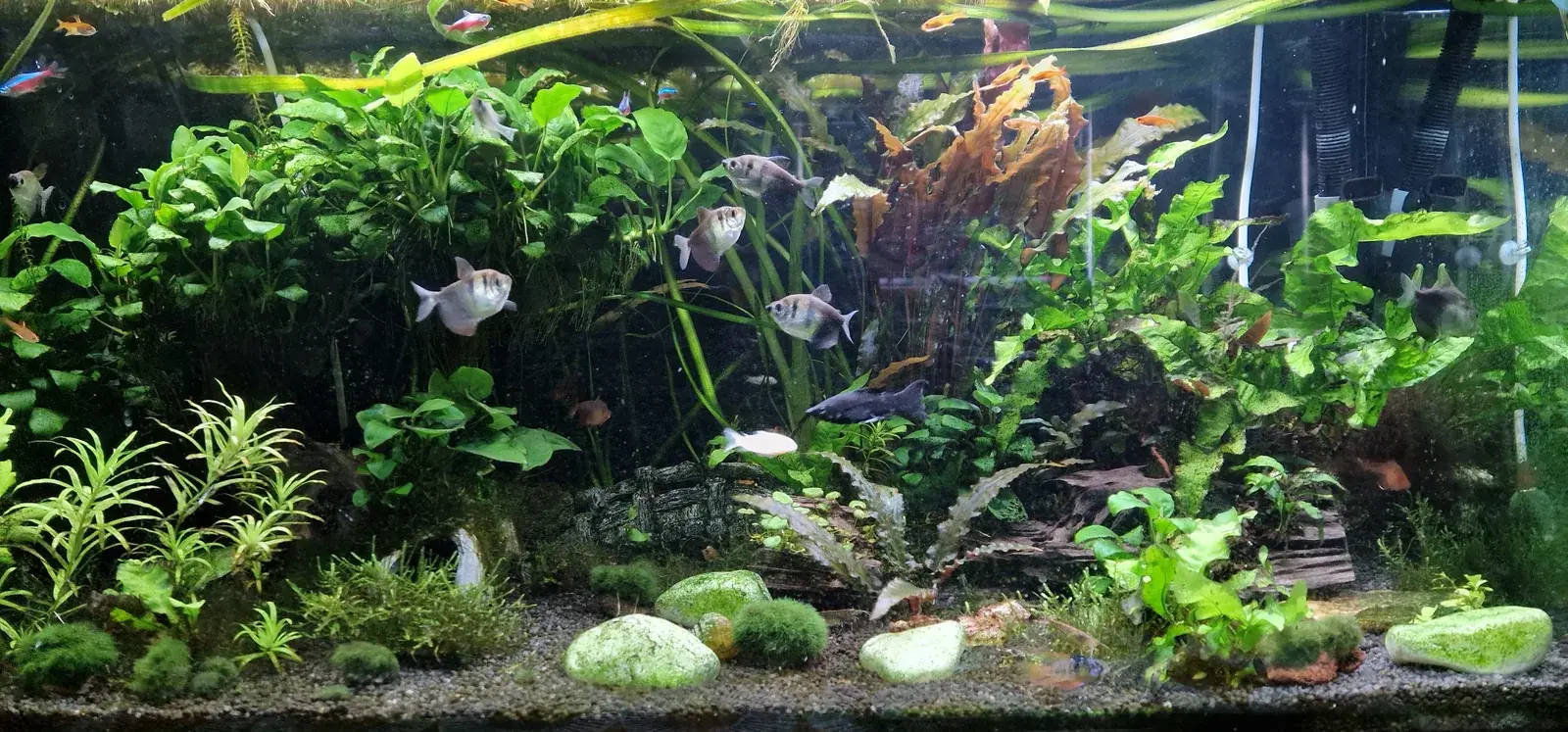
What "easy" actually means
"Beginner-friendly" is doing several different jobs on a shop label, and they don't all mean the same thing. Sometimes it genuinely means tolerant of imperfect water and forgiving of an early mistake. Sometimes it means hardy in that sense but with a completely separate catch — a breeding population you weren't expecting, a social structure that turns aggressive in the wrong numbers, or supplemental feeding a species needs once it's finished the job it was bought for. And sometimes it's simply optimistic: a species that survives beginner conditions without doing well in them, or one that specialist sources consistently say needs a stable, mature tank a genuine first-timer's setup can't yet provide.
None of this means "beginner-friendly" fish should be avoided. It means the label alone isn't enough information to buy on, and the species below are grouped by what we've actually found researching each one individually, not by reputation.
Genuinely solid first-tank choices
These species are hardy in the ways that matter for a new tank's inevitable early instability, and forgiving of the kind of mistake most new keepers make at least once. Each still has one specific thing worth planning for — none of these are "add and forget" — but none of them require a mature tank or a level of experience a genuine first-timer doesn't have.
Corydoras catfish
A hardy, genuinely social shoaling catfish that does well in a proper group. The one real catch: their barbels are soft, sensitive feelers that sharp or dirty substrate can damage in a way that doesn't reliably grow back, so substrate choice matters more than most in-store advice suggests. See our corydoras catfish care guide.
Cherry shrimp
Tolerant, low-bioload and straightforward, but genuinely prolific breeders in an ordinary freshwater tank — a growing population is the normal outcome of keeping them well, not a warning sign, and different colour strains will interbreed if kept together. See our cherry shrimp care guide.
Mystery snail
A calm, genuinely easy-to-keep grazer for most community planted tanks, provided you get shell health, diet and a secured lid right — mystery snails are notorious for climbing out of an uncovered tank. See our mystery snail care guide.
Swordtail and platy
Hardy, tolerant livebearers with essentially identical care needs. The catch is stocking ratio: males pursue females persistently, so too few females relative to males means that attention never lets up, and an ongoing population of fry is the normal result of keeping both sexes together. See our swordtail and platy care guide.
Bristlenose pleco
Tolerant water parameters, straightforward breeding and genuinely useful algae grazing. The catch isn't the fish itself but the shop tank: "pleco" can also mean a common pleco capable of outgrowing almost any home aquarium, sometimes sold alongside identical-looking bristlenose juveniles, so correct identification at the point of sale matters. See our bristlenose pleco care guide.
Easy fish that need one specific thing planned for
These species are genuinely tolerant of a new tank's water chemistry, but each has a real temperament, social or logistical catch that's easy to miss if you only read the "easy" part of the label.
Betta
Tolerates a wide range of conditions, which is exactly what the "needs no heater or filter" marketing leans on — but tolerating conditions and doing well in them are different claims, and research points to measurably better behaviour in a properly heated, filtered and furnished tank than a bare, minimal one. See our betta fish care guide.
Three spot gourami
Hardy in terms of water tolerance, but adult males are consistently documented as territorial, particularly toward other males. A single male, optionally with one or two females, is a more reliably peaceful arrangement than a multi-male group. See our three spot gourami care guide.
Kuhli loach
An easy, peaceful bottom-dweller, but a lot of "kuhli loaches just hide forever" reports trace back to too few individuals or too little cover, not the species itself being unsuitable. A well-settled group with proper cover becomes noticeably bolder over time. See our kuhli loach care guide.
Amano shrimp
Tolerant water parameters and no accidental breeding population, since their larvae need brackish-to-marine water to survive. The catch: an established tank only carries a finite amount of algae, and once it's grazed down, amano shrimp need supplemental feeding or they'll slowly decline. See our amano shrimp care guide.
Peacock gudgeon
A generally easy, attractive small fish, but males can show real territorial behaviour around a cave, particularly toward each other. More than one hiding spot spreads that pressure out rather than concentrating it on one fish. See our peacock gudgeon care guide.
Marketed as beginner-friendly, better suited to some experience
These species are commonly sold or described as easy, but specialist sources for each one point to a stability, water-chemistry or husbandry requirement that a genuine first tank — still cycling, still settling, still being learned on — doesn't reliably provide yet. None of this means they're impossible for a new keeper; it means they're a better second or third fish than a first one, once you have a mature, stable tank and some experience reading it.
| Species | What the label undersells |
|---|---|
| German blue ram | Wild-type specimens genuinely need soft, warm, stable acidic water; specialist sources describe them as suited mainly to experienced keepers despite a calm, "beginner-friendly" temperament label. |
| Celestial pearl danio | Commonly sold as an easy beginner fish, but specialist sources describe it as considerably more sensitive to unstable, fluctuating conditions than that label implies, doing better in a mature tank than a newly cycled one. |
| Blueberry snail | Typically wild-collected rather than captive-bred, with genuinely unsettled husbandry consensus, and depends on a mature, established tank rather than tolerating a new one. |
| Freshwater angelfish | Juvenile size and temperament say very little about the large, territorial cichlid it becomes as an adult — a common source of stocking mistakes made months later. |
| Mbuna cichlid | A small, calm-looking group in a shop tank isn't a preview of home behaviour — too few individuals is a documented aggression risk that needs specific group-size knowledge to avoid. |
| Hillstream loach | Needs specific flow and cooler temperatures most community setups don't provide by default; can persist for a while in the wrong conditions before problems become obvious. |
| African butterflyfish | A surface-ambush predator that needs specific tank shape, cover and a secure lid — not a typical "peaceful community" setup despite a mild-mannered appearance. |
| Panda garra | Peaceful toward other species but territorial with its own kind — the wrong group size is a documented, avoidable source of stress or injury. |
| Chinese algae eater | Bought almost universally as a beginner "clean-up crew" fish, but becomes genuinely aggressive as it grows — a well-documented, growth-linked change most buyers are never told about. |
| Clown killifish | Small tank size is often assumed to mean low-maintenance, but a small volume of water is less forgiving of ammonia and nitrite spikes than a large one, not more. |
| Vampire shrimp | Needs specific flow and a genuine feeding plan; can look healthy for a while in the wrong setup before the effects of inadequate feeding become visible. |
| Rubber lip pleco | Sold under one name covering several similar species with slightly different needs, plus specific flow and grazing requirements more specialist than the "easy pleco" label implies. |
Four of the species above — hillstream loach, panda garra, Chinese algae eater and rubber lip pleco — are commonly bought specifically for algae control. See our algae-eating fish and snails comparison if that's what you're actually shopping for; it covers these four alongside bristlenose pleco and mystery snail, matched to what your tank's current and temperature actually provide.
How to evaluate any "beginner" label yourself
You don't need to memorise every species on this page. A short, repeatable check catches most of the mismatches above before you buy:
- Look up adult size, not shop size. A juvenile rarely looks like the animal it becomes.
- Check whether it's a shoaling or social species. Many "easy" fish specifically need a proper group, not a pair, to behave normally.
- Check whether males of the species tolerate each other. Several popular "peaceful" species have a well-documented same-sex aggression pattern.
- Ask whether it breeds readily in freshwater. A "surprise" population is the normal, predictable outcome for several livebearers and shrimp, not a rare accident.
- Check whether specialist sources say it needs a mature tank. "Hardy" and "suited to a brand new tank" aren't always the same claim, even for genuinely hardy species.
Before you buy
Get your tank ready
-
Cycle your tank before adding livestock
See our guide to starting a new aquarium for how fishless cycling works and a simple testing schedule.
-
Work out what your tank can actually support
Use the Aquarium Calculator for volume, bioload and filtration guidance rather than a rule of thumb.
Research before you buy
-
Read the specific species guide, not just the shop label
Confirm adult size, social structure and whether it needs a mature tank before it comes home.
-
Check compatibility with anything already in the tank
See our guide to choosing tank mates for the factors that actually determine whether two species can share a tank safely.
-
Plan for the specific catch, not just the species
Whether that's group size, sex ratio, supplemental feeding or tank maturity, decide how you'll handle it before you buy, not after.
What not to do
- Don't buy on a "beginner-friendly" or "easy" label alone without checking a species-specific guide first.
- Don't assume a small tank is a simpler, more forgiving starting point — smaller volumes are generally less forgiving of water-quality swings, not more.
- Don't add a species specialist sources describe as needing a mature tank while yours is still in its first few weeks.
- Don't buy a single individual of a genuinely social or shoaling species and expect it to behave like a solitary one.
- Don't assume a fish's size or temperament at the point of sale predicts its adult size or temperament.
Setting yourself up for success
- Cycle your tank fully before adding any livestock, and keep testing through the early weeks.
- Start with one or two species from the "genuinely solid" tier above while you build confidence and routine.
- Keep a simple written stocking plan, including adult sizes and group requirements, so future additions get checked properly rather than from memory.
- Give a newly cycled tank time to mature before adding a species that specifically needs stability.
Frequently asked questions
What actually makes a fish good for a beginner?
Genuine tolerance of the water-parameter swings a new, still-stabilising tank produces, forgiveness of an occasional missed water change or overfeeding, and a temperament and social structure that doesn't need to be got exactly right from day one. It has almost nothing to do with a shop label, and a species can be genuinely hardy in some of these ways while still needing one specific thing planned for, such as group size, sex ratio or tank maturity.
Are bettas really good beginner fish?
In terms of water tolerance, largely yes — but the common marketing that they need minimal space, no heater and no filter describes what a betta can survive, not what it needs to do well. See our betta care guide for the difference between those two claims and what actually improves welfare.
Why do some "easy" fish need a mature tank rather than a brand new one?
A brand new tank is still cycling and its water chemistry is comparatively unstable, even when it tests fine on a given day. Some species tolerate that instability well; others are documented as more sensitive to fluctuation specifically, regardless of how hardy they otherwise are, so they do better added once a tank has been running successfully for a while rather than in its first few weeks.
Is a small tank easier for a beginner than a large one?
Usually the opposite. A smaller volume of water has less capacity to dilute a mistake, so ammonia, nitrite and temperature swings happen faster and more sharply than in a larger, more stable volume. "Small and simple" is a common assumption worth questioning rather than a genuine beginner advantage.
Should I avoid every fish marketed as "beginner-friendly"?
No — several genuinely are, and the label isn't wrong so much as incomplete. The more useful question is what specifically the label is glossing over for that species: a hidden catch to plan for, or a level of stability the fish needs that a brand new tank can't yet provide. Checking a species-specific guide before buying answers that far more reliably than the label on the tank.
How AquaPulse can help
Once you've chosen your first fish, keeping the water they actually need stable matters more than any single buying decision. Recording your ammonia, nitrite, nitrate and temperature readings in AquaPulse builds a history you and Water Check can refer back to, so you can see whether your tank has genuinely settled enough for a species that needs stability, rather than guessing from a single reading.
AquaPulse works from the information you enter — it doesn't take automatic readings, doesn't recommend specific livestock for your tank, and can't tell you what's currently happening unless you've told it. Get AquaPulse on the App Store or Google Play to try it, or see the Water Check feature page for more detail.
Sources and editorial information
- Published
- 1 August 2026
- Last reviewed
- 1 August 2026
- Written and maintained by
- AquaPulse (Valeon Labs Ltd)
This guide draws entirely on AquaPulse's own species-specific care guides, each independently researched and sourced against specialist and, where available, peer-reviewed material — see each linked guide's own "Sources and editorial information" section for the underlying research behind that species' specific claims. The tiering here reflects our own editorial judgement based on that research, not a formal or universally agreed classification, and reasonable keepers may weigh some factors differently. We'll update this page if we find something we've got wrong, or as new species guides are published.
Good to know: This guide provides general informational guidance only. It cannot guarantee outcomes for your specific tank and livestock, and does not replace specialist advice for a genuinely uncertain stocking decision.