Knowledge Centre · Species guidance
Three spot gourami care: what it needs and why gold, opaline and blue are the same fish
Gold gourami, opaline gourami, platinum gourami, cosby gourami, blue gourami and three spot gourami are almost always sold as if they're different fish — they're not. Every one of those names is a selectively bred colour form of the same species, Trichopodus trichopterus, and they'll interbreed freely with each other. That matters for stocking decisions, not just curiosity: two "different" gouramis bought thinking they're unrelated species may in fact be the same territorial fish. This guide covers what the species actually needs, how to tell it apart from genuinely different gourami species sold under similar names, and the stocking choices — particularly around keeping more than one male — that determine whether it settles peacefully or not.
Before adding a three spot gourami
May be suitable when…
You can provide a heated tank of a reasonable size with a secure, part-covering lid, you're planning a single male (optionally with one or two females) rather than multiple males, and your tankmates are calm and not small enough to be bullied.
Reconsider when…
You're planning to keep two or more male gouramis of this species together, your tank is small and heavily stocked with boisterous fish, or you're buying multiple "different-coloured gouramis" assuming they're separate species with no compatibility overlap.
Worth knowing: the colour on the label tells you almost nothing about compatibility — a gold gourami and a blue gourami of this species are the same fish underneath, with the same territorial tendencies toward each other.
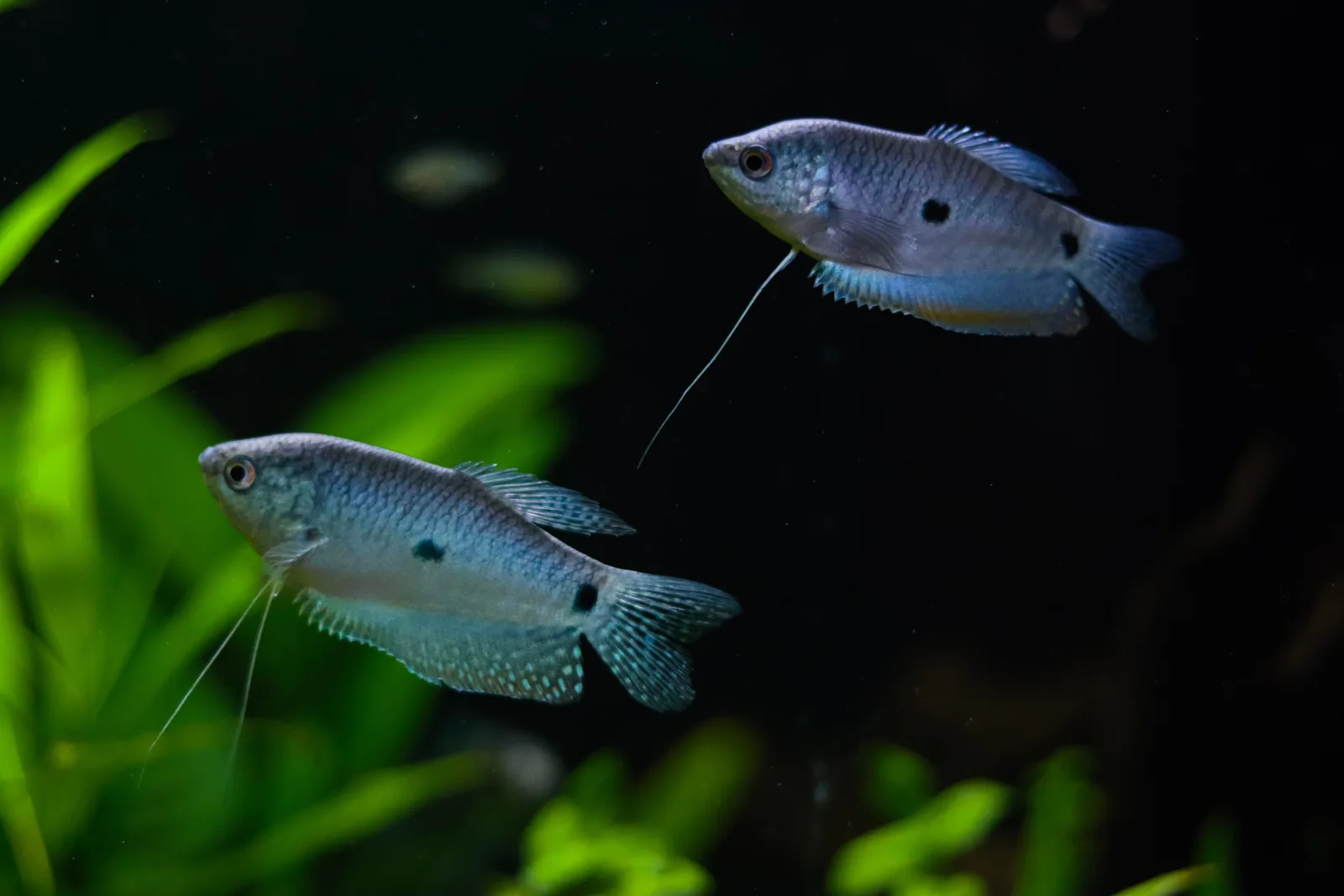
Identification: one species behind several trade names
Trichopodus trichopterus (Pallas, 1770) is a labyrinth fish in family Osphronemidae, also catalogued under the older synonym genus name Trichogaster trichopterus in some taxonomic references[1]. The "three spot" common name refers to the two dark spots along the flank, which combine with the eye itself to make three visible marks — not three separate body spots as the name might suggest.
Decades of selective breeding have produced several named colour strains of this exact species: gold, opaline (also called cosby or marbled), platinum and various blue-toned forms. Specialist reference Seriously Fish is explicit that these are colour morphs of the same species, not separate fish, and that they interbreed freely[3]. Practically, this means "which gourami do I actually have" matters less than "is this a three spot gourami colour morph, or a genuinely different species" — and the second question does matter. Dwarf gourami (Trichogaster lalius), pearl gourami (Trichopodus leerii), snakeskin gourami (Trichopodus pectoralis) and croaking gourami (Trichopsis vittata) are all separate species sold under the shared "gourami" umbrella, each with its own care profile distinct from this guide.
Water parameters that matter most
This species is native to standing and slow-moving freshwater habitats across mainland and island Southeast Asia, including marshes, swamps, canals and lowland wetlands that can become seasonally flooded or reduced[2]. It's widely regarded as one of the hardier, more adaptable fish in the trade as a result. Treat the ranges below as a practical starting point rather than a single precise target.
| Factor | Commonly reported range | Notes |
|---|---|---|
| Temperature | Roughly 22–28°C (72–83°F) | A tropical species; consistency matters more than the exact figure. |
| pH | Roughly 6.0–8.0 | Broad tolerance, consistent with a genuinely adaptable species[3]. |
| General hardness | Soft to moderately hard | Wide tolerance reported across specialist sources. |
| Ammonia / nitrite | Zero | Same standard as any freshwater fish — see our ammonia and nitrite guides. |
| Nitrate | Kept low | No species-specific numeric ceiling in the sources we reviewed was well-supported enough to repeat here — see our nitrate guide for general guidance. |
Tank size, layout and the labyrinth organ
Adults can reach around 15cm (6in), among the larger commonly kept gourami species, and specialist reference Seriously Fish recommends a tank of at least roughly 200 litres for keeping a small group in a community setting[3]. A single specimen or pair can be kept in a more modest but still genuinely spacious tank, with floating plants and some open swimming space alongside cover.
Lifespan is commonly cited in the region of four to eight years with consistent water quality and appropriate stocking, though estimates vary across the hobbyist sources we reviewed and we haven't found a dedicated longevity study to narrow that range further[5]. Aggression from an unsuitable stocking arrangement is sometimes cited as a factor shortening it in practice, which is one more reason the stocking ratio covered below is worth getting right from the start.
Like other anabantoid (labyrinth) fish, this species has a folded, highly vascularised organ that lets it gulp air directly from the surface, supplementing what it can extract through its gills[4]. That's consistent with its native habitat of shallow, sometimes seasonally low-oxygen wetlands[2]. A tank with a secure, part-covering lid and a warm air gap above the waterline supports this normal breathing behaviour; a fully sealed lid with no airspace, or a cold room chilling that air gap, both work against it.
Feeding behaviour and diet
This species is an omnivore and generally an easy, undemanding feeder, accepting flake, pellets, and occasional live or frozen foods such as bloodworm or brine shrimp. A varied diet is commonly recommended over a single staple food, though we found no source specifying an exact required ratio. Feeding a modest amount once or twice daily, rather than as much as the fish will accept, is the general cautious approach shared with most aquarium fish.
Stocking ratio and tank mates
This is the point most likely to be missed by anyone buying this species purely on its "easy beginner fish" reputation. Specialist sources consistently note that adult males of this species are territorial, particularly toward other males, and that keeping two or more males together is a common, avoidable source of ongoing aggression[3]. A single male, optionally kept with one or two females, is described as a more reliably peaceful arrangement than a multi-male group[3]. Because colour is not a reliable guide to relatedness (see "Identification" above), this applies equally to two males of any colour combination — a gold male and a blue male are still two males of the same territorial species to each other.
Beyond its own species, it's commonly reported as compatible with larger, robust community fish able to hold their own without being aggressive themselves — sturdier tetras, danios, rasboras and bottom-dwelling corydoras are frequently suggested pairings across specialist and hobbyist sources[5]. Very small, slow-moving or long-finned fish can be at some risk from an established, territorial individual, as can fin-nipping species provoking it in the other direction. Dwarf shrimp and snails are a separate, genuine concern: this species is widely reported to view them as food rather than tankmates, so a cherry shrimp or mystery snail colony and a three spot gourami are a poor combination if you want the invertebrates to survive[5].
None of this is a guarantee for your specific tank — individual temperament varies, and a generic compatible-species list can't account for your layout, stocking density or the individual fish involved. See our guide to choosing tank mates for the fuller framework, and use AquaPulse's Water Check to confirm your water chemistry is stable while you plan a stocking change.
Water stability considerations
Avoid adding this species to a tank that's still cycling or has recently shown signs of a cycle disruption. Its labyrinth organ helps with low dissolved oxygen specifically; it does nothing to offset ammonia, nitrite, or unstable temperature, which remain separate water-quality risks like they are for any fish.
Normal behaviour
- Regular trips to the surface to gulp air — normal labyrinth-organ breathing, not distress on its own (see our fish gasping at the surface guide for how to tell the difference from genuine distress in fish without this adaptation).
- Building a bubble nest at the surface among floating plants or décor, typically by a male — a normal sign of readiness to breed, not a problem.
- Chasing or displaying at another male, including flaring fins — a recognised territorial behaviour in this species, worth monitoring rather than automatically alarming.
- Periods of stillness near the surface or among plants — generally normal, particularly if the fish responds normally when approached or fed.
Warning signs and what to check first
None of the signs below confirms a specific problem on its own. Each has more than one possible explanation, and reacting immediately — especially by adding a product or a large water change — before checking the more likely causes can make things worse.
Torn fins or persistent chasing between two gouramis
What it might mean: Male-male territorial aggression, particularly if both are mature males; see "Stocking ratio and tank mates" above.
What else could explain it: A gourami harassing an unrelated, smaller tankmate rather than another gourami specifically.
Check this first: Whether both fish involved are male, and whether the aggression is one-sided or ongoing rather than a single brief interaction.
Don't: Assume it will resolve on its own if it's persistent and one-sided — separating or rehoming one fish is sometimes the more humane option.
Excessive gasping or gathering at the surface
What it might mean: For most fish this is a clear warning sign, but this species gulps air normally. A genuine change from its own established pattern — markedly more frequent trips, or obvious distress rather than routine air-gulping — is what's actually worth checking.
What else could explain it: Low dissolved oxygen affecting other, non-labyrinth tankmates even if the gourami itself seems unaffected.
Check this first: Ammonia and nitrite, and whether any tankmates are showing distress too.
Don't: Dismiss a genuine change in frequency just because occasional air-gulping is normal for this species.
Clamped fins or a duller-than-usual colour
What it might mean: A recognised general stress indicator, often linked to water quality, temperature, or ongoing aggression from a tankmate.
What else could explain it: Recent transport, a new tank, or a recent water change.
Check this first: Ammonia, nitrite, and current temperature. See our clamped fins guide for the general picture across species.
Don't: Wait several days before testing water if this appears suddenly.
Not eating, or ignoring food it previously accepted
What it might mean: Stress, water-quality problems, or, if brief, sometimes simply normal appetite variation.
What else could explain it: Recent overfeeding or being outcompeted by faster tankmates at feeding time.
Check this first: How many feeds have actually been refused, water parameters, and feeding competition. See our fish not eating guide for more.
Don't: Immediately switch foods repeatedly — check the environment first.
Common husbandry mistakes
- Keeping two or more male gouramis together without realising colour doesn't indicate compatibility or relatedness.
- Buying several "different" colour varieties assuming they're separate, unrelated species rather than the same territorial fish.
- Using a fully sealed lid with no warm air gap, working against the species' normal labyrinth-organ breathing.
- Treating "easy beginner fish" as "no stocking planning needed", rather than accounting for its real territorial tendencies.
- Housing it with very small or slow-moving tankmates without monitoring for bullying from an established, territorial individual.
What the aquarium cannot compensate for
- A larger tank reduces but doesn't reliably eliminate aggression between two mature males — that's a stocking decision, not just a space one.
- The labyrinth organ's tolerance of low dissolved oxygen does nothing to offset ammonia, nitrite, or unstable temperature.
- Good water quality doesn't prevent fin damage or stress from an ongoing territorial conflict between tankmates.
- A secure lid alone doesn't help if it removes the warm air gap this species relies on for normal surface breathing.
When specialist help may be appropriate
Aquatic veterinary expertise specific to ornamental fish is less widely available than for common pets, but it exists, and a knowledgeable specialist retailer or aquatic-health specialist can sometimes help with a genuinely puzzling case.
Frequently asked questions
Are gold, opaline, platinum and blue gourami all the same species?
Yes. Every one of those names describes a selectively bred colour morph of the same species, Trichopodus trichopterus, not a separate species with its own needs. They'll interbreed freely with each other and with the plain, wild-type three spot form. Care requirements don't differ by colour, but it does mean two "different" gouramis you've bought thinking they're unrelated species may actually be the same fish, with the same stocking and compatibility considerations.
Is a dwarf gourami the same as a three spot gourami?
No, and this is a genuinely common point of confusion given how similar the names sound. Dwarf gourami (Trichogaster lalius) is a distinct species, smaller and, notably, with its own well-documented disease susceptibility issues in the trade. Pearl, snakeskin and croaking gourami are further distinct species again. "Gourami" covers many different fish, and the colour-morph situation described above applies specifically to Trichopodus trichopterus, not to gouramis generally.
How long do three spot gourami live?
Commonly cited in the region of four to eight years with consistent water quality and appropriate stocking, though estimates vary across the hobbyist sources we reviewed and we haven't found a dedicated longevity study to narrow that range further. Aggression from an unsuitable stocking arrangement is sometimes cited as a factor shortening it in practice.
Can I keep two male three spot gouramis together?
It's a common source of ongoing aggression and isn't recommended as a routine stocking choice. Males of this species are frequently reported as territorial toward each other, and specialist sources describe keeping a single male, optionally alongside one or two females, as a more reliably peaceful arrangement than housing multiple males in the same tank.
What fish make good tank mates for a three spot gourami?
Larger, robust community fish that can hold their own without being aggressive themselves tend to work best — sturdier tetras, danios, rasboras and bottom-dwelling corydoras are frequently suggested pairings. Avoid very small, slow-moving or long-finned fish, which can be at some risk from an established, territorial individual, and avoid dwarf shrimp or snails, which this species is widely reported to view as food rather than tankmates. None of this guarantees compatibility in your specific tank, so treat it as a starting point rather than a promise.
Does a three spot gourami need a heater and a lid?
Yes to both. It's a genuinely tropical species needing a stable, warm temperature a heater provides reliably. A secure lid matters for a different reason here: this species uses its labyrinth organ to breathe air directly from just above the water's surface, so a warm, humid air gap under the lid is part of its normal breathing environment, not just a tool to stop it jumping.
Is the three spot gourami really a good beginner fish?
In terms of water-parameter tolerance and general hardiness, yes, genuinely. Where the "easy beginner fish" label understates the picture is temperament: specialist sources are consistent that it can become territorial and aggressive, particularly toward other males or smaller tankmates, which is a real stocking consideration a beginner needs to plan around rather than assume away.
Sources and uncertainty
- Published
- 29 July 2026
- Last reviewed
- 29 July 2026
- Written and maintained by
- AquaPulse (Valeon Labs Ltd)
This guide draws on a taxonomic reference database, a US federal non-indigenous species profile, two specialist hobbyist references (one already used elsewhere on this site), and a peer-reviewed study of labyrinth-organ function and territorial behaviour in anabantoid fish generally, since we found no dedicated peer-reviewed welfare study specific to this exact species. We'll update this page if we find something we've got wrong.
Good to know: This guide provides general informational guidance only. It is not a veterinary service and does not replace specialist or aquatic health advice for serious livestock health issues.
- [1] Integrated Taxonomic Information System (ITIS) — "Trichogaster trichopterus (Pallas, 1770)" (TSN 172634) Used as the taxonomic authority for species name and author citation. ITIS lists the species under the older synonym genus Trichogaster; the currently accepted name used throughout this guide is Trichopodus trichopterus.
- [2] USGS Nonindigenous Aquatic Species (NAS) database — "three-spot gourami (Trichogaster trichopterus)" Used for native range (Southeast Asia) and wild habitat description (marshes, swamps, canals, seasonally flooded wetlands).
- [3] Seriously Fish — "Trichopodus trichopterus (Three-spot Gourami)" Specialist hobbyist reference source, already used elsewhere on this site. Used for water-parameter ranges, maximum size, recommended tank size, colour-morph/interbreeding information, and male-male territorial behaviour and stocking-ratio guidance. Not a peer-reviewed source.
- [4] Ravi, P. & Jiang, J. et al., "Life in a bubble: the role of the labyrinth organ in determining territory, mating and aggressive behaviours in anabantoids," Journal of Fish Biology (via PubMed) Used for labyrinth-organ anatomy and function, and its general link to territorial behaviour across anabantoid fish (the group including both bettas and gouramis). Accessed via abstract/database record, not full text.
- [5] Fishkeeping World — "Three Spot Gourami Care Guide & Species Profile" Specialist hobbyist source. Used for commonly cited lifespan range and reported tank-mate suitability, including the predation risk to dwarf shrimp and snails. Not a peer-reviewed source; corroborated against other hobbyist sources we reviewed but not against a dedicated study.
What we deliberately left out: a single, precise lifespan figure rather than the four-to-eight-year range given above, since estimates varied across the hobbyist sources we reviewed without a dedicated study to confirm one exact number; and an exact minimum tank size for a single specimen, since sources varied and we didn't want to imply false precision beyond the group-housing figure we found best supported.