Knowledge Centre · Species guidance
Amano shrimp care: what they need and why they won't breed in your tank
Caridina multidentata is sold almost everywhere as a beginner-proof algae eater, and for adult shrimp in a stable, mature tank that's largely fair — but the marketing skips two things worth knowing before you buy. First, an established tank will only carry a finite amount of algae and biofilm, and once your amano shrimp have grazed it down, they need supplemental food or they'll slowly decline, not because they're delicate but because there's nothing left to eat. Second, their larvae need brackish-to-marine water to survive, so however many you buy is roughly however many you'll have — a genuinely useful fact if you're worried about a shrimp population explosion, unlike some of their smaller Neocaridina relatives. This guide covers what they actually eat, how many to buy, who's safe to keep them with, and the handful of ways they most commonly die in home aquaria.
Before adding amano shrimp
May be suitable when…
Your tank is established (not brand new), holds stable water free of copper, and you're keeping them with peaceful fish in a group of at least four to six rather than one or two.
Reconsider when…
You're relying on them as the sole algae solution in a tank without enough algae to sustain them long-term, your tankmates are large or predatory enough to see a shrimp as food, or your tank has an open top with a strong light source nearby (see "Common mistakes" below).
Worth knowing: despite being one of the most widely recommended "clean-up crew" shrimp, they still need a real diet plan once the algae they were bought to eat is gone.
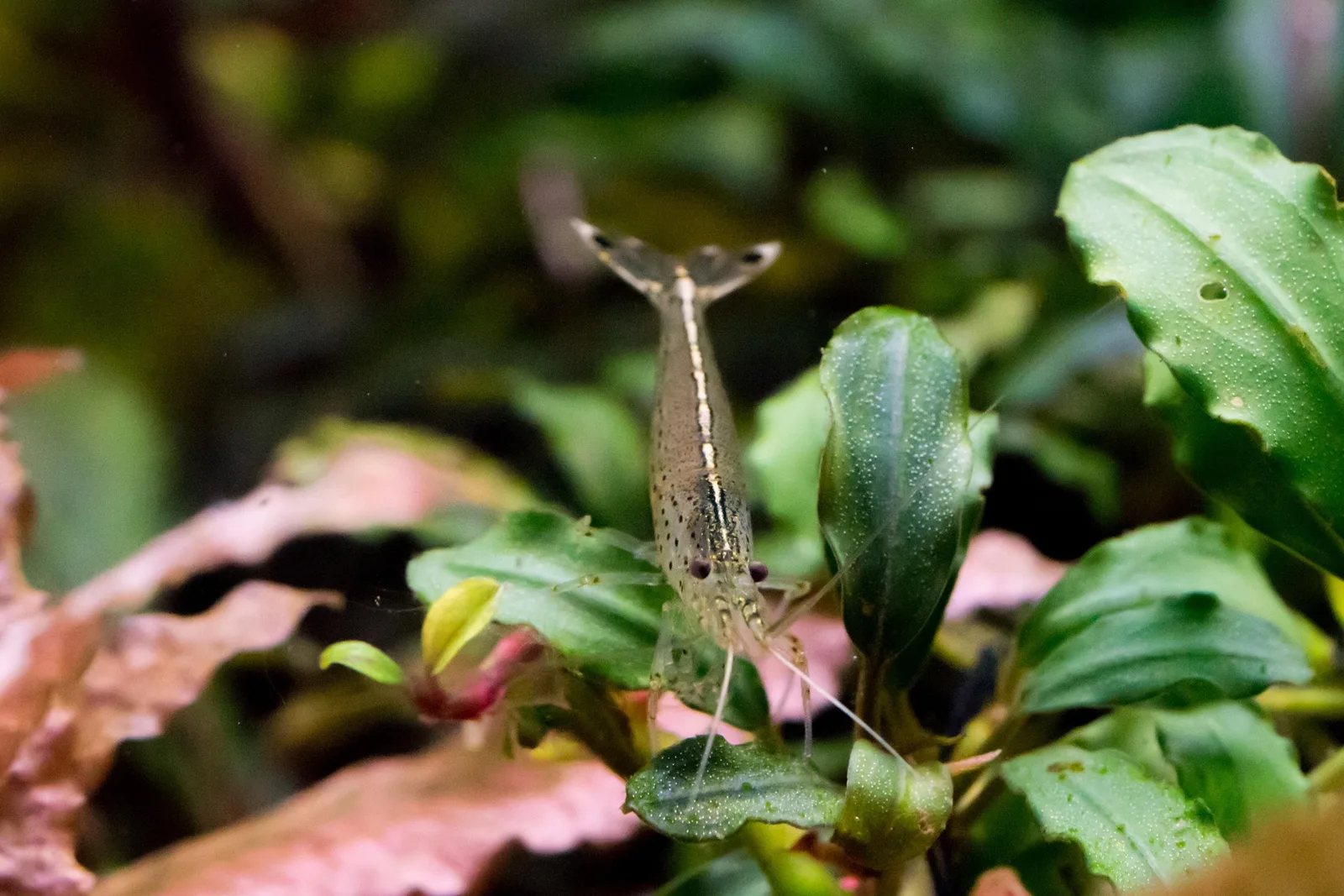
Identification, size and lifespan
Caridina multidentata Stimpson, 1860 — also sold as Amano shrimp, Yamato shrimp or Japanese shrimp — is a freshwater shrimp native to Japan and Taiwan, formally catalogued under this name by the World Register of Marine Species[1]. It reaches roughly 4–6 cm (1.5–2.4 in), among the larger shrimp commonly sold for freshwater aquaria, and is reported to live around two to three years in captivity given stable conditions[4], though we found no dedicated longevity study confirming a precise figure — treat that range as an aquarist-reported estimate rather than a settled scientific number.
Sexing is genuinely useful to know before you buy, since it changes what you're paying for: females run larger and carry a line of short, broken dashes along the lower flank, while males stay smaller with a more continuous, unbroken line in the same position. Colouration varies from near-transparent to a mottled brown depending on the individual and its surroundings, and isn't a reliable way to sex or identify them on its own.
Water parameters that matter most
Amano shrimp tolerate a wider range than many dedicated shrimp species, which is part of why they're recommended so often, but "tolerates" and "thrives long-term" aren't the same claim. Treat the ranges below as a practical starting point gathered from multiple specialist shrimp-keeping sources, not a single precise scientific target.
| Factor | Commonly reported range | Notes |
|---|---|---|
| Temperature | Roughly 18–28°C (65–82°F) | A genuinely wide tolerance, but this is a subtropical species — the cooler half of that range is more consistent with where it's found in the wild than the warmer half. |
| pH | Roughly 6.5–7.5 | Stability matters more than hitting an exact figure. |
| General hardness | Moderate to hard | Adequate mineral content supports moulting — see "Water stability and moulting" below. |
| Ammonia / nitrite | Zero | As sensitive as most freshwater invertebrates — see our ammonia and nitrite guides. |
| Copper | None, ever | Copper-based medications are toxic to shrimp at concentrations used to treat some fish parasites[2] — see "Water stability" below. |
Tank size, layout and minimum numbers
Specialist shrimp-keeping sources commonly suggest around 10 US gallons (roughly 38 litres) as a sensible minimum, though we'd treat that as a widely used hobbyist convention rather than a figure derived from a specific welfare study. What matters more than the exact volume is that the tank is established: amano shrimp depend on existing algae and biofilm as a baseline food source, and a freshly cycled tank simply hasn't grown enough of either yet (see "Diet" below).
Keep more than one or two. Amano shrimp are reported to be more confident and consistently active in groups of four to six or more than singly or in pairs[4], and buying just one or two — a common instinct when they're sold as a "clean-up crew" add-on rather than the main livestock — tends to produce a shrimp that spends most of its time hidden. A planted tank with driftwood, leaf litter or dense stem plants gives them surfaces to graze and places to retreat to, particularly useful during moulting (see below).
Diet: what they actually eat once the algae is gone
Do they eat algae? Yes, and enthusiastically — algae and biofilm are their primary food in a new or lightly stocked tank, which is exactly why they're sold as a clean-up crew. Do they eat plants? Generally no: amano shrimp are widely reported as safe for planted tanks, grazing biofilm and algae from leaves rather than the leaves themselves, though they may pick at already-dying or decaying plant matter, which isn't the same as damaging healthy growth.
The part that gets left out of most "great algae eater" recommendations is what happens after the algae is gone: a tank doesn't produce an infinite, self-renewing supply, and a shrimp that's cleared its food source needs a replacement, not a pat on the back for doing its job well. Offer sinking pellets, blanched vegetables, or dedicated shrimp food a few times a week once algae looks visibly reduced, and watch body condition over weeks rather than assuming "the tank looks clean" means they're fine. This is one of the more common, quietly gradual ways amano shrimp decline in home aquaria — not sudden and dramatic, but a slow loss of condition that's easy to miss if you're not specifically looking for it.
Moulting also has a dietary angle: calcium and other minerals are needed to rebuild the exoskeleton after each moult[5], and leaving a shed exoskeleton in the tank rather than removing it lets shrimp graze the calcium back out of it — a genuinely useful, low-effort habit in softer water especially.
Tank mates and compatibility
Amano shrimp are peaceful and are widely kept alongside small, non-predatory community fish, other peaceful shrimp (including Neocaridina species, though the larger amano may out-compete smaller shrimp for food if underfed) and most snails. The real compatibility question isn't temperament, though — it's size and appetite. Any fish large enough to view a shrimp as food, including many cichlids, larger gouramis, and some barbs and loaches, is a genuine predation risk, especially to a shrimp that's just moulted and temporarily soft-shelled (see "Water stability" below). Fin-nipping isn't the concern here; being eaten is.
Compatibility genuinely depends on your specific aquarium, not just a generic species pairing list — the same fish that ignores adult shrimp in a densely planted 200-litre tank with plenty of hiding spots may behave very differently in a sparse 40-litre tank with nowhere to retreat to. If you're planning to add amano shrimp to an already-stocked tank, thinking through your existing fish's size and temperament against your shrimp's numbers and hiding spots — rather than checking a single "shrimp-safe" label — is what actually determines whether it works. AquaPulse's Water Check can help you confirm your water chemistry is genuinely stable and ready before adding them, on top of that stocking check.
Breeding: why it (almost never) happens at home
This is worth understanding even if you have no interest in breeding them, because it directly answers a common worry: "will my amano shrimp take over my tank?" The short answer is no. Amano shrimp are amphidromous — adults live and mate in freshwater, but the resulting larvae are planktonic and require brackish-to-marine salinity (commonly cited as roughly 30–35 ppt) to survive and develop through several weeks of larval stages before they can tolerate freshwater again as juveniles[3]. A female carrying eggs in an ordinary freshwater aquarium is a normal, harmless sight; those eggs hatching into anything that survives past a few days in that same freshwater tank is not something that happens without a dedicated brackish-to-marine rearing setup, live phytoplankton, and active intervention[3].
Practically, this means you can buy exactly as many amano shrimp as you want to keep, without the accidental-population-explosion risk some smaller freshwater shrimp species carry.
Water stability and moulting
Like all crustaceans, amano shrimp periodically shed and regrow their exoskeleton, reported at roughly once every four to six weeks depending on age and growth rate[5]. Immediately after a moult, the new shell is soft and the shrimp is genuinely vulnerable — to predation from tankmates, to physical damage, and to poor water quality, since the new shell hasn't hardened yet. A moulting or freshly moulted shrimp hiding more than usual is normal, not necessarily a sign of illness; interference (netting it out to "check on it") is more likely to cause harm than the moult itself.
Beyond moulting, treat copper as an absolute line: copper-based medications, sometimes used to treat fish parasites, are toxic to shrimp and other invertebrates at concentrations well below what's used therapeutically for fish[2], and copper can re-release from substrate or décor even after water tests read zero. Avoid adding amano shrimp to a tank that is still cycling or has recently shown a cycle disruption — sudden ammonia or nitrite exposure is a welfare risk for any invertebrate, and shrimp generally show fewer obvious external symptoms than fish before a problem becomes serious.
Normal behaviour
- Near-constant grazing across leaves, décor and substrate, picking at biofilm and algae — the behaviour they're bought for, and a genuine sign of a settled shrimp.
- Increased hiding around moulting, sometimes for a day or so before and after — normal, not a sign of illness on its own.
- Brief, rapid backward flicks ("shrimp jump") if startled — a normal escape response, though see "Common mistakes" below for why this matters practically.
- Clustering together, particularly around a good food source or preferred current — normal social behaviour, not crowding stress, in a tank sized appropriately for the group.
- Reduced visible activity in bright, freshly lit tanks, becoming more active as lights dim — some individuals show a degree of light-shyness, particularly in a tank with little cover.
Why can't I find my Amano shrimp?
A missing amano shrimp is one of the most common questions we see, and the honest answer is that it's usually still in the tank — amano shrimp are genuinely good at staying out of sight, and a few situations make that far more likely than usual.
- Normal hiding after introduction. A newly added shrimp settling into an unfamiliar tank commonly hides heavily for the first few days to a couple of weeks, especially without established tankmates or a group of its own already present. This is caution, not distress.
- Increased hiding around moulting. As covered above, a shrimp that's about to moult or has just moulted is soft-shelled and vulnerable, and tends to retreat somewhere sheltered for a day or so either side of it. Missing for a day or two, then reappearing, is a normal pattern worth recognising rather than reacting to.
- Cover and group confidence. A sparsely decorated tank, or a group smaller than the four-to-six minimum recommended above, tends to produce shrimp that stay hidden far more than a well-planted tank with a confident group size — this is a housing and numbers issue as much as an individual shrimp's temperament.
- Escape routes and open-top risk. Amano shrimp can and do climb, particularly along equipment cords, airline tubing or algae-covered background, and their startle response ("shrimp jump," described above) can occasionally launch them out of a gap near the waterline. Check the floor and any nearby surfaces, including behind or under the stand, if the tank has an open or poorly sealed top.
- Filter intakes and equipment spaces. A shrimp can wedge itself into a filter intake, behind a heater, inside a spray bar, or into a gap around a piece of equipment, particularly a smaller or younger individual. Check intake guards specifically, since an unguarded or damaged one is a genuine entrapment risk.
- Predation risk. If tankmates large enough to view a shrimp as food are present (see "Tank mates and compatibility" above), a missing shrimp is a real possibility worth including in your thinking, particularly if it disappeared shortly after a moult.
The absence of a body doesn't confirm what happened either way — shrimp remains are small, pale, and are often scavenged or broken down quickly by tankmates, snails, or bacteria, so "I never found it" isn't evidence the shrimp is fine, and it isn't evidence it was eaten. It genuinely doesn't tell you much on its own.
Before disturbing the whole tank
- Check likely daytime hiding spots first — dense planting, the underside of driftwood, behind or beneath décor — ideally with a torch, since amano shrimp are more active once lights dim.
- Check the floor around the tank and any open gaps at the waterline.
- Check filter intakes, spray bars and any equipment with gaps a shrimp could enter.
- Look again after dark or once tank lights have been off for a while — a "missing" shrimp often reappears once it feels safe to graze.
- If you still can't locate it after a few days of checking, and water quality and the rest of the group look normal, a full substrate and décor search is a reasonable next step — but it isn't usually the first one.
Warning signs and what to check first
None of the signs below confirms a specific problem on its own. Each has more than one possible explanation, and reacting immediately — especially with a large water change or a new product — before checking the more likely causes can make things worse.
Sudden, unexplained death with no obvious cause
What it might mean: Copper or another toxin exposure, a sudden parameter swing, or a failed moult.
What else could explain it: Natural end-of-lifespan, particularly in an older shrimp whose age you don't know.
Check this first: Anything recently added to the tank (medication, new décor, a different water source), and ammonia, nitrite and pH.
Don't: Assume "shrimp are just fragile" without checking for a specific, identifiable cause first.
Visible weight loss or a shrunken, less full-looking body
What it might mean: Insufficient food, particularly in a tank where algae has already been grazed down (see "Diet" above).
What else could explain it: Recent moulting, which can temporarily make a shrimp look different before the new shell fills out.
Check this first: How much visible algae/biofilm is actually left, and whether you're supplementing with other food.
Don't: Wait for obvious starvation before adjusting feeding — condition loss is easier to reverse early.
Found outside the tank
What it might mean: A "shrimp jump" startle response near an open top, or an attempt to escape unsuitable water conditions.
What else could explain it: A sudden disturbance (tapping the glass, a nearby loud noise, a predatory tankmate's approach) rather than a water-quality problem.
Check this first: Water parameters, and whether your tank has an open top or a gap a shrimp could climb through near the waterline.
Don't: Assume this is purely behavioural without checking water quality if it happens more than once.
Failed or incomplete moult (shell partially shed, shrimp struggling)
What it might mean: Insufficient calcium or mineral content in the water, or a health problem.
What else could explain it: A moult that's simply still in progress — give it time before intervening.
Check this first: General hardness, and whether you're leaving shed exoskeletons in the tank for other shrimp to graze.
Don't: Try to physically assist a stuck moult — this is more likely to injure the shrimp than help it.
Multiple shrimp dying in a short period
What it might mean: A shared environmental cause — a toxin, a sudden parameter shift, or a cycle disruption — is more likely than coincidence.
What else could explain it: A batch of recently added, already-stressed shrimp from the same purchase, rather than a tank-wide issue.
Check this first: Ammonia, nitrite, copper source, and whether any fish or other invertebrates are also affected.
Don't: Treat each death as isolated if several happen close together — look at the whole tank first.
Common mistakes, and why amano shrimp die
- Buying them purely as an algae solution and not feeding them once the algae is gone — a slow, easily missed cause of decline.
- Using copper-based medication anywhere in the same system, including on a shared filter or in décor moved between tanks.
- Buying only one or two, then finding them permanently hidden rather than active.
- Keeping them in a tank that's still cycling, or adding them straight after a large, sudden water change.
- Housing them with fish large enough to eat them, particularly right after a moult.
- Removing every shed exoskeleton immediately, rather than leaving some for other shrimp to graze for calcium.
- Assuming they'll breed and multiply the way some smaller dwarf shrimp do — see "Breeding" above for why that's very unlikely in an ordinary freshwater tank.
What the aquarium cannot compensate for
- A large, well-filtered tank cannot compensate for keeping amano shrimp with fish large enough to eat them.
- Good water chemistry cannot substitute for actual food once existing algae and biofilm are exhausted.
- No amount of water-quality management protects an invertebrate from a copper-based treatment used anywhere in the same system.
- A freshwater aquarium, however well run, cannot replicate the brackish-to-marine larval stage this species needs to reproduce — which is a reproductive limitation, not a husbandry failure on your part.
When specialist help may be appropriate
Invertebrate-specific veterinary expertise is limited, but a knowledgeable specialist retailer or aquatic-invertebrate specialist can sometimes help interpret an unusual case, particularly a sudden multi-shrimp die-off.
Frequently asked questions
How long do Amano shrimp live?
Amano shrimp are commonly reported to live around two to three years in captivity given stable water conditions and consistent feeding. We haven't found a dedicated longevity study confirming a precise figure, so treat that range as an aquarist-reported estimate rather than a settled scientific number.
Do Amano shrimp need to be kept in groups?
They're reported to be more confident and consistently active in groups of four to six or more than singly or in pairs. Buying just one or two — a common instinct when they're sold as a clean-up-crew add-on — tends to produce a shrimp that spends most of its time hidden rather than grazing visibly.
What do Amano shrimp eat?
Algae and biofilm are their primary food in a new or lightly stocked tank, which is why they're sold as an algae solution. Once that supply is grazed down, they need supplementing with sinking pellets, blanched vegetables or dedicated shrimp food a few times a week — a tank doesn't produce an infinite, self-renewing food source.
Can Amano shrimp live in saltwater?
Adult Amano shrimp live and are kept in freshwater. The saltwater connection is about their larvae, not the adults: this species is amphidromous, meaning any larvae that hatch need brackish-to-marine salinity to survive their planktonic stage, which is why they don't accidentally breed into a population explosion in an ordinary freshwater tank.
What water parameters do Amano shrimp need?
Roughly 18–28°C (65–82°F), pH around 6.5–7.5, and moderate-to-hard general hardness, gathered from multiple specialist shrimp-keeping sources as a practical range rather than one confirmed figure. Stability matters more than hitting an exact number, and ammonia, nitrite and copper should all read zero.
Why can't I find my Amano shrimp?
Most often it's still in the tank — normal hiding after introduction, extra caution around moulting, insufficient cover or group size, or a spot wedged near equipment are all more likely than the shrimp having disappeared entirely. Not finding a body doesn't confirm it's fine or that it was eaten; see "Why can't I find my Amano shrimp?" above for what to check before disturbing the whole tank.
Sources and uncertainty
- Published
- 26 July 2026
- Last reviewed
- 9 September 2026
- Written and maintained by
- AquaPulse (Valeon Labs Ltd)
This guide draws on a taxonomic reference database, a general invertebrate copper-toxicity extension publication, and specialist shrimp-keeping sources for day-to-day husbandry, since no dedicated peer-reviewed welfare or longevity study of this species appears to be publicly available. We've been explicit throughout about which figures are aquarist-reported estimates rather than confirmed scientific values. We'll update this page if we find something we've got wrong.
Good to know: This guide provides general informational guidance only. It is not a substitute for specialist invertebrate-health advice.
- [1] World Register of Marine Species (WoRMS) — "Caridina multidentata Stimpson, 1860" Used as the taxonomic authority for species name and author citation.
- [2] University of Florida IFAS Extension — "Use of Copper in Marine Aquaculture and Aquarium Systems" (FA165) Used for general invertebrate sensitivity to copper-based treatments and the risk of copper re-releasing from substrates.
- [3] Institute for Environmental Research and Education — "How do Amano shrimp breed?" Used for the amphidromous life cycle and the brackish-to-marine salinity requirement of the larval stage. Institutional/educational source, not a peer-reviewed study.
- [4] Fishkeeping World — "Amano Shrimp: Breeding, Care, and Lifespan" Specialist hobbyist source, used for general size, lifespan and behaviour reporting. Not a scientific authority.
- [5] The Shrimp Farm — "Breeding Amano Shrimp (Caridina multidentata)" Specialist trade/hobbyist source, used for moulting frequency and mineral/calcium requirements. Not a scientific authority.
What we deliberately left out: a precise scientific lifespan figure (we found consistent aquarist estimates of two to three years, but no dedicated longevity study); an exact minimum tank volume backed by a welfare study, rather than widely repeated hobbyist convention; and a specific numeric copper threshold, since published toxicity figures vary by compound and we didn't want to imply false precision.