Knowledge Centre · Species guidance
Vampire shrimp care: what they need and why most shrimp food won't reach them
Atya gabonensis looks like other large aquarium shrimp, but it eats in a completely different way: it's a filter feeder, using fan-shaped appendages to strain fine particles drifting past in moving water, rather than picking up food from the substrate the way a cherry or Amano shrimp does. That single difference changes almost everything about keeping it well — it needs strong, steady, one-directional current to feed from and a food source fine enough for its fans to catch, and the ordinary sinking shrimp pellets that work perfectly well for other species are largely useless to it. This guide covers the flow and feeding setup this species actually needs, and the quiet, easily missed way it starves when a tank doesn't provide them.
Before adding vampire shrimp
May be suitable when…
Your tank has a strong, steady, unidirectional current from a filter outlet or powerhead, with rock or driftwood perches positioned in that flow, and you're prepared to feed fine, suspended filter-feeder food regularly rather than relying on sinking pellets.
Reconsider when…
Your filtration produces weak or diffuse flow with no clear current to anchor in, you're expecting it to function as an algae eater, or you're not prepared to feed suspended food specifically formulated for filter feeders.
Worth knowing: a vampire shrimp can look perfectly healthy for a while in the wrong setup before the effects of inadequate feeding become visible — getting flow and food right from the start matters more than it does for most other aquarium shrimp.
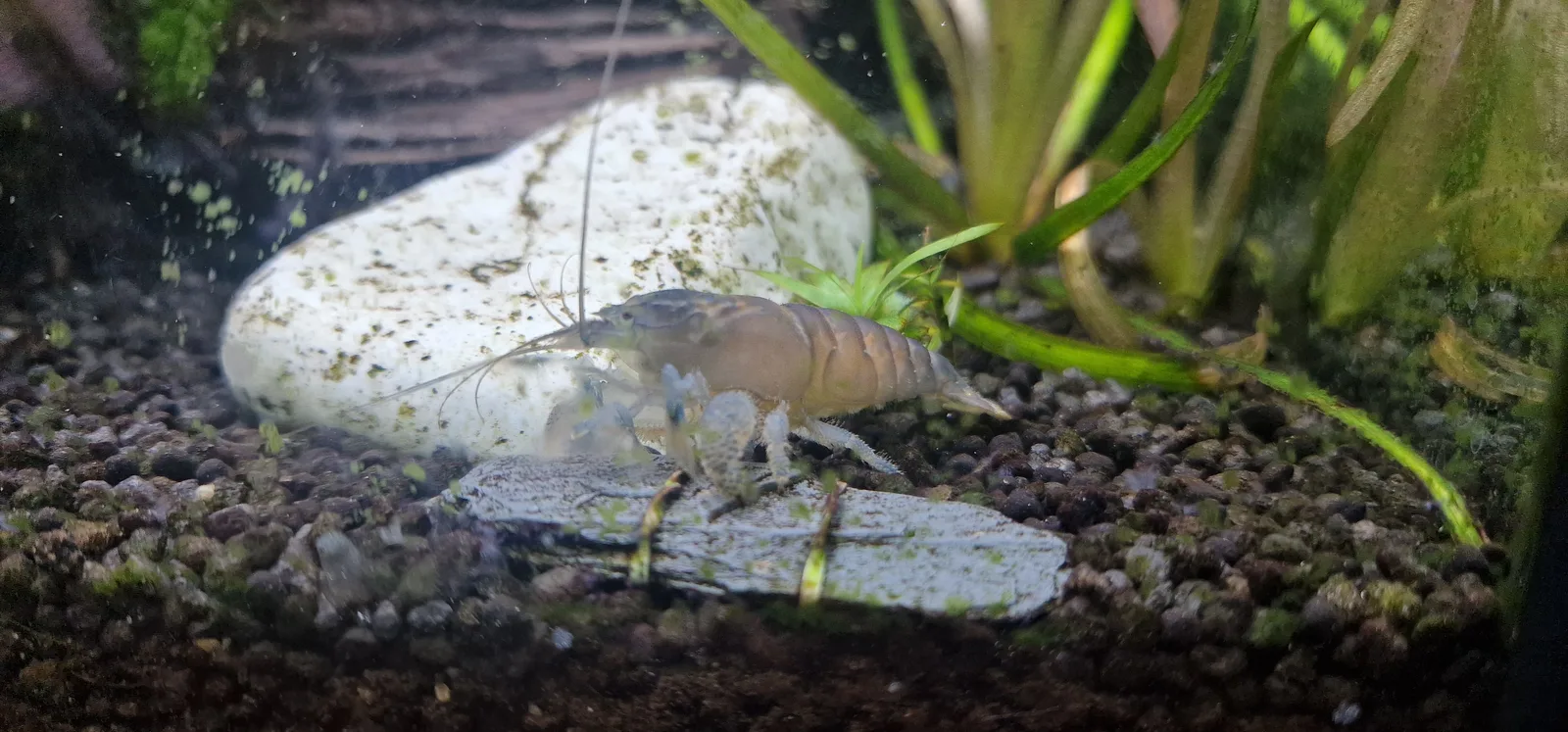
Identification and native habitat
Atya gabonensis Giebel, 1875 is a large freshwater shrimp in family Atyidae[1], also sold as African filter shrimp or blue vampire shrimp depending on colour form. It's native to West Africa, recorded from rivers across a range spanning roughly Senegal to the Democratic Republic of the Congo[2].
Its native habitat is directly relevant to keeping it well: this species lives in fast-flowing, rocky, oxygen-rich rivers, gripping stable surfaces in the current rather than moving freely through calm water[2]. Everything about a suitable aquarium setup, covered under "Tank setup" below, follows fairly directly from that native environment.
Water parameters that matter most
Treat the ranges below as a practical starting point gathered from specialist shrimp-keeping sources, not a single precise scientific target.
| Factor | Commonly reported range | Notes |
|---|---|---|
| Temperature | Roughly 23–28°C (73–82°F) | A tropical species from a warm river environment. |
| pH | Roughly 6.5–7.5 | Stability matters more than hitting an exact figure. |
| General hardness | Moderate | Supports healthy moulting — see "Water stability and moulting" below. |
| Dissolved oxygen | High | A genuinely fast-flowing-river species; strong, well-oxygenated current isn't optional the way it might be for a calmer-water invertebrate. |
| Ammonia / nitrite | Zero | As sensitive as most freshwater invertebrates — see our ammonia and nitrite guides. |
| Copper | None, ever | Copper-based fish medications are toxic to shrimp at treatment concentrations — see our Amano shrimp guide for more on this risk. |
Tank setup: current and perches
This is the single most important setup decision for this species. Specialist sources are consistent that a vampire shrimp needs strong, steady, unidirectional current — the kind a filter outlet or powerhead produces directly, not the general gentle circulation many community tanks are set up for[3]. Arrange rock or driftwood directly in that flow so the shrimp has a stable surface to grip while it deploys its feeding fans into the current; without a suitable perch in strong enough flow, it may be forced to forage the substrate instead, where its delicate fans are at real risk of damage from coarse material[3].
A well-established, mature tank helps too, since ongoing detritus and microfauna add to what's available for it to filter, on top of whatever you're actively feeding.
Feeding: why most shrimp food is the wrong shape
This is the point most likely to be missed by anyone applying general "shrimp care" knowledge to this species. A vampire shrimp's fans are built to strain fine, suspended particles out of moving water; a sinking pellet or wafer, however well-suited to a cherry or Amano shrimp, is the wrong size and delivery method entirely[3]. Feed powdered filter-feeder-specific foods or liquid suspensions a few times a week, released upstream of the shrimp's perch so the current carries it past its fans, and consider periodically squeezing filter media gently in the tank water to release fine particulate matter into the flow[3].
Starvation from inadequate suspended food is reported as a genuinely common problem with this species, and it isn't sudden or dramatic — a shrimp that's abandoned its perch to sift the substrate instead is a widely reported sign that it isn't getting enough from filter feeding alone[3]. See "Warning signs" below for what to check if you notice this.
Tank mates and keeping more than one
Vampire shrimp are generally peaceful and are commonly kept with small, non-predatory community fish and other peaceful invertebrates, including Amano shrimp and cherry shrimp. As with other large shrimp, any fish large enough to view it as food is a genuine predation risk, particularly right after a moult.
They can be kept in small groups, but it's worth planning for more than one good feeding spot: each shrimp needs its own reliable current to filter feed from, and a single filter outlet may only comfortably support one or two perches. Several shrimp competing for one current source can leave some under-fed even in a tank that otherwise looks adequately set up. AquaPulse's Water Check can help you confirm your water chemistry is stable while you plan a stocking decision like this.
Breeding: why it won't happen at home
Like several other large aquarium shrimp, A. gabonensis has an amphidromous life cycle: adults live and spawn in freshwater, but hatched larvae require an extended period developing in brackish or marine water before returning to freshwater as juveniles, a pattern well documented across amphidromous shrimp generally[4]. A female carrying eggs in an ordinary home aquarium is a normal, healthy sight; those eggs hatching into anything that survives past a few days in that same freshwater tank isn't something that happens without a dedicated brackish-to-marine rearing setup and active intervention. Practically, this means you can buy exactly as many vampire shrimp as you want to keep, the same reassurance that applies to Amano shrimp.
Water stability and moulting
Like all crustaceans, vampire shrimp periodically shed and regrow their exoskeleton, and are genuinely vulnerable immediately afterward while the new shell hardens — a settled, secure perch away from strong competition matters here too. Avoid adding vampire shrimp to a tank that's still cycling or has recently shown a cycle disruption; sudden ammonia or nitrite exposure is a welfare risk for any invertebrate, and shrimp generally show fewer obvious external symptoms than fish before a problem becomes serious. Copper-based medications remain toxic even at concentrations used therapeutically for fish, and can re-release from substrate or décor after water tests read zero.
Normal behaviour
- Anchored in place with fans extended into the current — the core, expected behaviour of a settled, well-fed shrimp, not a sign it's stuck or in distress.
- More active and visible after dark, hiding more during bright daylight hours — this species is largely nocturnal.
- Periodically retracting and re-casting its fans, sometimes bringing them to the mouth — normal feeding behaviour, part of the filtering process.
- Increased hiding around moulting, sometimes for a day or so before and after — normal, not illness on its own.
Warning signs and what to check first
None of the signs below confirms a specific problem on its own. Each has more than one possible explanation, and reacting immediately — especially with a large water change or a new product — before checking the more likely causes can make things worse.
Regularly sifting the substrate instead of filter feeding
What it might mean: Insufficient suspended food reaching its perch, or inadequate current at the spot it's chosen; see "Feeding" above.
What else could explain it: A newly added shrimp still settling in and exploring, rather than an established feeding pattern.
Check this first: Flow strength at the shrimp's perch, and how much suspended food you're actually providing versus assuming sinking food covers it.
Don't: Assume this is just normal foraging variety without checking flow and feeding first.
Torn, frayed or reduced fan filaments
What it might mean: Physical damage from foraging on coarse substrate, often linked to inadequate current keeping it away from its intended perch.
What else could explain it: Normal wear that's typically restored at the next moult, if the underlying cause is corrected.
Check this first: Substrate texture near where it's been observed foraging, and current strength at available perches.
Don't: Assume damaged fans will resolve without addressing why it left its perch in the first place.
Sudden, unexplained death
What it might mean: Copper or another toxin exposure, a sudden parameter swing, or a failed moult.
What else could explain it: Gradual prior starvation reaching a critical point rather than a sudden cause.
Check this first: Anything recently added to the tank, ammonia, nitrite and pH, and how consistently it's been feeding.
Don't: Assume a sudden death has a sudden cause — a slow decline can look abrupt at the end.
Failed or incomplete moult
What it might mean: Insufficient calcium or mineral content in the water, or a health problem.
What else could explain it: A moult still in progress — give it time before intervening.
Check this first: General hardness, and whether it's been feeding adequately in the period before the moult.
Don't: Try to physically assist a stuck moult — this is more likely to injure the shrimp than help it.
Common mistakes
- Feeding only sinking pellets or wafers, assuming "shrimp food" is interchangeable across species regardless of how each one actually eats.
- Setting up gentle, diffuse flow suited to a calm-water invertebrate rather than the strong, unidirectional current this species needs.
- Not providing a stable perch directly in the current, leaving the shrimp to forage the substrate and risk fan damage.
- Buying it expecting algae control, when its actual role is filtering suspended particles, not grazing surfaces.
- Keeping several without enough current sources, leaving some competing for one good feeding spot.
- Using copper-based medication anywhere in the same system, including a shared filter or décor moved between tanks.
What the aquarium cannot compensate for
- Good water chemistry cannot substitute for suspended food reaching the shrimp's perch — that's a flow and feeding decision, not a water-quality one.
- A large tank doesn't help if it lacks a stable, strong-current perch for the shrimp to feed from.
- No amount of water-quality management protects an invertebrate from a copper-based treatment used anywhere in the same system.
- A freshwater aquarium, however well run, cannot replicate the brackish-to-marine larval stage this species needs to reproduce.
When specialist help may be appropriate
Invertebrate-specific veterinary expertise is limited, but a knowledgeable specialist retailer or aquatic-invertebrate specialist can sometimes help interpret an unusual case.
Frequently asked questions
Can vampire shrimp eat normal shrimp pellets?
Not effectively. Their fan-shaped feeding appendages are built to catch fine, suspended particles drifting past in the current, not to pick up or process a solid pellet the way a cherry or Amano shrimp would. Ordinary sinking shrimp food isn't the right shape or size for how this species actually eats, which is why relying on it alone is a common, easily missed cause of starvation.
Why is my vampire shrimp sifting through the substrate instead of filter feeding?
This is widely reported as a sign of hunger, not a normal alternative feeding style. A well-fed vampire shrimp with a good current spends most of its time anchored in the flow with its fans deployed; one that's regularly abandoning that spot to forage the substrate instead is more likely not getting enough suspended food where it's perched. It's worth treating as a cue to check both your water flow and how much fine, suspended food you're actually providing.
Will my vampire shrimp breed in my aquarium?
Very unlikely to result in surviving offspring in an ordinary freshwater tank. This species has an amphidromous life cycle: adults live and spawn in freshwater, but the hatched larvae need to develop in brackish or marine water for an extended period before they can return to freshwater as juveniles. A female carrying eggs in a home aquarium is a normal, healthy sight, but without a dedicated brackish-to-marine rearing setup, those eggs hatching into anything that survives isn't something that happens by itself.
Do I need more than one water outlet if I keep several vampire shrimp?
It's worth planning for. They're generally peaceful toward each other and can be kept in small groups, but each shrimp needs its own reliable spot in the current to filter feed from. A single filter outlet or powerhead may only comfortably support one or two good feeding perches, so several shrimp competing for one current source can leave some of them under-fed even in an otherwise adequate tank.
Is a vampire shrimp a good algae eater?
No, and it's worth being clear about this before buying one expecting algae control. It's a filter feeder, not a grazer, so it doesn't eat algae off surfaces the way a nerite snail or an Amano shrimp does. Its role in a tank is filtering suspended particles from moving water, which is a genuinely different job, not a variation on algae control.
Sources and uncertainty
- Published
- 29 July 2026
- Last reviewed
- 29 July 2026
- Written and maintained by
- AquaPulse (Valeon Labs Ltd)
This guide draws on a marine taxonomic reference database, a species-summary reference database, a peer-reviewed review of amphidromous shrimp life cycles, and specialist shrimp-keeping sources for day-to-day flow and feeding practicalities, since detailed captive-husbandry research specific to this species is limited. We've been explicit throughout about which practical recommendations reflect specialist/hobbyist consensus rather than a dedicated welfare study. We'll update this page if we find something we've got wrong.
Good to know: This guide provides general informational guidance only. It is not a substitute for specialist invertebrate-health advice.
- [1] World Register of Marine Species (WoRMS) — "Atya gabonensis Giebel, 1875" Used as the taxonomic authority for species name and author citation.
- [2] SeaLifeBase — "Atya gabonensis" species summary Used for native range (West Africa) and wild habitat description (fast-flowing, rocky, oxygen-rich rivers).
- [3] The Shrimp Farm — "Vampire shrimp (Atya gabonensis) | Care & info" Specialist trade/hobbyist source, already used in a similar role on this site's Amano shrimp guide. Used for current/flow requirements, filter-feeding behaviour, suspended-food feeding practice, starvation risk, and substrate-sifting as a hunger indicator. Not a scientific authority.
- [4] Bauer, R.T. (2013), "Amphidromy in shrimps: a life cycle between rivers and the sea," Latin American Journal of Aquatic Research, 41(4), 633–650 Peer-reviewed review article, used for the general amphidromous life-cycle mechanism this species and several other aquarium shrimp share.
What we deliberately left out: a precise lifespan figure, since hobbyist sources commonly cite an unusually long 8–10 years for this species but we found no dedicated longevity study to confirm it; and claims about this species occurring naturally outside West Africa, which we found conflicting and unreliable information about during research.