Knowledge Centre · Species guidance
Mystery snail care: what it needs and which warning signs matter
The "mystery snail" sold in most of the trade is Pomacea diffusa, a species only confirmed genetically distinct from the similar, less commonly traded Pomacea bridgesii in the 2000s — which is part of why care advice online is inconsistent, since it's often written for "bridgesii" without the distinction being checked. Despite belonging to the same family as the invasive giant apple snails that make headlines, this species is a calm, attractive, genuinely easy-to-keep grazer for most community planted tanks, provided you get shell health, diet and a secured lid right. This guide covers what it actually eats, how to keep its shell from eroding, why the lid matters more than people expect, and which behaviour changes are worth checking rather than reacting to.
Before adding a mystery snail
May be suitable when…
Your tank holds moderately hard, neutral-to-alkaline water, you're prepared to supplement calcium if your water is soft, and your tank has a secure lid or a large enough airgap that a determined snail can't climb out.
Reconsider when…
Your water is soft and acidic with no plan to buffer it, you're keeping delicate or very soft-leaved plants you're not willing to risk some grazing on, or you have small children or pets who might handle an egg clutch (see "Warning signs" below).
Worth knowing: it isn't the same species as the invasive giant apple snails some countries restrict, but it's still never appropriate to release any aquarium snail into local waterways.
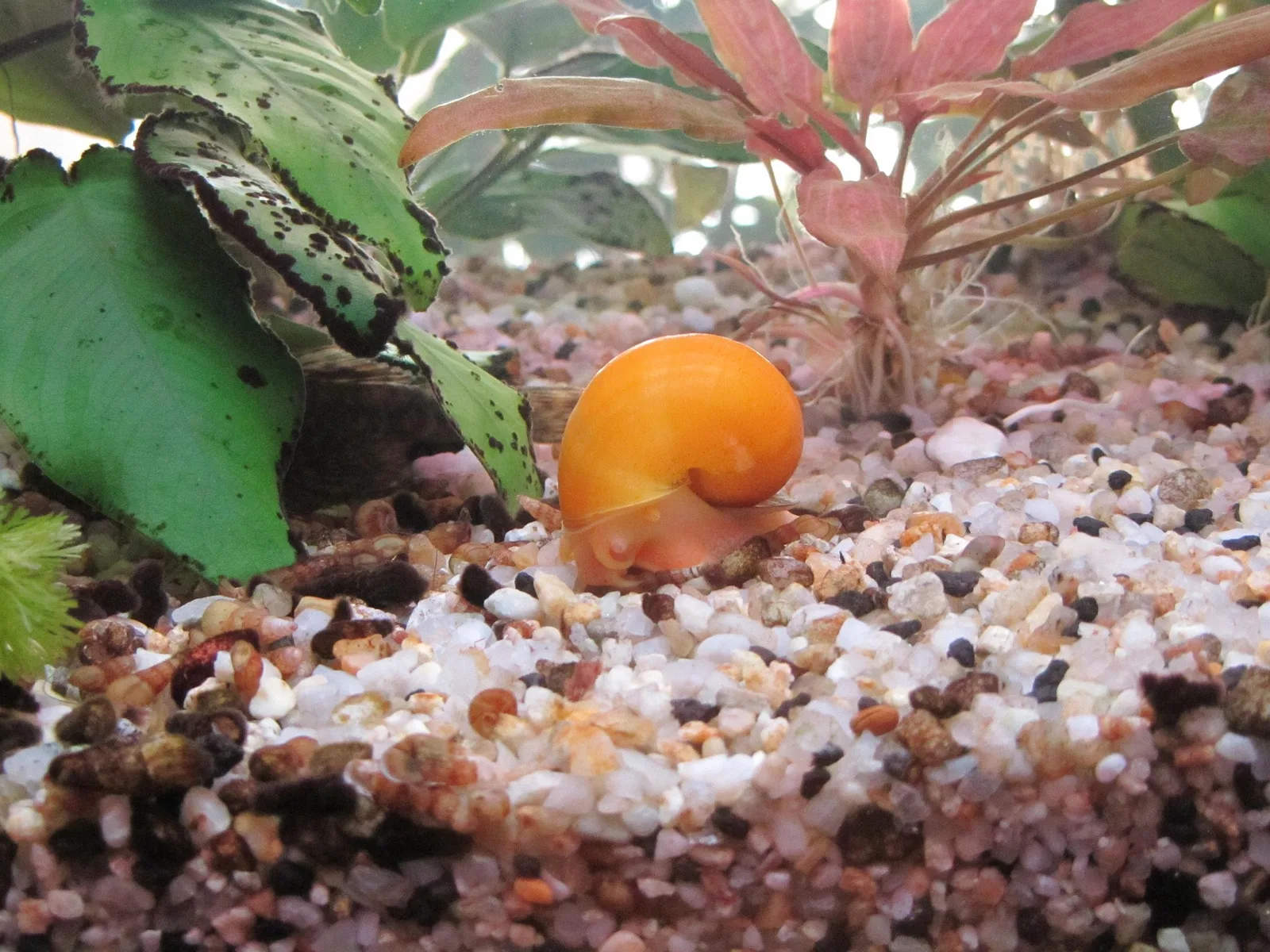
Identification and naming caveats
The animal sold as "mystery snail" today is almost always Pomacea diffusa Blume, 1957, a member of family Ampullariidae[1]. For decades it was treated as a form of the separate species Pomacea bridgesii, with the two names used almost interchangeably in older hobbyist literature; genetic analysis later confirmed them as distinct species, with P. diffusa the widespread, common form found through much of the Amazon basin and P. bridgesii a genuinely rarer species with a much smaller natural range[2]. ITIS still catalogues Pomacea bridgesii as a valid, separately recognised name[3] — the practical takeaway isn't that one name is "wrong," but that care advice written under either name may be describing the same trade animal, and shouldn't be assumed to apply to some other, truly rare species.
Colour and shell-pattern names in the trade — gold, ivory, blue, purple, brown-and-black-striped — describe selectively bred colour forms of the same species, not different snails with different needs. None of them changes anything about the care described in this guide.
Water parameters that matter most
Shell health is the single biggest parameter-driven welfare issue for this species, and it's directly tied to water chemistry, not just diet. Treat the figures below as a practical starting range gathered from multiple specialist sources, not a single precise scientific target.
| Factor | Commonly reported range | Notes |
|---|---|---|
| Temperature | Roughly 22–28°C (72–82°F) | A genuinely tropical range for a species from the Amazon basin. |
| pH | Roughly 7.0–8.0 (neutral to alkaline) | Consistently reported as preferring alkaline over acidic water, which supports shell integrity. |
| General hardness | Moderate to hard | Soft water with little dissolved calcium is the single most commonly cited cause of shell pitting and erosion in this species. |
| Ammonia / nitrite | Zero | Same standard as any freshwater livestock — see our ammonia and nitrite guides. |
| Copper | None | As with most aquarium invertebrates, copper-based medication is a genuine risk — see "Water stability" below. |
Tank size, lid and layout
A single mystery snail is commonly recommended a minimum of around 5 US gallons (roughly 19 litres), treated here as a hobbyist convention rather than a figure from a specific welfare study. It isn't a schooling or group-dependent animal — a single snail does perfectly well alone, and there's no minimum group size requirement the way there is for some social fish.
The lid matters more than most people expect. Mystery snails are capable climbers and will readily explore right up to, and sometimes past, the waterline, particularly if water quality dips or they're seeking somewhere to lay eggs (see "Breeding" below). A snail found dried out on the floor after climbing out overnight is one of the more avoidable losses in this hobby. A secure lid, or at minimum an airgap too narrow for a snail's shell to fit through, removes this risk almost entirely.
Diet: does it eat algae, plants or leftover food?
Does it eat algae? Yes, readily, alongside biofilm and decaying organic matter, and it's commonly sold with this reputation in mind. Does it eat plants? This is genuinely more variable than most care sheets admit: many keepers report their mystery snails leaving healthy, established plants alone in favour of algae and softer, decaying leaf matter, while others report noticeable grazing damage to soft-leaved species. Treat "snail-safe plant" claims with some caution rather than as a guarantee, and watch your specific snail's behaviour with your specific plants rather than assuming either outcome.
Does it eat shrimp or other snails? No — this species is not predatory and poses no realistic threat to shrimp, other snails, or their eggs, which makes it one of the more straightforward invertebrate tankmates in a mixed community.
In an established tank, algae and biofilm may not be enough on their own, particularly for a growing or breeding snail. Supplement with blanched vegetables (courgette and cucumber are widely reported favourites), sinking pellets, or dedicated snail/shrimp food, and offer a calcium source — cuttlebone or a commercial calcium supplement — especially if your water is on the softer side, since dietary calcium alone often isn't enough to fully offset low-mineral water.
Tank mates and compatibility
Mystery snails are peaceful, slow-moving grazers with no offensive capability, which makes the compatibility question almost entirely one-directional: can anything else in the tank hurt it. Most peaceful community fish, shrimp and other snails coexist with it without issue. The genuine risks come from species known to target snails specifically — some pufferfish and loaches are notable snail predators — and from boisterous or nippy fish that may repeatedly harass a slow-moving animal that has no way to retreat quickly beyond withdrawing into its shell.
As with any invertebrate, compatibility depends on your specific tank, not a generic pairing list: a fish that ignores an adult mystery snail in one aquarium may behave differently toward a smaller, newly hatched snail in another, or in a tank with fewer hiding spots and higher stocking density. If you're planning to add a mystery snail to an already-stocked community tank, it's worth thinking through your existing fish's known behaviour toward snails specifically, not just their general temperament rating. See our guide to choosing tank mates for a broader framework on working through a stocking decision like this one. AquaPulse's Water Check can help confirm your water chemistry is stable and hard enough to support healthy shell growth before you buy.
Breeding, eggs and why the clutch matters
Mystery snails are gonochoristic (individuals are either male or female, not both), so breeding requires two snails of opposite sex; sex isn't reliably determinable by shell appearance alone. A fertilised female will climb above the waterline — another reason a secure lid or airgap matters — and lay a clutch of eggs in a gelatinous mass that hardens on exposure to air, typically on the underside of a tank lid or on emergent decor.
If you don't want more snails, the practical approach is to remove and discard egg clutches before they hatch (typically two to four weeks after laying), rather than trying to prevent laying in the first place.
Water stability considerations
As with most aquarium invertebrates, mystery snails are more sensitive to copper than the majority of fish, and copper-based medications used to treat some fish parasites are toxic to them at concentrations well below typical therapeutic fish doses[6]. Avoid copper treatments anywhere in the same system, and be cautious re-adding snails to a tank where copper has been used recently, even after readings return to zero, since copper can re-release from substrate or décor.
Avoid adding a mystery snail to a tank that's still cycling or has recently shown a cycle disruption. Sudden ammonia or nitrite exposure is a genuine welfare risk, and a snail can be affected by a water-quality problem well before it shows an obvious external symptom.
Normal behaviour
- Slow, continuous grazing across glass, décor, substrate and plant leaves — the core, expected daily behaviour.
- Extended periods of stillness, including remaining in one spot for hours — normal for the species, not automatically a sign of illness.
- Climbing toward or above the waterline, particularly in a mature female — usually egg-laying behaviour (see "Breeding" above), not an attempt to escape a problem.
- Withdrawing fully into the shell, closed with the operculum, after handling, a sudden disturbance, or a water change.
- A visible siphon extended toward the surface — this species breathes atmospheric air via a siphon as well as using gills, so surface visits for air are normal, not a sign of poor water quality on their own.
Warning signs and what to check first
None of the signs below confirms a specific problem on its own. Each has more than one possible explanation, and reacting immediately before checking the more likely causes can make things worse.
Shell pitting, cracking or a visibly thinning, flaking shell
What it might mean: Insufficient calcium or overly soft/acidic water, the most commonly reported cause in this species.
What else could explain it: Pre-existing damage from before purchase, or physical damage from décor or handling.
Check this first: General hardness and pH, and whether you're supplementing calcium directly.
Don't: Expect a supplement to reverse existing shell damage — it can help prevent further erosion, but existing damage doesn't reliably repair.
Remaining withdrawn and closed for an unusually long period
What it might mean: Stress, unsuitable water chemistry, or simply resting — this species is capable of extended inactivity.
What else could explain it: A recent water change, handling, or a change in tankmates.
Check this first: Recent tank events and current water parameters against your usual baseline.
Don't: Prise the shell open to check — this is more likely to cause harm than resolve anything.
A strong, unpleasant odour, or the body appearing to detach from the shell
What it might mean: The snail has died and is decomposing — this is one of the more time-sensitive warning signs, since a decomposing snail can affect ammonia readings for the rest of the tank.
What else could explain it: Normal, harmless retraction if disturbed shortly before observation, which doesn't produce an odour.
Check this first: Whether there's any response at all to gentle stimulation, and test ammonia if you're not sure.
Don't: Leave a suspected dead snail in the tank "just in case" — remove it and confirm rather than risk an ammonia spike.
Found outside the tank or dried out
What it might mean: A climbing snail that reached an open top or a gap around the lid.
What else could explain it: Little else — this is almost always a lid/airgap issue rather than a health problem.
Check this first: Whether your lid or airgap genuinely prevents this, going forward.
Don't: Assume a snail found dry but not obviously decomposing is beyond help — rehydration in tank water sometimes allows recovery if it hasn't been out for long, though outcomes vary.
Egg clutch appears on the lid or above the waterline
What it might mean: Normal reproduction — not a health problem for the snail that laid it.
What else could explain it: Nothing else; this is unambiguous breeding behaviour.
Check this first: Whether you want to keep or discard the clutch (see "Breeding" above), and remind anyone in the household not to handle it.
Don't: Let children or pets touch or taste the clutch — see the toxin caution above.
Common mistakes
- Keeping soft, acidic water without supplementing calcium, the leading reported cause of shell erosion in this species.
- Leaving a tank without a secure lid or narrow enough airgap, risking a snail climbing out and drying out.
- Using copper-based medication anywhere in the same system.
- Assuming every "snail-safe" plant claim applies to your specific snail — grazing behaviour toward live plants genuinely varies between individuals.
- Letting egg clutches accumulate unchecked if you don't want more snails, rather than removing them while still unhatched.
- Handling or allowing children to handle egg clutches — see the toxin caution in "Breeding" above.
What the aquarium cannot compensate for
- Hard, mineral-rich water cannot be substituted for by diet alone if calcium intake is otherwise insufficient, and vice versa — both matter for shell health.
- A well-run tank cannot protect a snail from climbing out through an open top or an oversized airgap.
- No amount of water-quality management protects an invertebrate from a copper-based treatment used anywhere in the same system.
- The aquarium cannot repair shell damage that has already occurred — only help prevent further erosion going forward.
When specialist help may be appropriate
Invertebrate-specific veterinary expertise is less widely available than for fish, but a knowledgeable specialist retailer or aquatic-invertebrate specialist can sometimes help with a genuinely puzzling case.
Frequently asked questions
Are mystery snail eggs dangerous?
Treat them as something to leave alone rather than handle or ingest. A neurotoxin (PV2) has been confirmed in the eggs of closely related, invasive apple snails, capable of causing gut damage in animals that ingest it. We couldn't find a study confirming the same toxin at comparable levels specifically in Pomacea diffusa eggs, but given it's documented elsewhere in the same genus, keeping children and pets away from any clutch is a sensible precaution regardless.
Do mystery snails eat plants?
It varies more than most care sheets admit. Many keepers report their mystery snails leaving healthy, established plants alone in favour of algae and decaying leaf matter, while others report noticeable grazing on soft-leaved species. Treat "snail-safe plant" claims with some caution and watch your specific snail's behaviour with your specific plants.
How big of a tank does a mystery snail need?
A minimum of around 5 US gallons (roughly 19 litres) per snail is a commonly used hobbyist convention rather than a figure from a specific welfare study. It isn't a schooling or group-dependent animal — a single snail does perfectly well alone.
Can mystery snails escape the tank?
Yes — they're capable climbers and will readily explore right up to, and sometimes past, the waterline, particularly if water quality dips or a female is seeking somewhere to lay eggs. A secure lid, or at minimum an airgap too narrow for a snail's shell to fit through, removes this risk almost entirely.
What causes shell pitting or cracking in mystery snails?
Insufficient calcium or overly soft, acidic water is the most commonly reported cause. Checking general hardness and pH, and supplementing calcium directly if your water is soft, can help prevent further erosion — though existing shell damage doesn't reliably repair once it's occurred.
Sources and uncertainty
- Published
- 26 July 2026
- Last reviewed
- 11 August 2026
- Written and maintained by
- AquaPulse (Valeon Labs Ltd)
This guide draws on taxonomic reference databases, a U.S. federal ecological risk assessment, peer-reviewed toxin research on a closely related invasive species, and specialist snail-keeping sources for day-to-day husbandry. Where research exists only for a related species rather than Pomacea diffusa specifically, we've said so directly rather than implying it's confirmed for this species. We'll update this page if we find something we've got wrong.
Good to know: This guide provides general informational guidance only. It is not a substitute for specialist invertebrate-health advice, and it is not guidance on invasive-species law in your jurisdiction — check local regulations directly if you're unsure what's permitted.
- [1] GBIF (Global Biodiversity Information Facility) — "Pomacea diffusa Blume, 1957" Used as the taxonomic authority for species name and author citation.
- [2] Wikipedia — "Pomacea diffusa" Secondary orientation source, used for the historical taxonomic split from Pomacea bridgesii and relative range/commonness. Not used as the primary taxonomic authority.
- [3] Integrated Taxonomic Information System (ITIS) — "Pomacea bridgesii" (TSN 70344) Used to confirm Pomacea bridgesii remains a separately catalogued, valid name distinct from P. diffusa.
- [4] Dreon, M.S. et al., "Structure and stability of the neurotoxin PV2 from the eggs of the apple snail Pomacea canaliculata," PubMed Peer-reviewed study of the PV2 egg neurotoxin in a closely related, invasive Pomacea species. Accessed via abstract/database record, not full text. Not a study of Pomacea diffusa eggs specifically.
- [5] "Insights into Embryo Defenses of the Invasive Apple Snail Pomacea canaliculata: Egg Mass Ingestion Affects Rat Intestine Morphology and Growth," PMC Peer-reviewed study confirming ingestion of egg-mass extract from a related invasive Pomacea species affects gut morphology and growth in a mammalian model.
- [6] University of Florida IFAS Extension — "Use of Copper in Marine Aquaculture and Aquarium Systems" (FA165) Used for general invertebrate sensitivity to copper-based treatments.
- [7] U.S. Fish & Wildlife Service — "Ecological Risk Screening Summary: Spike-topped Applesnail (Pomacea diffusa)" Used for the species' introduced-population history, uncertain overall risk classification, and current U.S. state-level regulation.
What we deliberately left out: a confirmed claim that Pomacea diffusa eggs carry the PV2 toxin at levels comparable to P. canaliculata/P. maculata, since we found that research only for the related invasive species, not this one specifically; a precise minimum tank volume backed by a welfare study rather than hobbyist convention; and a single definitive statement on which trade name (bridgesii vs diffusa) is "correct," since both remain in active taxonomic use.