Knowledge Centre · Planted aquariums
Starting a planted aquarium: how to set it up and cycle it safely
A planted aquarium follows the same underlying nitrogen cycle as any freshwater tank, but live plants change what you need to set up and how you might cycle it. The safest approach is still to establish a working biological filter before fully stocking with fish, whether through conventional fishless cycling or a fast-growing, densely planted "silent cycle" that uses the plants themselves to absorb ammonia as it's produced — though even a silent cycle still needs testing to confirm, not assuming. Substrate, lighting and, optionally, CO2 injection matter more here than in an unplanted tank, since they determine whether your plants actually grow rather than languish. Expect an early adjustment period, including some algae, while lighting and nutrients settle into balance. The sections below walk through substrate and lighting choices, cycling with plants, and what to expect in the first few weeks. If you haven't settled on freshwater over saltwater yet, our freshwater vs saltwater comparison covers that broader decision first.
At a glance
What's actually different from an unplanted tank
The same nitrogen-cycle biology applies, but substrate, lighting and often CO2 now directly determine whether your plants thrive, not just how the tank looks.
The safest way to start
Cycle fishless as usual, or use a densely planted, fast-growing "silent cycle" — either way, test to confirm rather than assuming plants alone are handling it.
Sensible immediate response
If you're seeing algae or losing plants early on, adjust light duration and nutrients gradually rather than reacting to every change at once.
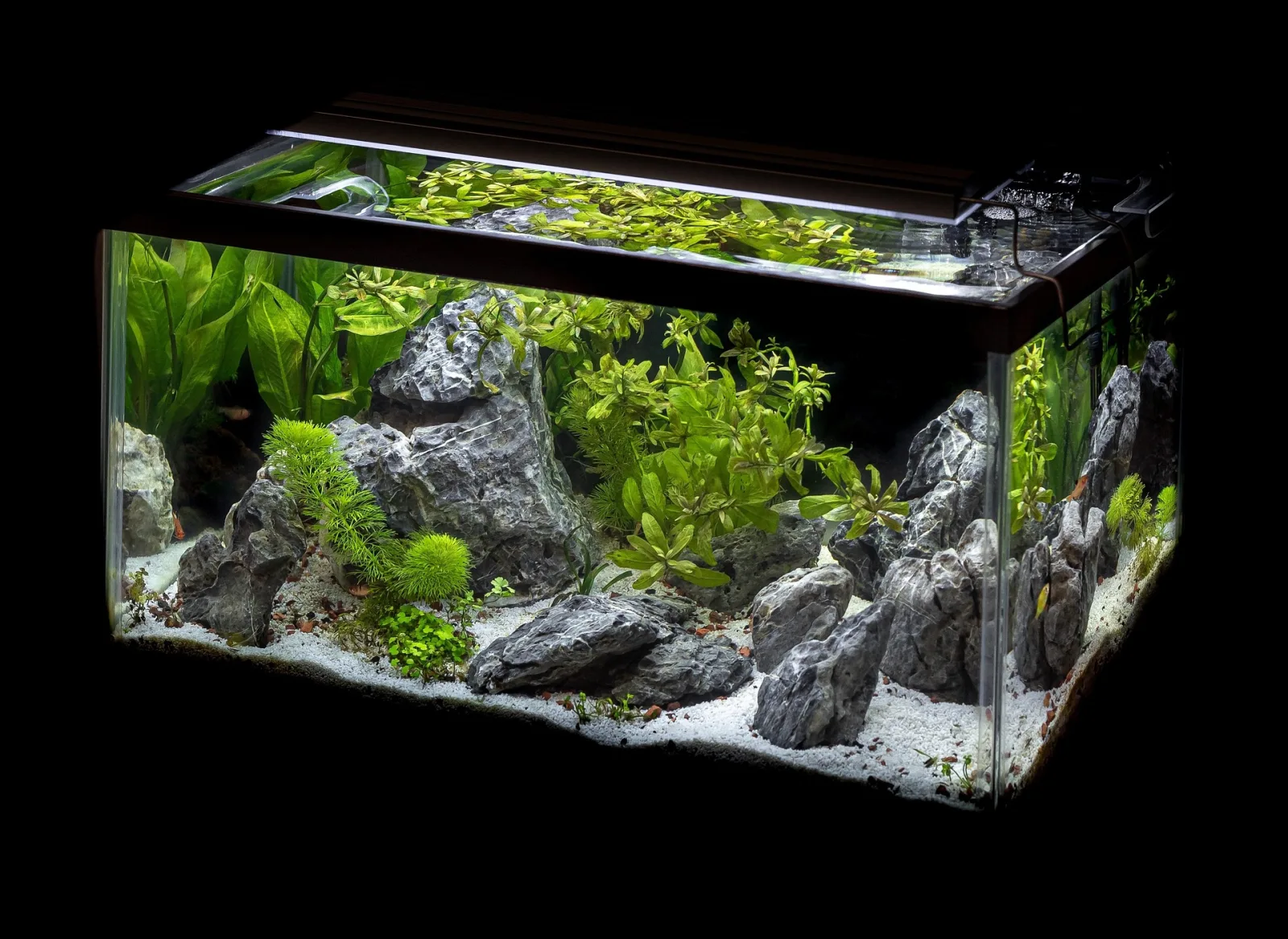
Why a planted tank needs a slightly different approach
The biology of cycling itself doesn't change: bacteria living on filter media, substrate and decor convert ammonia into nitrite and then into far less harmful nitrate, exactly as in any freshwater tank[2]. See our guide to the aquarium nitrogen cycle for that underlying process in full.
What's genuinely different is that live plants participate directly in nitrogen processing, not just bacteria. Aquatic plants generally take up ammonium as a preferred nitrogen source over nitrate, since it takes less energy for them to use[3] — which is why a heavily and appropriately planted tank can run with lower, sometimes barely detectable, ammonia and nitrite readings during cycling, and why our nitrate guide notes that well-grown plants can also ease a tank's ongoing nitrate load. On top of that biology, you're now choosing a substrate that either does or doesn't feed plants, setting lighting intended for photosynthesis rather than just for viewing, and deciding whether to add supplemental CO2 — all genuinely new decisions an unplanted freshwater tank doesn't require.
What to set up before you start
As with any new tank, cycling happens inside a system that's already running as it would with livestock, minus the livestock itself. Have the following in place before you begin:
Not sure of your tank's volume yet? Use the free Aquarium Calculator to work out litres or gallons from its dimensions and its approximate water weight — useful for checking a stand or floor can take the load before you fill it.
- A substrate suited to plants — see choosing a substrate below for how nutrient-rich and inert options differ.
- Lighting intended for plant growth, not just for viewing — see lighting and CO2 below.
- A running filter, sized appropriately for your tank. The free Aquarium Filter Turnover Calculator covers planted-tank turnover conventions specifically, including why very strong flow can shred delicate plants or blow substrate around.
- A heater and thermometer, if you're keeping tropical species, set to your intended stocking temperature. The free Aquarium Heater Calculator gives a sensible wattage range to shop from.
- CO2 injection or a liquid carbon supplement, if you're using one — genuinely optional at the start; see lighting and CO2 for the trade-offs.
- A liquid fertiliser or root tabs appropriate to your substrate choice, since even a nutrient-rich substrate typically needs topping up with liquid or column feeders over time.
- A liquid test kit that measures ammonia, nitrite and nitrate — test strips are less precise for the low concentrations that matter most during cycling.
- An ammonia source for fishless cycling, if you're not relying on a silent, plant-led cycle — dosed and tracked according to its own instructions.
- A modest first selection of hardy, easy plants — species such as Java fern, Anubias, Cryptocoryne and Vallisneria are widely considered forgiving starting points, though as with livestock, research any specific species' actual needs before buying rather than assuming "easy" applies universally.
Choosing a substrate
Nutrient-rich substrate (often called aqua soil) supplies root-feeding plants with nutrients directly from below, and is generally considered the more forgiving option for a first planted tank since it does some of the fertilising work for you. Its main practical caveat: many aqua soils release, or "leach", some ammonia during their first one to two weeks as the material settles, which can show up as an ammonia reading that isn't necessarily a sign anything has gone wrong — test to understand what you're seeing rather than assuming either a problem or that everything is automatically fine.
Inert substrate, such as plain sand or gravel, is simpler, generally cheaper and won't leach anything on its own, but it also won't feed plants at all — root tabs pushed near root-feeding species, plus a liquid fertiliser for everything else, become necessary from the start rather than optional.
Either substrate works with either cycling method described below; the choice mainly affects your fertilising routine and what to expect in the first couple of weeks, not the underlying cycling biology. See our choosing an aquarium substrate guide if you're weighing this against other factors like barbelled bottom-dwellers you're also planning to keep.
Lighting and CO2
Light is what actually drives plant growth, and more isn't automatically better: a longer photoperiod or higher intensity than your plants and nutrients can keep up with is one of the most common causes of algae in a new tank (see algae in a new planted tank). A modest photoperiod of roughly 6–8 hours a day is a commonly used starting point for a newly set up tank, adjusted from there based on plant growth and algae rather than fixed permanently. Low-light, undemanding plants like Java fern and Anubias tolerate a wide range of lighting; carpeting or colourful stem plants generally need more. See our lighting guide for PAR, light tiers and matching a fixture to your plant list in full depth.
CO2 injection is genuinely optional. Plants can photosynthesise using CO2 already dissolved in the water from respiration and surface exchange, just more slowly than with supplemental CO2. Adding CO2 (via a pressurised system or a liquid carbon supplement) generally speeds growth and widens which plants and light levels are realistic, but it adds cost, equipment and a real safety consideration, so many keepers start without it and add it later if they want faster growth or more demanding species. Our CO2 guide covers injection methods, monitoring and the overdose risk in full.
If you do inject CO2, treat overdose as a genuine risk, not a theoretical one. Hobbyist guidance commonly targets around 30 ppm of dissolved CO2 as a practical injection level, but veterinary sources describe toxicity (hypercarbia) beginning at meaningfully lower concentrations[4] — so treat 30 ppm as a ceiling to stay comfortably under, not a confirmed safe target. Use a drop checker or similar indicator, turn CO2 off before lights-out since plants stop consuming it once photosynthesis stops, and watch for fish gasping at the surface or unusual lethargy, which warrant immediately increasing surface agitation and reducing CO2 input.
Choosing how to cycle
Conventional fishless cycling works exactly as in any freshwater tank: dose an ammonia source into an empty, filtered, heated tank and test until ammonia and nitrite both convert to nitrate reliably, before any animal goes in. This remains a reliable, well-understood default, and it's the approach to fall back on if you're not confident your plant mass is dense or fast-growing enough for the alternative below.
Silent cycling (sometimes called a plant-led or "planted cycle") relies on a densely planted tank, generally using fast-growing stem or floating plants specifically, to absorb ammonia directly as it's produced, often keeping readings low or undetectable rather than following the usual rise-and-fall pattern. This is a genuine effect grounded in how plants use nitrogen[3], not a myth, but it depends on having enough fast-growing plant mass relative to your eventual bioload — slow growers like Anubias, Java fern or Cryptocoryne on their own generally won't achieve it. Whichever route you take, keep testing ammonia and nitrite regularly: silent cycling changes what the numbers tend to look like, not whether checking them still matters.
Cycling, step by step
Set up
-
Add substrate, hardscape and your initial plants, then fill and start the filter
Planting before or during cycling, rather than after, lets plants begin establishing and taking up nitrogen from day one. Get the filter and heater running continuously from this point on.
-
Condition the water correctly
Use a conditioner appropriate to your water supplier's treatment. Many suppliers use chloramine, which combines chlorine and ammonia, and a conditioner that only addresses chlorine can leave the ammonia portion behind[1].
-
Test before dosing anything further
If you're using a nutrient-rich substrate, don't be surprised by an early ammonia reading from leaching — note it, and keep testing to see whether it's falling as plants and bacteria take hold, rather than assuming either a crisis or that it will simply disappear.
Establish ammonia-to-nitrite
-
Dose an ammonia source, if you're not relying on a silent cycle
Follow the product's own dosing instructions. If you're attempting a silent cycle instead, skip dosing and rely on your plant mass and any ammonia already present from substrate or décor.
-
Test ammonia and nitrite every few days
In a conventional cycle, watch for ammonia beginning to fall as bacteria establish, and don't be concerned if nitrite starts appearing and rising. In a silent cycle, both readings may stay low throughout — that's the plants working, not a reason to stop testing.
-
Keep re-dosing (or keep growing) as appropriate
Continue feeding a conventional cycle's bacterial colony until it's consistently converting a full dose, or continue letting a silent cycle's plants grow and take up nitrogen, trimming and removing cuttings as needed rather than leaving decaying trimmings in the tank.
Establish nitrite-to-nitrate
-
Expect nitrite to rise before it falls (in a conventional cycle)
A second, slower-establishing bacterial population converts nitrite into nitrate, so a nitrite spike after ammonia has started clearing is normal, not a sign anything has gone wrong[2]. A well-run silent cycle may show much less of this pattern.
-
Keep testing through this stage
Continue testing ammonia and nitrite regularly and watch for nitrate appearing — its presence, even at a low level in a heavily planted tank, is evidence the fuller sequence is working.
Confirm completion
-
Confirm ammonia and nitrite are reliably at zero
In a conventional cycle, this typically means a full ammonia dose reading back at zero for both ammonia and nitrite within about 24 hours. In a silent cycle, it means readings staying at or near zero across several consecutive tests, not just one.
-
Do a partial water change before adding any livestock
This brings accumulated nitrate (and, if relevant, any residual substrate leaching) down to a sensible starting level and gives you a clean baseline reading before the tank has to support animals.
A simple testing schedule while you wait
There's no fixed calendar date when a planted tank finishes cycling, and the pattern can look noticeably different from a conventional cycle if you're going the silent-cycling route — testing is what tells you where you actually are either way.
| Stage | What you're likely to see | What to do |
|---|---|---|
| Early | Ammonia present (from dosing, substrate leaching, or both); nitrite and nitrate close to zero | Test every 2–3 days; keep dosing (if conventional) and let plants establish |
| Ammonia converting | Ammonia starting to fall; nitrite beginning to appear (may be minimal in a well-planted silent cycle) | Keep testing both; don't be concerned by a nitrite reading in a conventional cycle |
| Nitrite peak / plateau | Ammonia consistently at or near zero; nitrite at its highest (conventional) or staying low (silent) | Test every 2–3 days; nitrate should start appearing soon |
| Nitrite converting | Nitrite starting to fall; nitrate rising and clearly present | Continue testing; you're approaching completion |
| Cycled | Ammonia and nitrite reliably at or near zero across several tests, with nitrate present | Do a water change, then add plants and livestock gradually |
Adding your plants and first fish
Add the bulk of your plants early, ideally before or during cycling rather than after, so they've had time to establish before livestock arrive — see our best beginner aquarium plants guide if you haven't chosen your plant list yet. Once your tank is genuinely cycled, add fish gradually rather than fully stocking on day one — the same principle that applies to any new tank applies here[5].
- Add a small first group of fish, then wait one to two weeks, testing ammonia and nitrite throughout, before adding more.
- Acclimate new arrivals properly, matching temperature before release, the same as any freshwater tank.
- Introduce new plants gradually where practical, and rinse or quarantine them if you're concerned about hitchhiking snails or algae from a previous tank.
- Test after every addition, not just during the original cycling process — a bioload increase can produce a small, temporary rise even in an otherwise stable, well-planted tank.
- Use the free Water Change Assistant if you need to work out how much water to change to bring a reading down — it supports a planted freshwater context directly.
Algae in a new planted tank
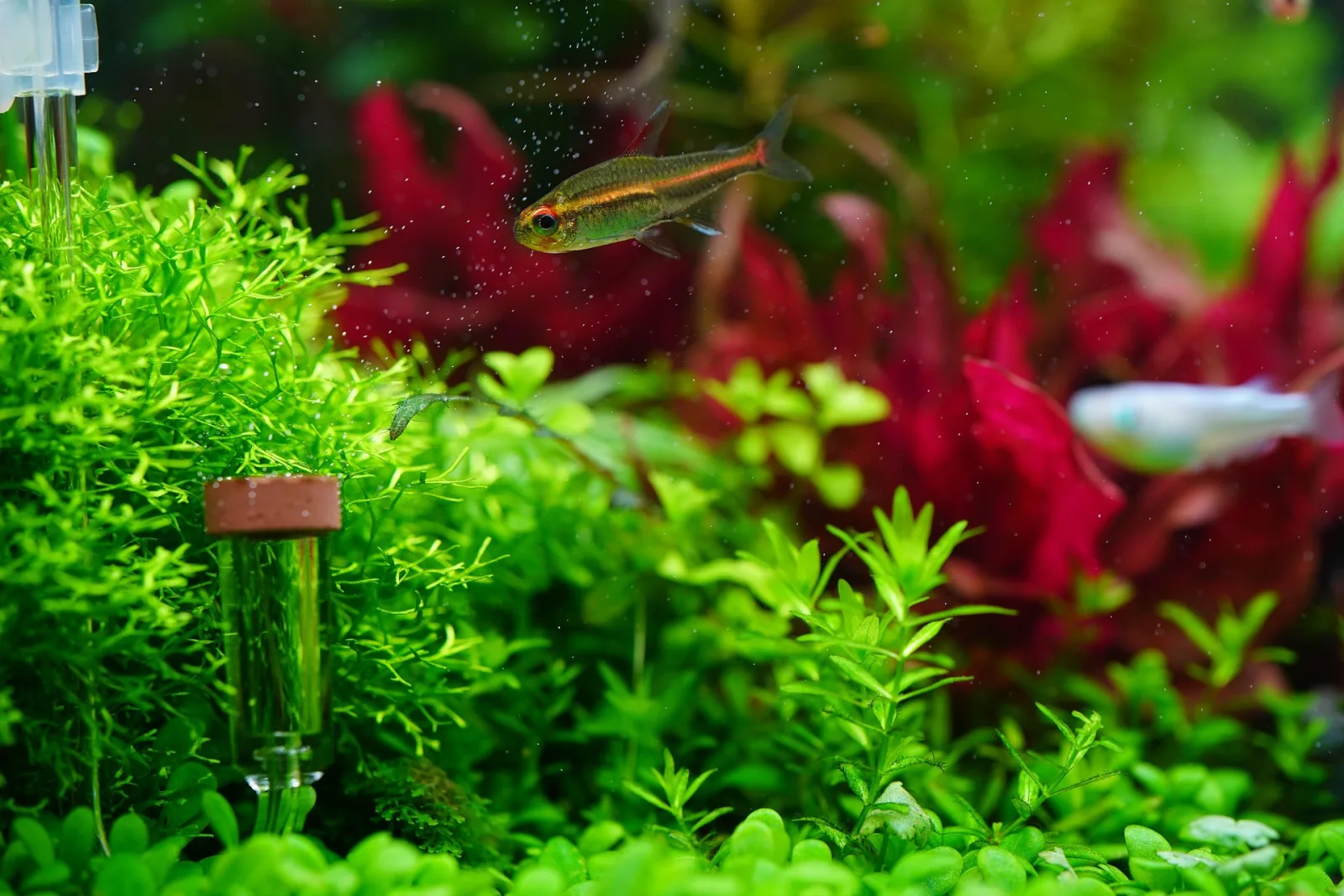
Algae in the first few weeks of a new planted tank is common and largely normal, not a sign of failure. It typically reflects more light and available nutrients than your still-establishing plants are able to use, leaving a surplus that algae, which grows faster than most aquarium plants, is well placed to exploit.
- Give it time. As plants mature and start actively competing for light and nutrients, algae commonly recedes on its own over several weeks.
- Check your photoperiod and intensity rather than assuming more light is always better — see lighting and CO2 above.
- Remove algae manually (siphoning, wiping glass, trimming affected leaves) in the meantime rather than reaching straight for a chemical treatment.
- Review dosing if you're fertilising — consistently overshooting what your plants can use feeds algae as readily as it feeds your plants. See our fertilising guide if you're not yet sure what or how much to dose.
- Don't panic-remove plants or livestock in response to ordinary early-stage algae; it's a normal adjustment phase for most new planted tanks, not typically an emergency.
Common planted-tank mistakes
- Running a long photoperiod or high light intensity from day one, well before plants or nutrient dosing have caught up.
- Assuming a silent cycle is complete because readings look fine after a few days, rather than confirming across several consecutive tests.
- Treating an early ammonia bump from a nutrient-rich substrate as a crisis, or conversely ignoring it without testing to check it's actually settling.
- Injecting CO2 without a drop checker or similar way to monitor it, and without turning it off before lights-out.
- Reaching for an algae treatment before adjusting light and dosing, the more common underlying causes.
- Adding fish before plants have had any time to establish, missing much of the benefit plants can offer during cycling.
- Giving up on testing once the tank "looks established" — a young planted tank's biological and plant-based nitrogen processing is still settling into balance and can be disrupted more easily than a long-established one.
Signs of trouble and when to get help
If livestock are already present while your tank is still establishing, watch for gasping at the surface, rapid or laboured breathing, unusual hiding, loss of balance, or appetite loss — all of which can indicate ammonia or nitrite exposure, or, if you're injecting CO2, a possible overdose. Test water quality immediately if you see any of these, and if you're running CO2, also reduce or pause injection and increase surface agitation as a precaution.
If you suspect an already-cycled tank has lost its bacterial colony — for example after a power cut, an overly aggressive filter clean, or certain medications — see our dedicated guide to recognising and responding to a possible cycle crash.
Setting yourself up for the long term
- Keep a simple written record of your lighting schedule, dosing and test results while cycling and through the first few months — there's more to track than in an unplanted tank.
- Decide your intended stocking, lighting and (if using it) CO2 setup before you start, so you're not adjusting several things at once later.
- Trim and thin plants regularly once established, rather than letting decaying, overgrown mass add to your bioload.
- Once livestock are added, settle into a regular water-change routine, adjusted for the fact that a well-grown planted tank may tolerate a slightly longer interval than an equivalent unplanted one, without treating that as a substitute for testing.
- Keep testing periodically even once the tank feels established — a stable, balanced planted tank is something you maintain by checking it, not something you set up once and stop monitoring.
Frequently asked questions
How is starting a planted aquarium different from a regular freshwater tank?
The underlying nitrogen cycle is the same biology either way, so establishing a bacterial colony before fully stocking with fish still matters. What's different is that substrate, lighting and often CO2 now directly determine whether your plants actually grow, not just how the tank looks, and live plants themselves take up some ammonia and nitrate directly as part of their own nitrogen metabolism, which can noticeably ease (but not replace) the cycling and maintenance picture.
Do I need CO2 injection to keep live plants?
No. Many hardy, low-light plants grow well without any supplemental CO2, just more slowly than they would with it. CO2 injection (or a liquid carbon supplement) generally increases growth rate and allows a wider range of plants and higher light levels, but it adds cost, complexity and a genuine safety consideration, so it's worth starting without it and adding it later if you want faster growth or more demanding species.
What is silent cycling, and can I rely on it instead of testing?
Silent cycling uses a densely planted tank, typically with fast-growing stem or floating plants, to absorb ammonia directly as it's produced, often keeping ammonia and nitrite readings low or undetectable rather than following the usual rise-and-fall pattern. It's a genuine, plant-physiology-based effect, not a myth, but it depends on having enough fast-growing plant mass relative to your bioload, and slow growers like Anubias or Java fern on their own won't achieve it. Test ammonia and nitrite regularly regardless — silent cycling changes what the numbers look like, not whether you should be checking them.
Why is my new planted tank getting algae?
Algae is a very common and largely normal part of a new planted tank's first few weeks, usually reflecting more light and nutrients available than your still-establishing plants can use. It generally settles down as plants mature and you dial in lighting duration and dosing, rather than needing an urgent fix. Reducing photoperiod slightly, avoiding excess light intensity, and removing algae manually in the meantime are more useful than reaching for a chemical treatment straight away.
What's the easiest substrate for a beginner?
A nutrient-rich planted-tank soil (often called aqua soil) gives root-feeding plants a built-in nutrient supply and is generally the more forgiving starting point, though it can leach a temporary ammonia bump in the first one to two weeks that's worth testing for rather than assuming is a problem. Inert substrates like sand or gravel are simpler and mess-free but need root tabs or liquid fertiliser from the start, since they don't feed plants on their own.
Is CO2 injection dangerous for fish?
It can be if overdosed. Hobbyist guidance commonly targets roughly 30 ppm of dissolved CO2 as a practical injection level, but veterinary sources describe toxicity risk (hypercarbia) starting at meaningfully lower concentrations, so treat 30 ppm as a ceiling to stay well under rather than a confirmed safe target. Watch for fish gasping at the surface or unusual lethargy, turn off CO2 injection before lights-out when plants stop consuming it, and increase surface agitation immediately if you suspect an overdose.
How AquaPulse can help
A planted tank runs a second clock alongside the nitrogen cycle: plants establishing, light and CO2 finding their balance, and the early algae this guide describes settling down as your plants start actually using the nutrients available. Cycling readings alone don't capture that second process. Once you've tested your water with your own kit, entering your readings and context about your tank, including a planted freshwater aquarium type, into AquaPulse at least keeps the chemistry side visible as your tank matures, so if algae or a growth stall shows up, you can rule water quality in or out rather than guessing whether it's light, CO2 or dosing instead.
If something looks wrong while your tank is cycling right now, the free Emergency Diagnosis tool can help you prioritise what to check first. Water Check works from the information you enter — it doesn't take automatic readings and isn't a substitute for testing your water with a reliable kit, or for professional or veterinary advice when livestock are seriously or persistently unwell. Get AquaPulse on the App Store or Google Play to try it, or see the Water Check feature page for more detail.
Sources and editorial information
- Published
- 25 July 2026
- Last reviewed
- 25 July 2026
- Written and maintained by
- AquaPulse (Valeon Labs Ltd)
This guide is written and maintained by the AquaPulse team at Valeon Labs Ltd. It draws on published aquatic-science, veterinary and plant-physiology references rather than a single author's personal experience, and we paraphrase and link to those sources rather than reproducing their wording. Lighting, photoperiod and CO2 figures given here reflect widely used hobby starting points rather than a single official standard; we've been explicit about that distinction throughout. We'll update this page if the sources it's based on change, or if we find something we've got wrong.
Good to know: This guide provides general informational guidance only. It is not a veterinary service and does not replace specialist or aquatic health advice for serious livestock health issues.
- [1] University of Florida IFAS Extension — "Ammonia in Aquatic Systems" (FA16/FA031) Used for background on chloramine treatment of tap water and general ammonia toxicity in aquatic systems.
- [2] Hovanec & DeLong (1996), "Comparative Analysis of Nitrifying Bacteria Associated with Freshwater and Marine Aquaria," Applied and Environmental Microbiology Used for confirming the bacterial nitrogen-cycle biology, including staggered establishment of ammonia- and nitrite-oxidising bacteria, applies to a planted tank exactly as it does to any freshwater aquarium.
- [3] Water & Environmental Research Institute of the Western Pacific — "Nitrogen Uptake by Tropical Freshwater Macrophytes" Used for aquatic plants generally taking up ammonium-nitrogen at a greater rate than nitrate-nitrogen, the physiological basis for silent cycling and for plants easing a tank's nitrogen load.
- [4] Merck Veterinary Manual — "Environmental Diseases of Aquatic Animals in Aquatic Systems" Used for dissolved CO2 (hypercarbia) toxicity risk to fish beginning at concentrations lower than commonly cited hobbyist CO2-injection targets.
- [5] RSPCA — "Choosing an Aquarium for Pet Fish" Used for the welfare case for fishless cycling before adding livestock, and for adding fish gradually rather than fully stocking a new tank at once.